
Unbiased headlines. Facts, not spin.
Unbiased Headlines is an independently owned news organization. We bring you the facts, not opinions, written fresh from 110+ named sources. Sources linked so you can verify it yourself.
 economy
Major Story (7/10)
Event date: October 20, 2026 ·
China's Fifth Plenum Opens as Land-Sale Revenue Falls 27.9% and CSI 300 Sits 20% Below June Peak
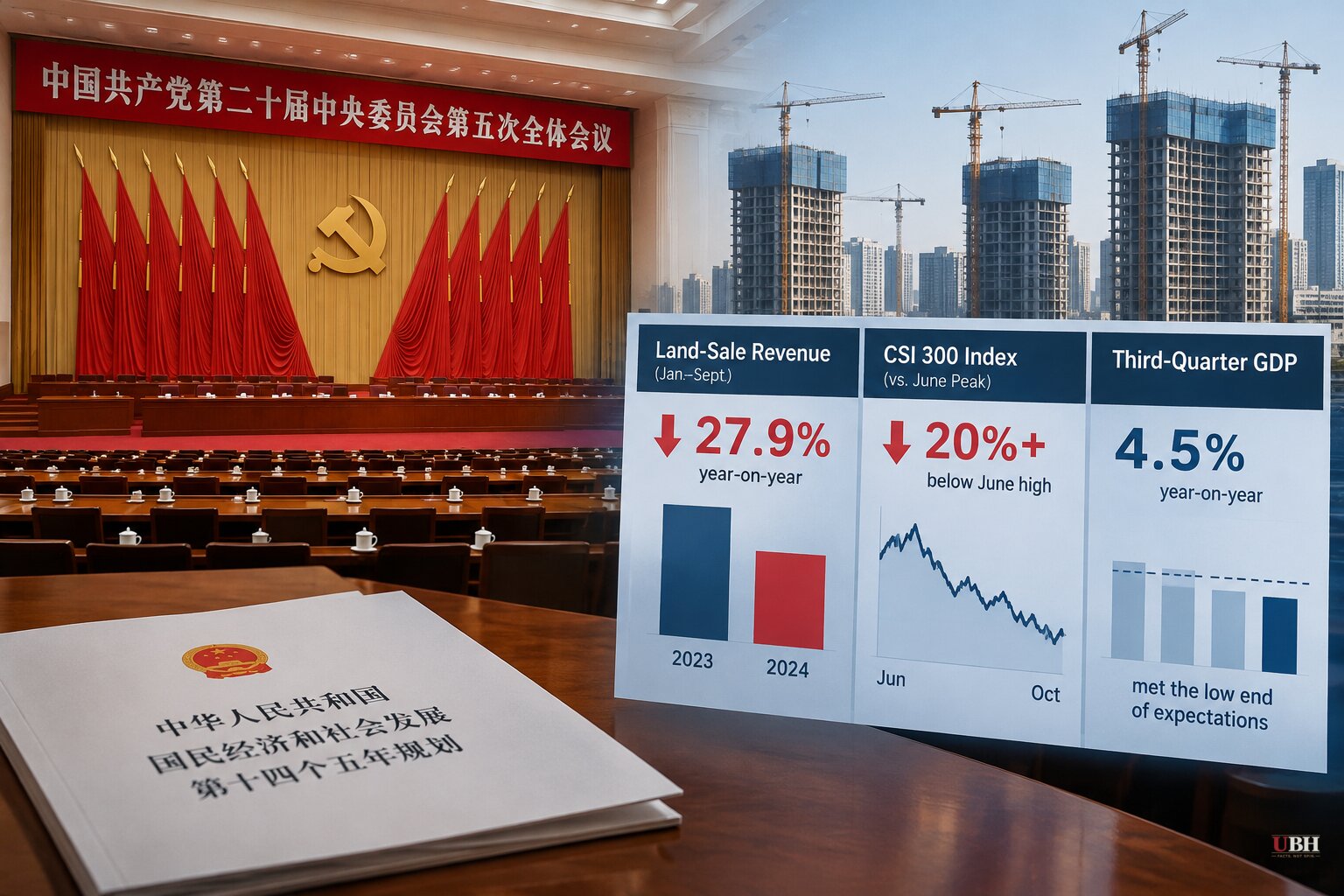
China's Communist Party leaders opened the Fifth Plenum of the 20th Central Committee in Beijing on Oct. 26. The meeting runs through Oct. 29. The Epoch Times, citing analysts it interviewed, reports the agenda is likely to center on political control and personnel ahead of the 2027 national congress rather than economic repair. The party's own stated emphasis is "full and rigorous governance over the Party."
The economic backdrop they walked into is mixed. The headline number is fine. The numbers underneath are not.
The fiscal squeeze from housing
China's Ministry of Finance said on Oct. 23 that revenue from state-owned land-use rights transfers totaled 1.61 trillion yuan (about $241 billion) in the first nine months of 2026. That is down 27.9% from a year earlier. Deed tax revenue fell 14.2% and land appreciation tax revenue fell 13.6%.
The property downturn has weakened a major source of local government funding, adding to the burden of debts accumulated during years of property-led growth.
The housing downturn is now in its fifth year. CNN puts the share of Chinese household wealth tied up in property at an estimated 70%. Real estate development investment is down 20.6% through September, which the Merics think tank calls a new low for the year. Last month, the government unveiled limited stimulus measures, including mortgage subsidies for first-time home buyers and targeted rate cuts.
Stocks and the state's hand
The benchmark CSI 300 fell 1.8% on Oct. 22 and closed more than 20% below its June peak. The Epoch Times attributes the sell-off to worries over weak consumption, corporate earnings and AI company valuations.
Li Hengqing, a U.S.-based Chinese economist, told the Epoch Times that state-backed funds appear to be propping up share prices. He said that could steady the market briefly but would not fix the confidence problem, and could shift risk onto taxpayers. "The regime is supporting the market not to protect stock investors, but to protect Xi Jinping's image and the political line he has put forward," Li said. That is his assessment.
A GDP number that fits the target
China's National Bureau of Statistics said the economy grew 4.5% year on year in the third quarter, up from 4.3% in the second, which was the weakest in more than three years. Growth for the first nine months was 4.6%, inside the official 4.5% to 5% annual target. Economists surveyed by Wind had expected 4.4%, according to the South China Morning Post.
The SCMP's editorial board called the result a "welcome, if qualified, surprise." It pointed to producer prices, which reached 5% in September, as a sign that Beijing's push to upgrade manufacturing is working. The board said the evidence points to a mix of cost-push and demand-driven gains, weighted towards demand, though it said more detail is needed.
Not everyone accepts the headline at face value. The Washington Post's opinion page noted that Chinese officials have "an uncanny knack for hitting their official targets." Derek Scissors, a senior fellow at the American Enterprise Institute, questioned the credibility of the official GDP figures in an Oct. 19 commentary, citing a slowdown in M1 money supply growth.
Max Zenglein, Asia Pacific senior economist at The Conference Board, said the headline figure is becoming "an increasingly poor indicator of how the broader economy is performing." He said it masks "widening disparities across industries, regions, and households."
Two economies
The split is stark in the September data.
- Exports rose 36.3% in value terms, and imports rose 31%, according to Merics.
- The Jan.-Sept. trade surplus reached $938 billion, putting China on track to pass last year's record $1.2 trillion.
- High-tech manufacturing value added rose 15.3%.
- Fixed-asset investment fell 7.2% in the first nine months.
- Retail sales grew 1.1% in September, up from 0.4% in August.
Merics notes that the household-goods trade-in program lifted some categories, with communication equipment sales up 31.1%. It adds that such gains tend to be short-lived because buyers simply pull purchases forward.
Youth unemployment hit 18.9% in August, matching last year's peak. Consumer prices rose only 0.9% in September.
Mao Shengyong, deputy head of the statistics bureau, acknowledged the gap at a Monday press conference. "The problem of insufficient domestic demand remains relatively prominent," he said.
Dave Chia, an economist at Moody's Analytics, said exports will likely stay strong but that global trade barriers remain a risk. The International Monetary Fund trimmed its 2026 China growth forecast to 4.5%, the bottom of Beijing's range.
What comes next
Merics expects the leadership to keep offering selective support and avoid a return to broad-based fiscal stimulus, since pressures outside the property sector do not appear to be worsening materially. That is Merics' forecast.
The plenum ends Oct. 29. Whether its communique says anything concrete about the property slump, local-government finances or household demand, or sticks to party discipline, will be the first signal of how Beijing intends to handle the 2027 congress year.
Sources used for this briefing
6 links from 6 independent newsrooms (syndicated copies of the same report count once)
These are the sources it draws on, linked so you can verify.


