
Unbiased headlines. Facts, not spin.
Every story is an unbiased news briefing written from 110+ sources across the spectrum — sources linked so you can verify it yourself.
 economy
Notable (5/10)
May 28, 2026 at 07:54 AM
economy
Notable (5/10)
May 28, 2026 at 07:54 AM
China's Economy Is Deflating — Pork Prices at 16-Year Lows Are Just the Beginning
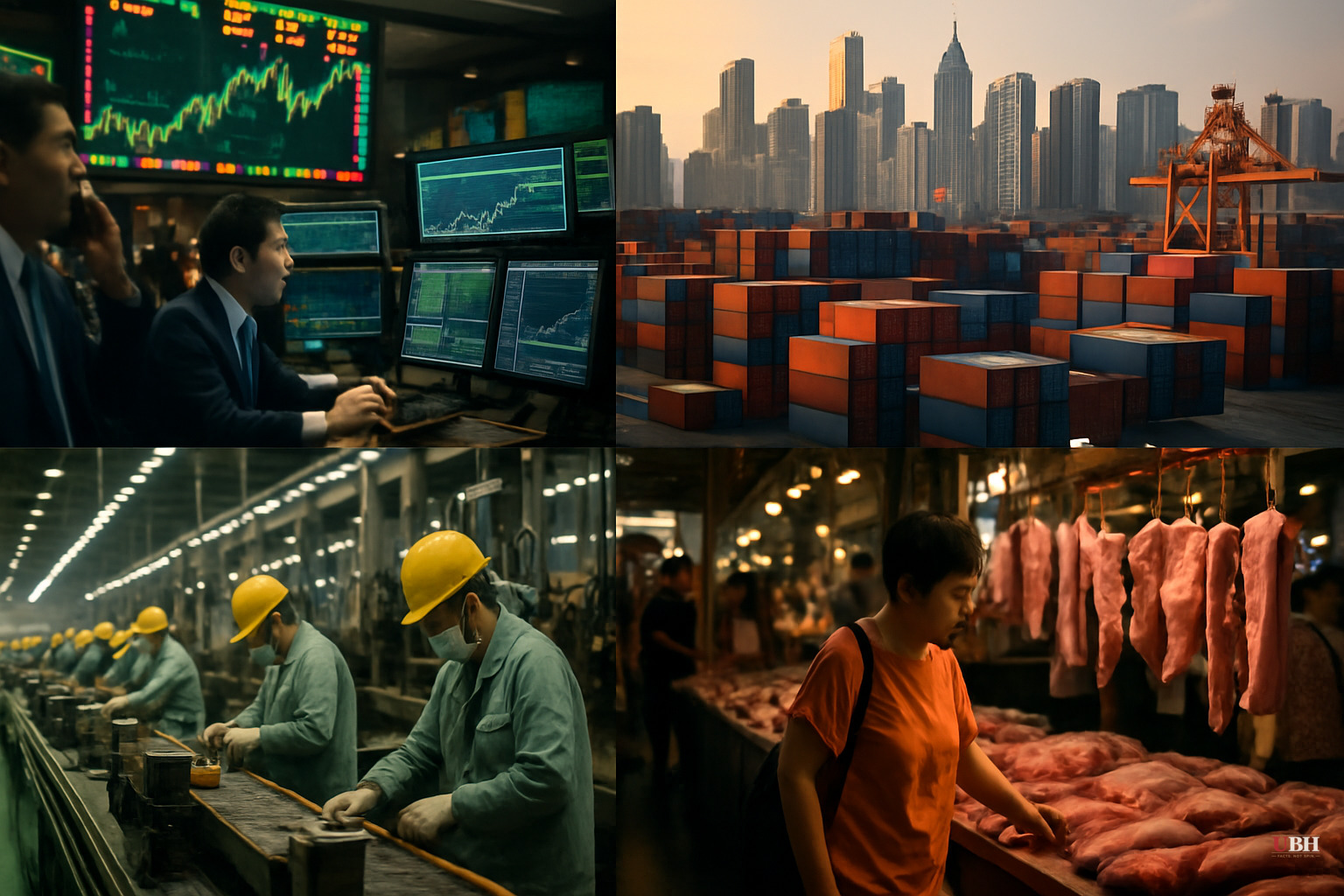
The Pork Price Problem Nobody Is Talking About
Pork is not a random data point in China. It's a cultural staple and an economic barometer. When pork prices drop 8.5% year-over-year — hitting a 16-year low — that tells you something fundamental is broken.
According to South China Morning Post, food prices in China fell 0.3% year-on-year in June 2025, marking the fifth straight month of decline. Eggs dropped 7.7%. The only categories bucking the trend were aquatic products (+3.4%) and fruit (+6.1%). Everything else is sinking.
Lynn Song, Greater China chief economist at Dutch bank ING, confirmed the data. This isn't a blip.
Real People Losing Real Money
According to South China Morning Post, a farmer in Shandong province posted on Douyin — China's TikTok — that she's been losing over 300 yuan (about $42) a day on more than 6,000 egg-laying hens since February. She can't afford to replace broken equipment.
That's not an isolated story. Analysts told South China Morning Post that weak end-market demand and high inventory levels are crushing the entire breeding sector. The supply chain from farmer to processor to retailer is bleeding.
The Bigger Picture: This Is NOT Just a Food Problem
The Atlantic Council laid out China's multidimensional macro weakness in detail — and food deflation is just one piece.
China's property sector, which accounts for an estimated 30% of GDP — roughly twice the U.S. share — started cracking in August 2021 and has never fully healed. Year-over-year growth in home sales by floor space fell 14% in June. Total funds raised by property developers collapsed 22% in a single month.
Manufacturing went into contraction after just three months of post-COVID expansion. China's official PMI fell below 50 — indicating a contracting economy — for four consecutive months. Industrial production growth hit 3.7% year-on-year in July, below the consensus forecast of 4.3%, according to the Atlantic Council.
Youth unemployment hit a record 21.3% in June. Beijing actually stopped publishing the youth unemployment figure for a period — a sign of how concerned the government is.
The Deflation Trap
Deflation sounds good — cheaper prices! — but it's a trap. When prices fall, consumers wait to buy because tomorrow will be cheaper. When consumers stop buying, companies cut production. When companies cut production, workers lose jobs or income. When workers lose income, they buy even less. The cycle repeats.
Bloomberg noted that China's deflationary spiral is hitting harder than official numbers suggest — though the exact figures from their reporting were behind a paywall. The direction is not in dispute.
China's consumer price index did technically move into positive territory in June for the first time since January, according to ING's Lynn Song as cited by South China Morning Post. But that headline number masks the continued decline in food prices, which hits ordinary Chinese households hardest.
Meanwhile, China's Car Industry Is Still Winning Abroad
China's domestic economy is deflating, but its export manufacturing machine — particularly in electric vehicles — is outcompeting the entire world.
The BBC visited factory floors at Auto China 2026, the world's largest car show, and found striking levels of automation. Honda CEO Toshihiro Mibe told Japanese media flat out: "We have no chance against this." Ford CEO Jim Farley warned that Western automakers are "in a fight for our lives."
Shanghai-based auto analyst Bill Russo told BBC: "The biggest mistake that the developed world is making is believing that the transition is only about electric cars. It's about who will lead the next generation of mobility technology."
According to a Rhodium Group report cited by BBC, China now dominates exports in 315 product categories — up from 163 in 2016. That's a manufacturing empire expanding even as the domestic consumer economy hollows out.
What Mainstream Coverage Is Getting Wrong
Left-leaning outlets tend to frame China's economic struggles as a reason to ease trade pressure — "see, China is hurting, we don't need tariffs." That's backwards logic. A financially stressed China that still dominates global manufacturing is more aggressive about pushing exports at below-market prices, not less.
The right-leaning framing isn't much better. Some coverage treats China's domestic weakness as proof the country is about to collapse. It's not. China has demonstrated repeatedly that its government can suppress political consequences of economic pain longer than Western analysts expect.
The real story is specific: China's domestic consumer base is broken, deflation is embedded in the economy, and the government hasn't found a credible fix. Meanwhile the export machine keeps grinding, undercutting global competitors and flooding markets — including ours — with cheap goods.
What This Means for You
If China can't fix domestic demand, it will keep exporting its deflation problem to the rest of the world. Cheap Chinese goods suppress prices globally, which sounds like a win for American consumers — until it wipes out American manufacturers who can't compete on cost.
A 16-year low in pork prices in Shandong is a warning signal from the second-largest economy on the planet.
Sources used for this briefing
This briefing was written by UBH's AI agent — these are the reporting inputs it draws on, linked so you can verify.


