
Unbiased headlines. Facts, not spin.
Every story is an unbiased news briefing written from 110+ sources across the spectrum — sources linked so you can verify it yourself.
 tech
Major Story (8/10)
July 6, 2026 at 05:45 PM
tech
Major Story (8/10)
July 6, 2026 at 05:45 PM
China's CXMT Testing Next-Gen Bonded DRAM, Closing Gap With Samsung and SK Hynix Faster Than Anyone Predicted
What CXMT Is Actually Building
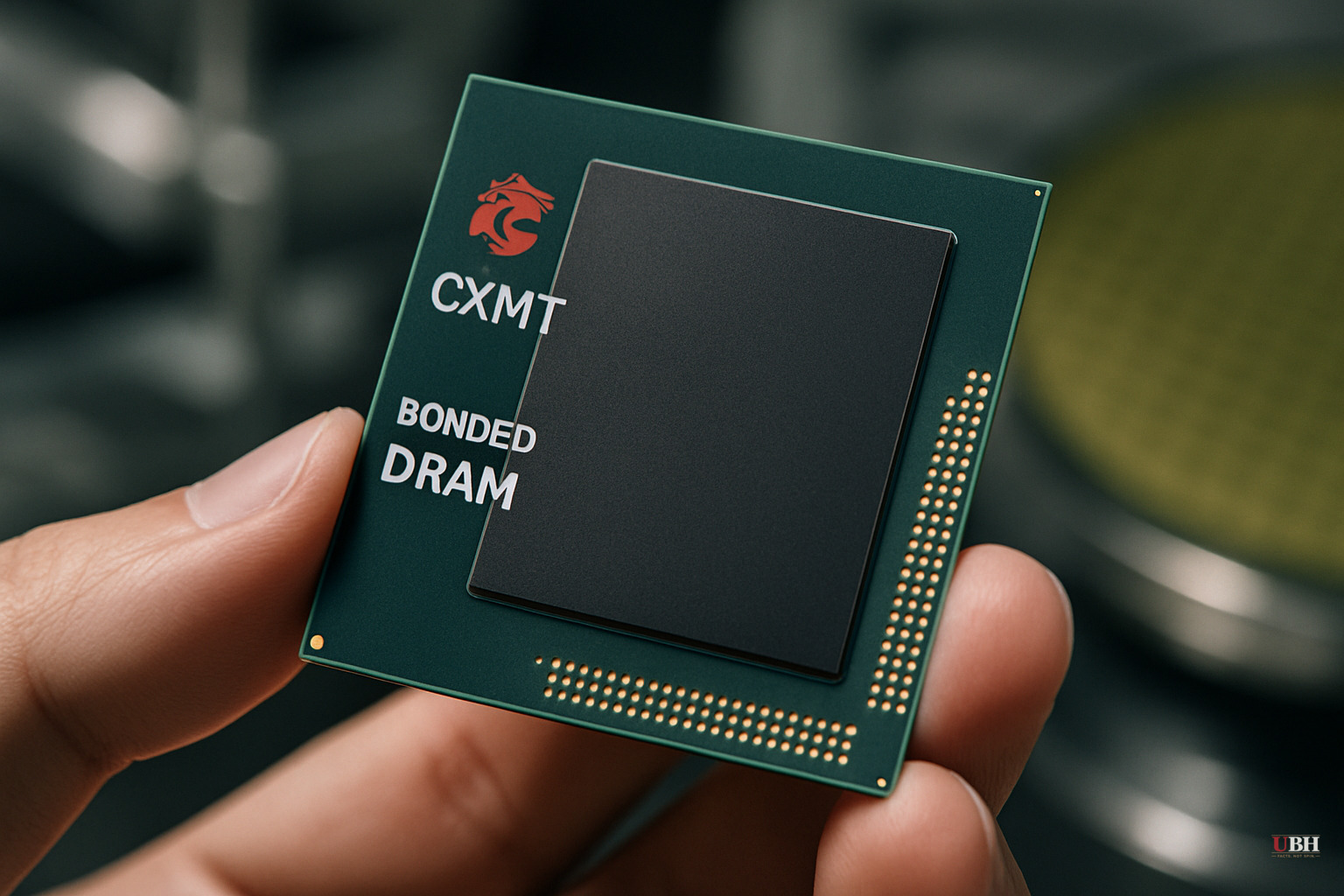
CXMT, headquartered in Hefei and reportedly preparing for an IPO in the coming weeks, has been quietly building a pilot production line for what the industry calls bonded DRAM, according to Korean financial outlet Hankgyung.
Bonded DRAM separates the memory cell array and peripheral circuitry onto two distinct wafers, then bonds them together. The payoff: you get ultra-high-density, high-performance memory without ever touching extreme ultraviolet (EUV) lithography. That matters enormously right now, because EUV tools are made exclusively by Dutch firm ASML and are subject to tight export controls that block China from buying them.
Deep ultraviolet (DUV) lithography with multi-patterning, which China can still access, is sufficient for the bonded approach. CXMT appears to have built its entire next-generation roadmap around that constraint.
The Gap Is Closing. Fast.
Two years ago, CXMT and YMTC, China's leading NAND chipmaker, were widely viewed as low-end manufacturers burning through capital with little competitive threat to the Korean majors. That assessment looks increasingly outdated.
Korean industry analysts cited by Hankgyung now assess that both companies have closed the technology gap with Samsung Electronics and SK Hynix "far faster than expected," compressing what was roughly a five-year lag down to approximately three years, despite U.S. export controls remaining in place.
On bonded DRAM specifically, the assessment is sharper. Korean media are reporting that CXMT may currently hold an edge over its Korean rivals in both the maturity of the technology and the pace of development. Samsung is pursuing bonded DRAM under an internal project called "B1b," and SK Hynix has a parallel effort underway. Neither has been reported to be at the pilot production stage ahead of CXMT.
Why This Technology Matters
Bonded DRAM is not a niche workaround. Korean industry sources quoted by Hankgyung describe it as a breakthrough capable of simultaneously maximizing both performance and capacity. If CXMT commercializes it first, that would represent a Chinese company leading on a next-generation memory architecture, not just catching up on older ones.
CXMT has reportedly recruited top-tier engineering talent to staff the Hefei R&D line. The goal, per Hankgyung, is to commercialize bonded DRAM before the Korean competitors do.
What the Export Controls Did and Didn't Do
The strongest argument for the U.S. export control regime is that it has kept China off EUV tools, which remain the cutting edge for the most advanced logic chips and conventional DRAM scaling. That constraint is real and consequential.
Critics of the current controls, however, have a legitimate counter: CXMT's bonded DRAM push is evidence that restricting one path can accelerate innovation on alternate paths. By blocking EUV access, Washington may have pushed China's chipmakers into architectures that, if they work, don't require EUV at all. Whether the controls ultimately slowed China's memory ambitions or redirected them into a more durable technological track remains an open question.
Reuters has separately reported China has built a prototype EUV machine domestically, though that machine's production readiness and yield performance are not established by available sources.
Stakes for the Global DRAM Market
The DRAM market is currently dominated by three players: Samsung, SK Hynix, and Micron. CXMT's emergence as a credible next-generation contender—rather than just a low-end commodity supplier—reshapes that competitive picture.
For Samsung and SK Hynix specifically, the threat is direct. Korean media framing this story as a warning to domestic industry is notable. These are not U.S. commentators alarmed about China, but Korean semiconductor journalists assessing a competitive threat to their own national champions.
For the U.S., the relevant question is Micron's position. Micron is the only American DRAM manufacturer, and it has no domestic buffer if CXMT successfully commoditizes high-performance memory at scale with lower costs enabled by Chinese state support.
What Isn't Known Yet
Pilot production lines are not mass production. CXMT testing a bonded DRAM R&D line in Hefei is a meaningful milestone, but yield rates, defect density, production costs, and time-to-commercialization are all unconfirmed. Samsung and SK Hynix have vastly larger production ecosystems and decades of process refinement. A technology lead in an R&D setting does not automatically translate into a market lead.
The unresolved question that will define this story: whether CXMT can achieve commercially viable yields on bonded DRAM before Samsung's B1b project reaches mass production. That race, not the current R&D milestone, is what actually determines who reshapes the global memory market.
Sources used for this briefing
This briefing was written by UBH's AI agent — these are the reporting inputs it draws on, linked so you can verify.


