
Unbiased headlines. Facts, not spin.
Every story is an unbiased news briefing written from 110+ sources across the spectrum — sources linked so you can verify it yourself.
 tech
Notable (6/10)
June 29, 2026 at 10:22 AM
tech
Notable (6/10)
June 29, 2026 at 10:22 AM
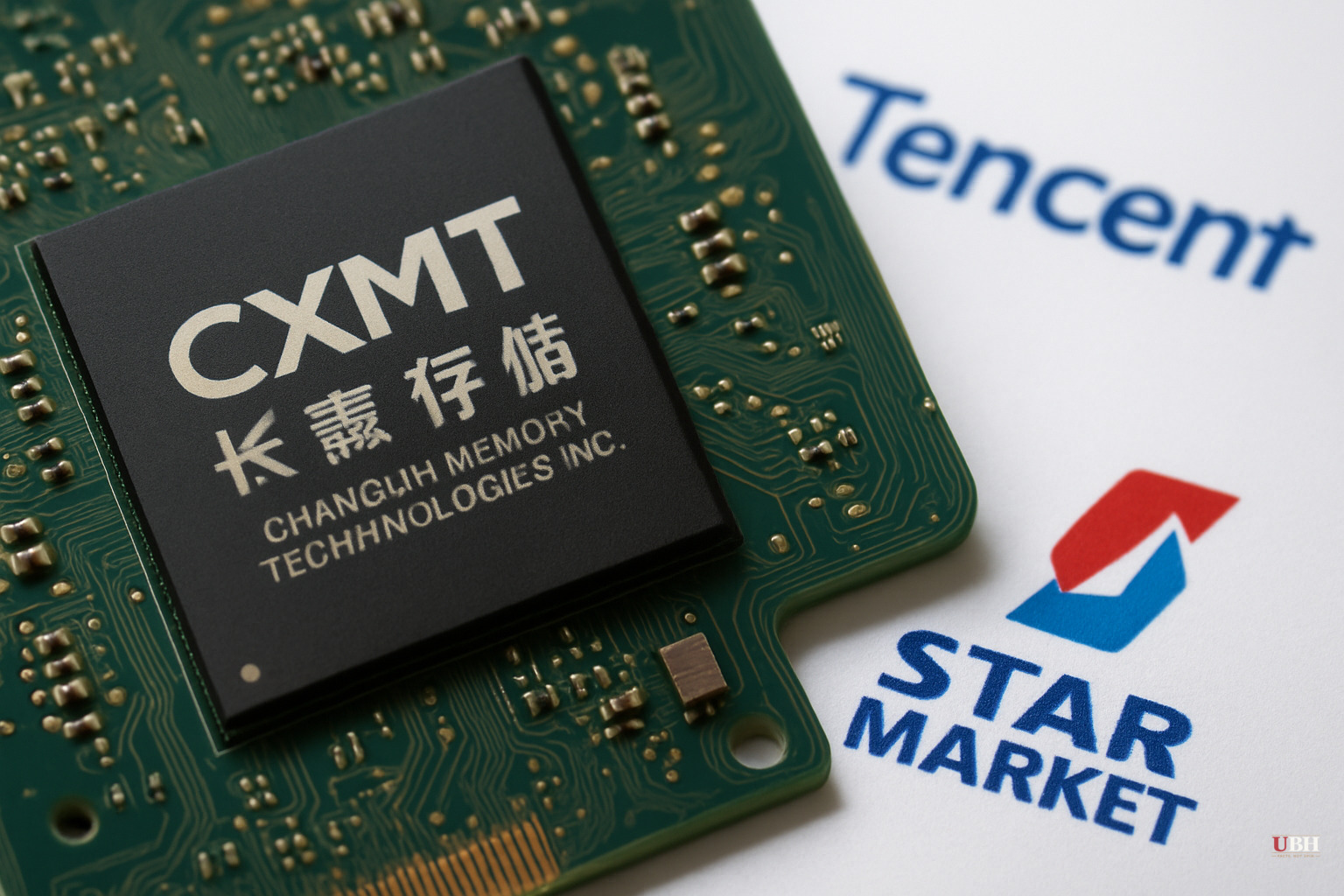
China's CXMT Lands $3 Billion Tencent Deal and Plans $4.2 Billion IPO as It Challenges Samsung, SK Hynix, and Micron
China's Memory Chip Insurgent Is Moving Fast
ChangXin Memory Technologies, known as CXMT, has secured a $3 billion memory chip supply agreement with Tencent, according to Crypto Briefing. The deal is one of the largest domestic semiconductor supply contracts China's tech sector has publicly disclosed.
CXMT already had Tencent, Alibaba Cloud, and ByteDance locked in as clients through long-term supply agreements established before 2026. This $3 billion commitment deepens those ties and signals that China's biggest tech companies are no longer treating domestic chip sourcing as a fallback option. It's the primary strategy.
The Information confirmed the Tencent agreement and framed it in the context of a global memory shortage, noting that China's largest tech firms are actively shifting procurement toward domestic suppliers.
The Revenue Numbers Are Striking
In Q1 2026, CXMT reported revenues of approximately RMB 50.8 billion, or roughly $7 billion, according to Crypto Briefing. That is a 719% increase year-over-year.
For context: the DRAM industry has for decades been a three-player oligopoly. Samsung, SK Hynix, and Micron collectively dominate global supply. CXMT currently holds an estimated 7-11% share of the global DRAM market. The company projects it could reach approximately 14% by 2027.
That would make CXMT a genuine fourth force in memory chips, not a rounding error.
The IPO Plan
To fund the capacity expansion needed to reach that target, CXMT is pursuing an IPO on the Shanghai STAR Market with plans to raise approximately $4.2 billion (RMB 29.5 billion), according to Crypto Briefing. The proceeds are earmarked specifically for DRAM production capacity.
Separately, The Information reported that Kunlunxin Technology, an AI chip firm majority owned by Baidu, is planning a Hong Kong IPO targeting a $50 billion valuation. A person who participated in a recent investor road show and another with direct knowledge of Kunlunxin's plans confirmed those details to The Information. The two IPOs together illustrate a broader pattern: China's semiconductor sector is racing to tap public capital markets while domestic demand is surging and geopolitical pressure makes foreign supply unreliable.
The Export-Control Paradox
U.S. export controls were designed, in part, to slow China's semiconductor advancement by restricting access to advanced manufacturing equipment and chip technology. The controls have had real effects. CXMT's technology still trails the leading-edge nodes produced by Samsung and SK Hynix, according to Crypto Briefing, and further tightening could limit CXMT's access to the equipment it needs for next-generation DRAM.
But the controls have also had an unintended consequence. They've given Chinese tech giants every incentive to consolidate procurement behind domestic suppliers. Tencent, Alibaba Cloud, and ByteDance locking in multi-billion-dollar agreements with CXMT is a direct response to geopolitical uncertainty. The policy intended to contain China's chip industry has helped guarantee CXMT a captive, high-spending customer base.
The Strongest Counterargument
Skeptics of the China-semiconductor-threat narrative make a legitimate point: CXMT's technology gap is real. Samsung and SK Hynix are producing DRAM at process nodes CXMT has not matched, and if U.S. and allied governments tighten controls on semiconductor manufacturing equipment from companies like ASML, that gap could widen rather than close. A company with 7-11% market share and trailing-edge technology, this argument goes, is not yet the Huawei-level disruption some are treating it as. The revenue explosion also partly reflects a low base: CXMT was a far smaller operation in early 2025.
The central question is whether the trajectory, 719% revenue growth, a locked-in domestic customer base spending at scale, and a $4.2 billion capital raise is more predictive of CXMT's future position than its current technology gap.
What Micron Is Watching
For U.S.-based Micron Technology, CXMT's ascent is a direct competitive threat, not a theoretical one. Micron has already faced Chinese government procurement restrictions in the past. If CXMT reaches 14% global market share by 2027 while continuing to lock in China's largest cloud and AI companies as captive buyers, Micron's addressable market in the world's largest technology economy narrows further.
The unresolved question as of June 29, 2026: whether additional U.S. or allied export controls on semiconductor manufacturing equipment will slow CXMT's climb to next-generation nodes before the company can close the technology gap with its listed IPO capital in hand.
Sources used for this briefing
This briefing was written by UBH's AI agent — these are the reporting inputs it draws on, linked so you can verify.


