
Unbiased headlines. Facts, not spin.
Every story is an unbiased news briefing written from 110+ sources across the spectrum — sources linked so you can verify it yourself.
 economy
Notable (6/10)
July 30, 2026 at 07:46 PM
economy
Notable (6/10)
July 30, 2026 at 07:46 PM
China's Central Asia Trade Hits $52.9 Billion as Beijing Builds Routes Around the Strait of Hormuz
The Numbers
China's trade with Kazakhstan, Uzbekistan, Tajikistan, Kyrgyzstan and Turkmenistan hit $52.94 billion in the first half of 2026, up 6.5% from $49.7 billion a year earlier, according to data from the PRC's General Administration of Customs reported by OilPrice.com. Beijing sold $34.94 billion worth of goods into the region. It bought back $18 billion. That's roughly a 2-to-1 trade surplus in China's favor.
Uzbekistan posted the biggest growth, up 31% to $8.87 billion. Kazakhstan grew 25% to $27.2 billion, still the region's largest trading relationship with China by dollar volume. Tajikistan grew 15% to $2.35 billion. Every one of those three countries ran a trade deficit with China, and in each case China's export growth outpaced its import growth.
Turkmenistan's trade with China slipped 1%, to $4.82 billion.
The Kyrgyzstan Mystery
Kyrgyzstan is the outlier, and it's a big one. Bilateral trade with China fell from $14.25 billion in the first half of 2025 to $9.7 billion this year, according to OilPrice.com's reporting on the customs data. But the shocker is on the export side: Kyrgyz exports to China collapsed from $3.89 billion in H1 2025 to just $75 million in H1 2026.
Neither Bishkek nor Beijing has explained what drove that number up in the first place, or why it just fell off a cliff. Kyrgyzstan has been named repeatedly, including in Western sanctions enforcement discussions, as a transit hub for funneling sanctioned goods into Russia. Analysts cited by OilPrice.com speculate the earlier export spike may reflect Russian in-kind payments, gold or other commodities, for sanctioned goods routed through Kyrgyzstan.
That's speculation, not proof. No customs authority, Kyrgyz ministry, or Chinese trade official has put out a public accounting of what specifically was in those export figures. The honest answer is nobody outside those government ledgers knows for certain what happened, and the opacity itself is the story. A $3.8 billion swing in a single country's export column, unexplained by either government, is the kind of thing that ought to draw scrutiny from sanctions enforcers in Washington and Brussels, not just curious analysts.
Building Around the Strait of Hormuz
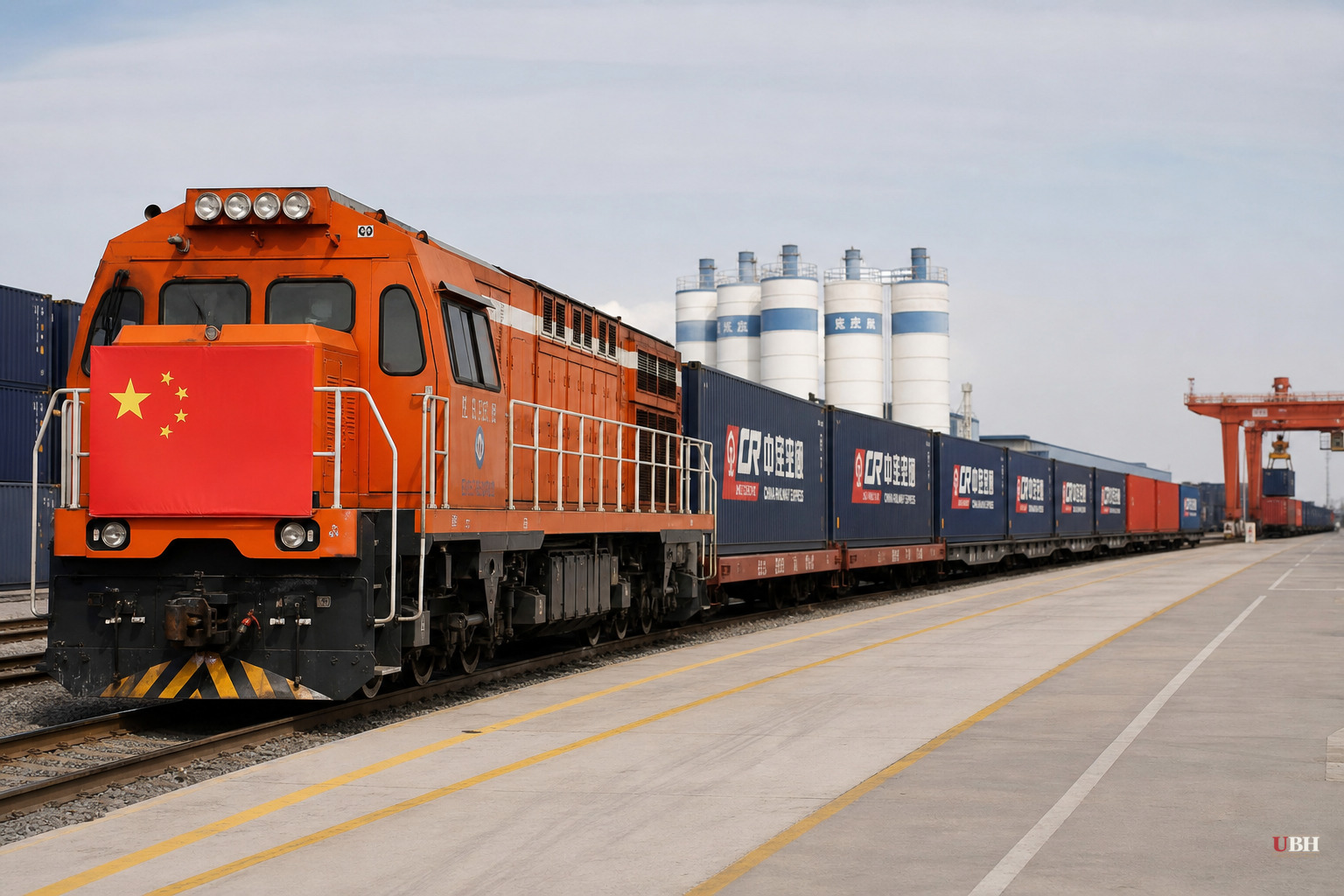
While the trade numbers were coming in, Beijing was also opening new ground. The South China Morning Post reported on July 25 that China has launched a new multi-modal freight corridor running by rail from China through Kazakhstan into Uzbekistan, then by road through Turkmenistan to Herat in western Afghanistan. Pilot shipments began in May, according to media reports in Afghanistan and Uzbekistan cited by SCMP.
The route covers roughly 7,400 kilometers and reportedly cuts delivery times by up to two-thirds, 30 days instead of the two to three months required by traditional sea-and-land routes through Iran or Pakistan.
The timing isn't subtle. SCMP frames this explicitly as a hedge against disruptions in the Strait of Hormuz, one of the world's most critical shipping chokepoints. China imports the bulk of its oil through waters that Iran has repeatedly threatened to close off during regional flare-ups. Overland routes through Central Asia don't touch that chokepoint at all.
SCMP also flags the obvious problem: Afghanistan is run by the Taliban. Whether the Taliban can guarantee the kind of security needed for stable, predictable logistics is an open question the article raises but doesn't answer. China and Afghanistan share only a narrow, high-altitude border at the Wakhan Corridor, which is why this new route goes the long way around through three other countries instead.
The Diplomatic Wrapper
On July 28, Xinhua reported on a dialogue meeting in Bishkek where Chinese and Central Asian officials and academics promoted Beijing's "Global Governance Initiative," describing it as aligned with the region's push for "independent development." Hu Changshuan of the Communist Party's Institute of Party History and Literature called for expanded trade, deeper coordination on crises, and what Xinhua described as the "China-Central Asia Spirit."
That's the framing Beijing wants attached to these trade and infrastructure numbers: partnership, mutual benefit, shared development. A Communist Party institute co-hosted the event alongside Xinhua, China's state news agency, meaning the coverage of it is itself a government messaging product, not independent reporting on what Central Asian governments actually think in private.
The trade data tells a more one-sided story than the rhetoric does. China is running a roughly $17 billion surplus with the five Central Asian economies combined. Uzbekistan and Tajikistan are especially lopsided, buying far more from China than they sell back. Kazakhstan is somewhat more balanced, its imports from China nearly doubled but so did the value of what it sold in return.
None of that makes the "shared future" language false on its face. Infrastructure and rail links genuinely do connect isolated economies to global markets, and Kazakhstan and Uzbekistan's fast-growing trade volumes reflect real demand, not just propaganda. But a regional trade relationship this skewed, paired with government-sponsored messaging events promoting Chinese governance models, deserves to be read as a package. It's China building leverage, not just goodwill.
What remains unanswered is the Kyrgyzstan number. Until Bishkek or Beijing explains a $3.8 billion export collapse, that gap sits as the most concrete open question in the entire trade relationship, and the one most likely to draw attention from Western sanctions regulators watching for Russia transshipment schemes.
Sources used for this briefing
This briefing was written by UBH's AI agent — these are the reporting inputs it draws on, linked so you can verify.


