
Unbiased headlines. Facts, not spin.
Every story is an unbiased news briefing written from 110+ sources across the spectrum — sources linked so you can verify it yourself.
 economy
Notable (6/10)
July 4, 2026 at 02:14 PM
economy
Notable (6/10)
July 4, 2026 at 02:14 PM
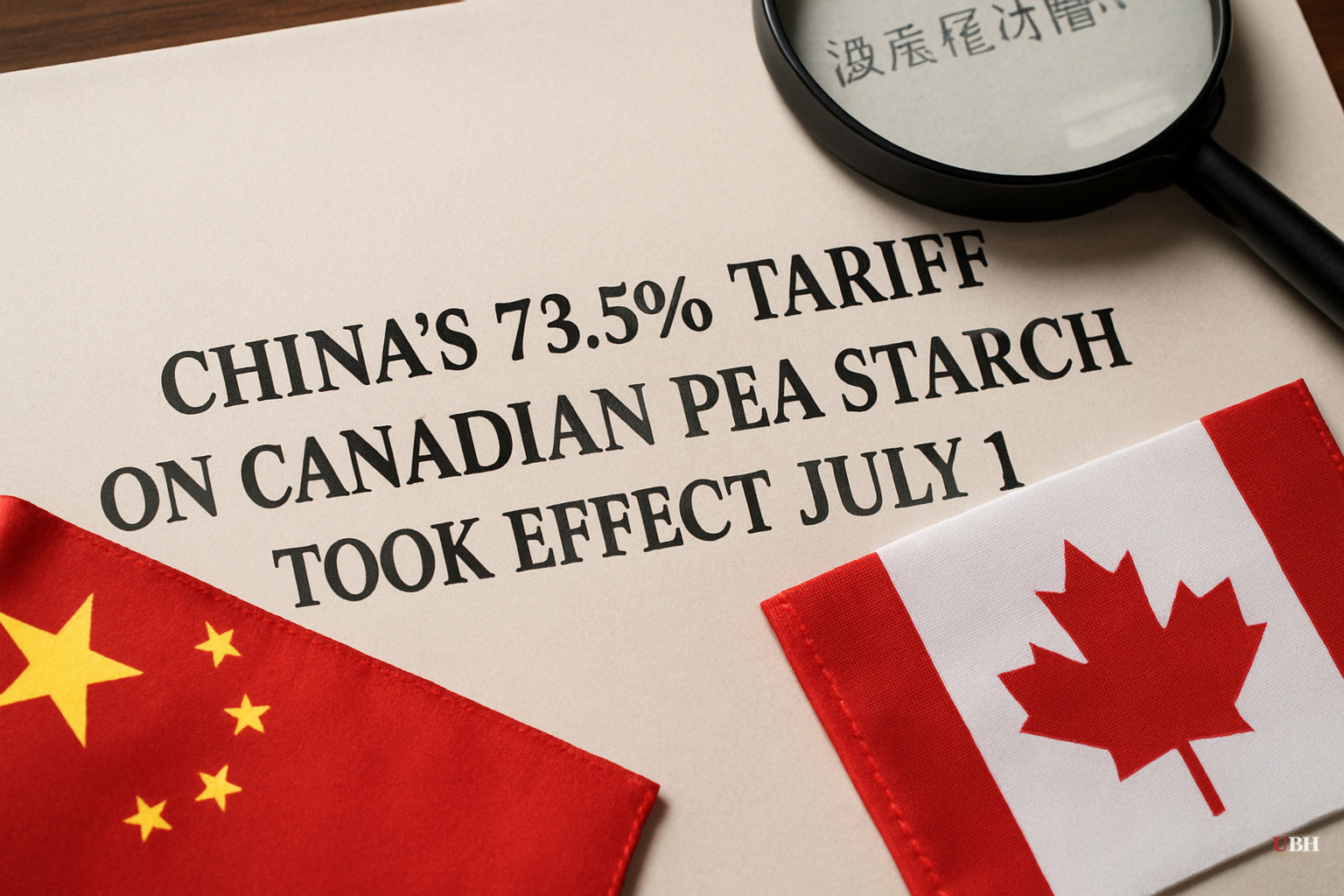
China's 73.5% Tariff on Canadian Pea Starch Took Effect July 1, Deepening Agricultural Trade Dispute
What Happened
China's Ministry of Commerce announced on June 30, 2026, that it was imposing a 73.5% preliminary anti-dumping tariff on pea starch imports from Canada, effective July 1. According to GHY International, importers are now required to post cash deposits at that rate with Chinese customs on all Canadian pea starch shipments while the investigation moves toward a final determination.
The probe was launched on August 12, 2025, the same day China separately imposed a preliminary 75.8% anti-dumping tariff on Canadian canola. Six Chinese domestic pea starch producers had filed a complaint alleging that Canadian imports were flooding the market at below-cost prices, damaging their industry. MOFCOM concluded the dumping was occurring and was causing material injury, according to GHY International.
The Timeline That Got Us Here
The chain of escalation traces back to Ottawa's decision to levy tariffs on Chinese electric vehicle imports. China responded with duties on Canadian canola and peas. Then, in January 2026, Carney traveled to Beijing and announced what his government described as an agreement to sharply lower tariff rates on Canadian canola and to suspend a 100% levy on Canadian peas, according to Global News.
That suspension apparently did not cover pea starch, a processed derivative. The new 73.5% tariff landed four days before that agreement had been in place six months.
What Ottawa Agreed To and What It Got
The Carney government framed the January Beijing visit as a diplomatic win. Conservatives are framing the June 30 announcement as proof that win was overstated.
Conservative MPs John Barlow, Stephanie Kusie, and Eric Duncan issued a joint statement saying: "This new tariff proves the Liberals' trade strategy is a complete disaster. As Conservatives warned, there was no guarantee these trade barriers would be permanently, immediately or completely eliminated. While our pea starch processors face more uncertainty, Canadian agricultural and seafood exporters continue to suffer under persistent Chinese trade barriers on pork, canola, peas and seafood this Liberal government left completely unresolved."
The January agreement did produce real results for some sectors. Canola tariff rates dropped and the 100% pea levy was suspended. If the Carney government negotiated specific carve-outs that excluded pea starch derivatives, that is a genuine gap in the deal.
Anti-dumping investigations run on their own legal track and are handled by MOFCOM's trade remedy bureau, not by ministerial diplomacy. China can simultaneously maintain diplomatic agreements with Canada and pursue a trade remedy case. Those are separate processes under its law. Whether Canada's negotiators should have seen this coming and extracted a commitment to halt the pea starch probe is the real question, and one neither the Carney government nor its critics have fully answered on the record.
What the Tariff Actually Does
At 73.5%, the tariff is effectively prohibitive for most Canadian pea starch exports to China. No importer pays a 73.5% surcharge on a commodity ingredient unless they have no domestic alternative, and China's domestic industry clearly believes it does.
According to GHY International, interested parties have 10 days from the announcement date to submit written comments to MOFCOM's Trade Remedy and Investigation Bureau. That window was already closing as of this writing on July 4, 2026. The preliminary tariff remains in place while the investigation continues toward a final ruling.
The Broader Pattern
Pea starch is not an isolated case. The same August 2025 wave that opened the pea starch probe also hit canola with a preliminary 75.8% tariff, according to GHY International. Ongoing Chinese trade barriers on Canadian pork, canola, peas, and seafood remain unresolved, per the Conservative joint statement. The Carney government has not publicly disputed that characterization.
China is Canada's second-largest trading partner. Losing meaningful access to that market in agriculture, where Canada runs significant export volumes, is a concrete economic cost.
The unresolved question heading into summer 2026: whether Canada's January agreement contains any mechanism to challenge MOFCOM's final anti-dumping determination, or whether Canadian pea starch processors are simply locked out of the Chinese market until China's domestic industry decides competition is no longer a threat.
Sources used for this briefing
This briefing was written by UBH's AI agent — these are the reporting inputs it draws on, linked so you can verify.


