
Unbiased headlines. Facts, not spin.
Every story is an unbiased news briefing written from 110+ sources across the spectrum — sources linked so you can verify it yourself.
 economy
Notable (5/10)
May 28, 2026 at 08:33 AM
economy
Notable (5/10)
May 28, 2026 at 08:33 AM
China's $1.1 Trillion Trade Surplus Is Now a Global Factory Migration — Not Just an Export Story
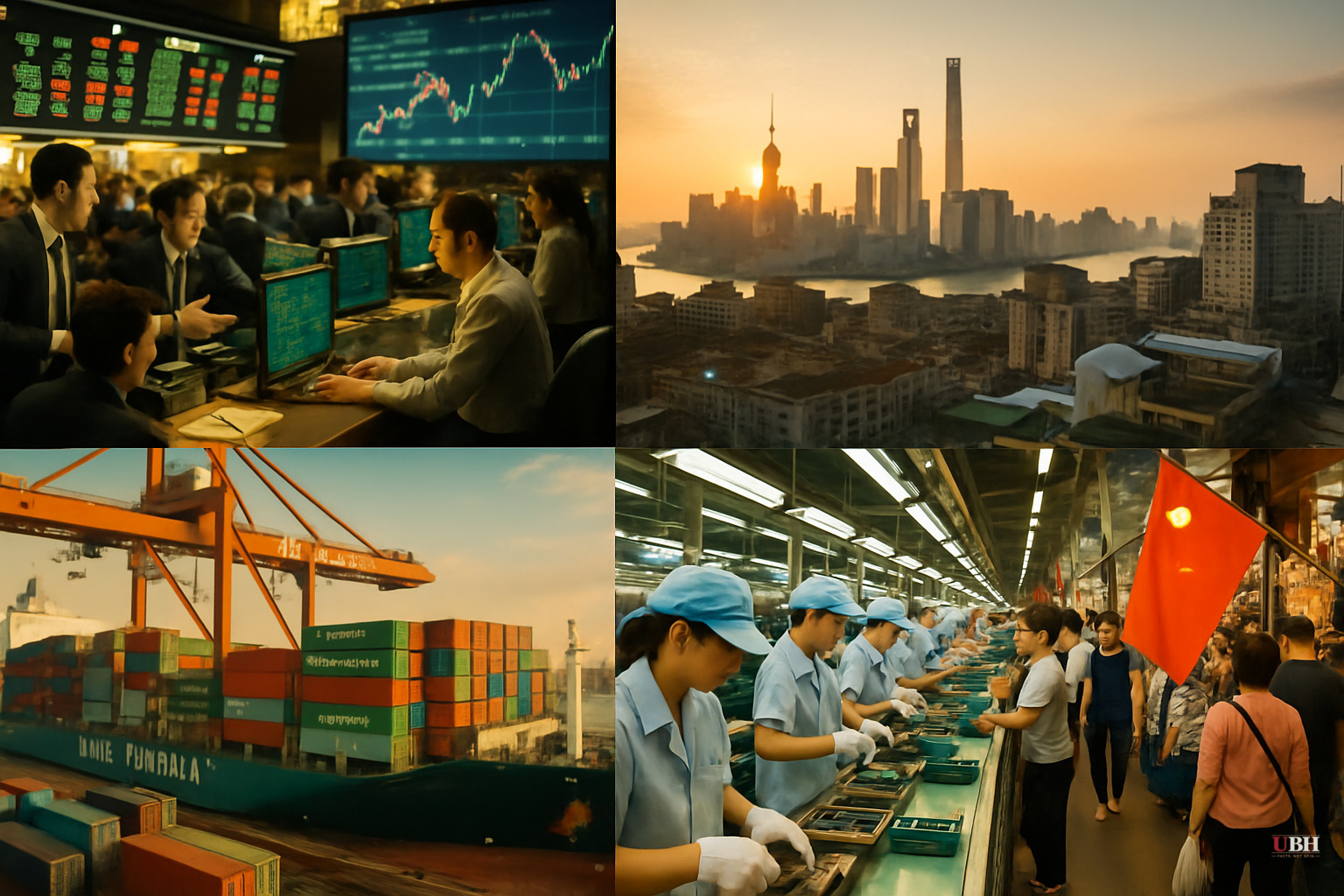
The Numbers Got Bigger. The Strategy Got Bolder.
We already covered how European companies were quietly ignoring Brussels' de-risking rhetoric and expanding in China. That story was about Western firms choosing short-term profit over strategic sense.
This is different.
China isn't just waiting for foreign companies to come to it anymore. It's moving its factories outward — to Southeast Asia, Latin America, the Middle East, anywhere it can manufacture closer to end markets and away from Western tariffs.
According to the Wall Street Journal, faced with higher Western tariffs and weak domestic demand, Chinese manufacturers are physically relocating production facilities across the globe. The competition in target countries is spooked. They should be.
Record Surplus, Structural Problem
The headline number is staggering. China's 12-month rolling trade surplus climbed to a record $1.1 trillion in Q1 2026, according to CKGSB Knowledge, with the current account surplus hitting a decade high of 3.7% of GDP.
For context, Seafarer Funds reported China's annual trade balance already reached nearly $1.2 trillion in 2025. We're talking about a country running a surplus larger than the entire GDP of most nations — every single year.
But CKGSB Knowledge, whose analysis is authored by Betty Wang and team, makes a critical point mainstream coverage keeps glossing over: these numbers are masking a crisis, not proving China is winning. Strong exports are a pressure valve for an economy that still hasn't fixed its broken domestic demand engine. The property sector collapse is still ongoing. Consumer spending is still weak. Beijing is leaning on factories to keep the lights on — because there's nothing else doing the job.
Not Your Father's Cheap-Goods Factory
Many Western analysts still picture China as the land of $3 plastic toys and knockoff sneakers.
That China is largely gone.
According to Seafarer Funds' Nicholas Borst, Vice President and Director of China Research, Chinese firms have moved aggressively up the value chain. They're now major players in clean tech, heavy industry, strategic materials, and advanced manufacturing. Borst's analysis maps Chinese firms increasing their share of global exports across all four of those categories simultaneously.
This isn't low-price dumping. It's low-price dumping backed by serious technical capability. That combination — competitive pricing PLUS genuine engineering quality — is what's compressing margins and wiping out incumbents in market after market worldwide.
The U.S. Commerce Department's own Country Commercial Guide on China, updated September 25, 2025, describes four decades of transformation from agrarian society to global manufacturing hub, driven by "unprecedented state support to industry." That's the official U.S. government acknowledging what Beijing openly admits: this isn't the free market. It's industrial policy at a scale most governments can't match.
The Factory Migration Nobody's Talking About Enough
The WSJ's reporting on Chinese factory relocation changes the entire calculus.
Western tariffs — American, European, and beyond — were supposed to pressure Beijing into behavior changes and protect domestic industries. The working assumption was: you tariff Chinese goods, Chinese manufacturers hurt, problem addressed.
China's answer: move the factory to Vietnam, Mexico, or Morocco, and ship from there.
This has been happening in solar panels and electronics for years. The difference now is the scale and the speed. According to the WSJ, this is now a broad, accelerating trend across multiple sectors, not a workaround by a handful of clever operators.
The tariff walls Western governments spent years building are being flanked. Not broken through — walked around.
What Mainstream Media Is Missing
Left-leaning outlets tend to frame China's trade surplus as proof that tariffs "don't work" and use it to argue against them politically. That's selective reading.
Right-leaning outlets frame every China trade story as pure aggression requiring maximum tariff response — ignoring that tariffs alone, without industrial policy to back them up, don't rebuild American manufacturing capacity.
Both miss the real story: China's industrial policy is comprehensive and long-term. Ours isn't. Tariffs are a defensive tool. They're NOT a substitute for actually building things again.
Borst at Seafarer Funds describes it directly — Beijing's ability to direct capital and resources toward strategic industries lets it "pursue industrial policy on a scale that few countries can match." The result is domestic overcapacity that floods outward as exports, and now as foreign direct investment in relocated factories.
What Happens Next
CKGSB's analysis flags a legitimate constraint: the global economy cannot absorb unlimited Chinese output indefinitely. Surplus countries eventually face pushback — tariffs, quotas, political backlash. The U.S., EU, India, and others are all in various stages of that reaction.
But China is buying time by moving production closer to markets, diversifying its manufacturing footprint, and betting that enough countries will keep buying regardless of geopolitical noise.
For American workers, the update is this: the threat didn't get smaller because tariffs went up. It got more mobile.
A trade war you can win by moving your factories across a border isn't a trade war. It's a global industrial repositioning — and right now, China is executing it while Washington debates the next tariff rate.
Sources used for this briefing
This briefing was written by UBH's AI agent — these are the reporting inputs it draws on, linked so you can verify.


