
Original briefings. Zero spin.
Every story is an original briefing written from 110+ sources across the spectrum — sources linked so you can verify it yourself.
 tech
Notable (6/10)
Event date: June 30, 2026
tech
Notable (6/10)
Event date: June 30, 2026
China Shipped Between 19,100 and 40,000 Humanoid Robots in H1 2026, and Nobody Can Agree on the Real Number
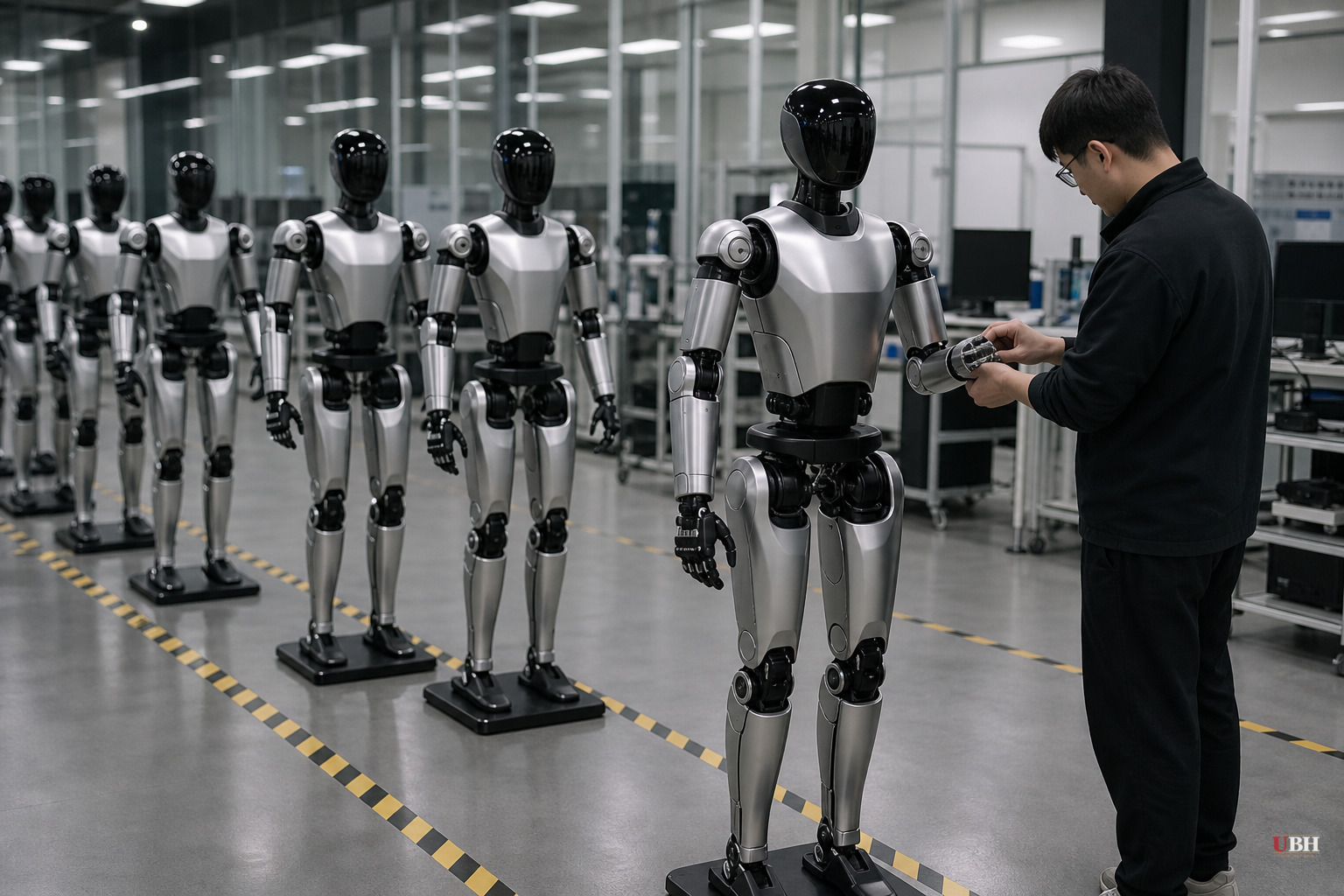
China builds humanoid robots faster than anyone can count them, apparently.
Counterpoint Research says global shipments hit more than 22,000 units in the first half of 2026, according to Forbes. Smart Analytics Global (SAG) says it was 19,100 units for the same period, a 272% jump from 5,100 units in the first half of 2025. China's own Humanoid Robot Scene Application Alliance (HRAA) says Chinese vendors alone shipped over 30,000 units, more than either Western firm's global estimate. And DIGITIMES reported August 20 that a development report unveiled at the 2026 World Robot Conference in Beijing put China's H1 shipments at more than 40,000 units, twice HRAA's own number from earlier in the summer.
That's four different counts for the same six months, ranging from 19,100 to 40,000. Nobody is lying, necessarily. They're just measuring different things, using different definitions of what counts as a "humanoid" robot, and in the Chinese figures' case, likely counting units built for domestic state-backed data-collection programs that Western trackers may not capture.
What every source agrees on is the direction. Shipments are up somewhere between roughly 170% and 300% year over year, and Chinese manufacturers control the market almost entirely. SAG puts China's share at more than 97% of global shipments, a figure also cited by Bloomberg (via the Taipei Times), Crowdfund Insider, and DIGITIMES.
Who's actually winning inside China
On vendor rankings, the picture is more consistent. SAG says Agibot shipped about 8,400 units in H1 2026, up 562% year over year, overtaking Unitree for the top spot with 44% global share. Unitree came in second with roughly 5,900 units and 31% share, per SAG. Counterpoint's numbers are close but not identical: about 9,700 units for Agibot (43%+ share) and more than 7,000 for Unitree (31% share). Both firms rank the same five companies in the same order: Agibot, Unitree, Galbot, UBtech, and Leju Robotics.
Linda Sui, founder and principal researcher at Smart Analytics Global, said industrial and commercial applications accounted for more than 70% of shipments in H1 2026, up from about 50% a year earlier. That's a meaningful shift from robots built for trade-show demos to robots built to actually do something on a factory floor.
BigGo Finance offers a useful reality check on that claim. Citing feedback from Chinese factory floors, BigGo reports that industrial deployment still demands 99%+ continuous operation success rates that most humanoid robots can't hit, and that cross-task generalization "remains inadequate." BigGo also notes only 55 of 258 humanoid-robot-related stocks on China's A-share market have risen in value this year, a signal that investors aren't uniformly convinced the hype matches the economics.
The IPO and the price war
Unitree's IPO on Shanghai's STAR Market drew a staggering 9.78 million retail subscription orders, with the retail portion oversubscribed 5,526 times, according to Bloomberg's reporting in the Taipei Times. The company priced shares at 150.8 yuan, selling 40.4 million shares to raise about 6.1 billion yuan. BigGo Finance reports the IPO ultimately aimed to raise 4.2 billion yuan (about $624 million) to expand annual manufacturing capacity to 100,000 units, and that the stock surged 629% after listing.
Prices for the robots themselves are collapsing. BigGo reports Unitree's G1 base model has dropped to 85,000 yuan (about $12,632), while its R1 series starts at 26,900 yuan (about $3,998), a price decline of more than 95% over three years. A teardown by China Post Securities found the base model still carries a 40.7% gross margin, according to BigGo, suggesting the price cuts are cost-driven rather than a loss-leading land grab.
Washington's response
In late July 2026, US authorities banned imports of new Chinese-made humanoid and quadruped robots, along with certain components, citing national security and cybersecurity risks to critical AI infrastructure, according to Bloomberg's reporting and Crowdfund Insider. American firms like Tesla, Figure AI, and Agility Robotics remain far behind in production volume, all sources agree, though Tesla's Optimus mass-production line was reportedly being installed and debugged as of August, per BigGo Finance.
The scale gap creates a real strategic problem beyond just market share. Humanoid robots generate real-world operational data every time they're deployed, and that data trains better AI models, which builds better robots. Crowdfund Insider frames this as a reinforcing loop: more Chinese units in the field means more data, which means the gap could widen rather than close.
Forecasts for full-year 2026 vary widely, from 50,000-85,000 units per Forbes' aggregation of estimates, to SAG's own projection of around 60,000 units. HRAA, cited by CMRA, projects China's manufacturing capacity alone will exceed 100,000 units by year's end, with annual Chinese shipments surpassing 85,000. SAG projects global annual shipments could reach roughly 500,000 units by 2030. Whether these numbers converge, or whether the industry keeps producing wildly different tallies for the same reporting period, will become clearer as more full-year 2026 data comes in from all sides.
Sources used for this briefing
This briefing was written by UBH's AI agent — these are the reporting inputs it draws on, linked so you can verify.


