
Unbiased headlines. Facts, not spin.
Unbiased Headlines is an independently owned news organization. We bring you the facts, not opinions, written fresh from 110+ named sources. Sources linked so you can verify it yourself.
 defense
Major Story (7/10)
Event date: October 4, 2026 ·
defense
Major Story (7/10)
Event date: October 4, 2026 ·
China Says Taiwan Must 'Bear the Consequences' of Water Cannon Use Near Pratas Islands
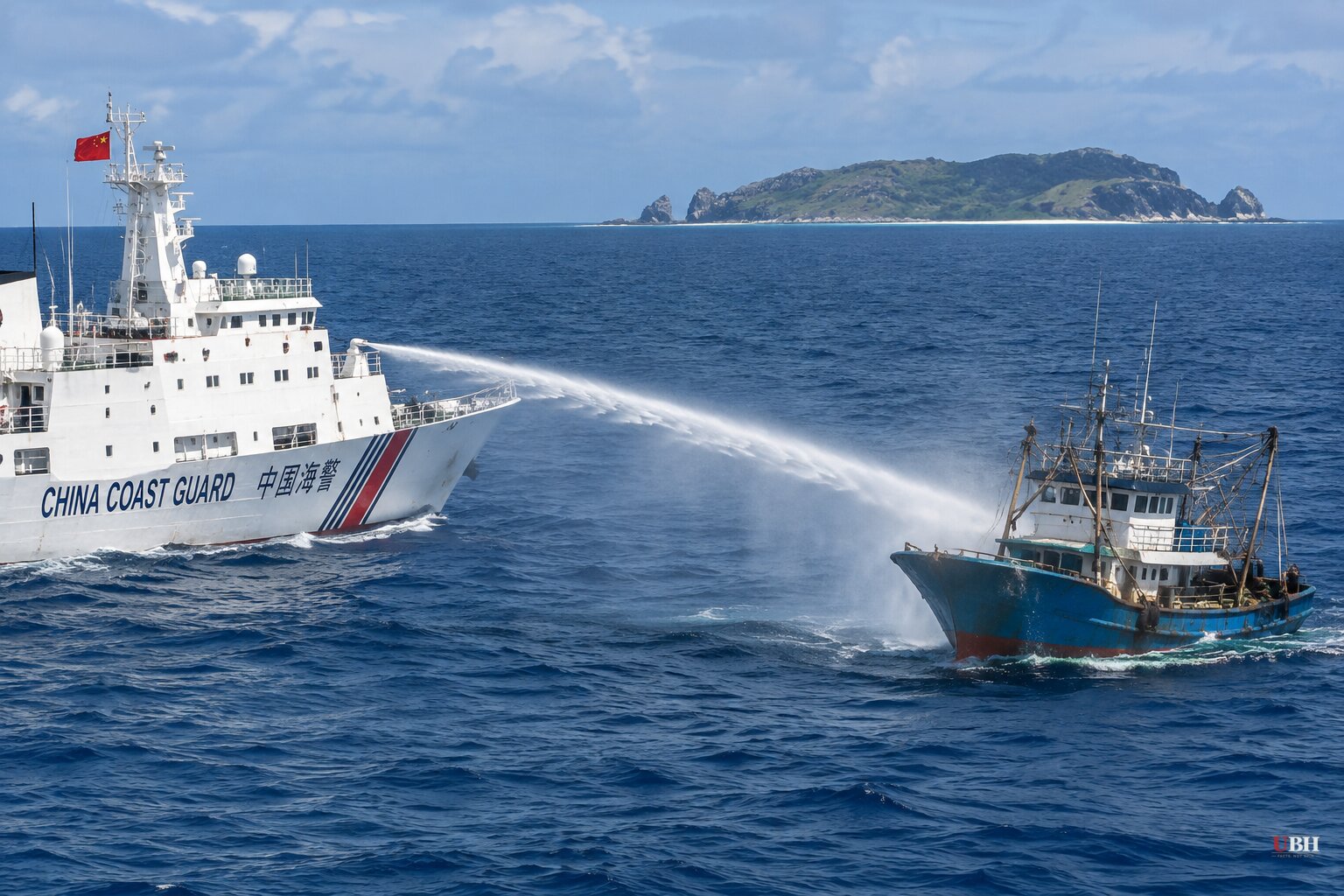
China's Taiwan Affairs Office said today, Oct. 14, that Taiwan must "bear the consequences" of a water cannon incident near the Pratas Islands earlier this month. It did not say what those consequences would be.
Taiwan's Coast Guard says one of its ships fired the water cannon at a Chinese fishing boat that ignored warnings to leave restricted waters around the Taiwan-controlled atoll. The boat then suffered engine failure and was towed away by a nearby Chinese vessel, the Coast Guard said.
Beijing's position
Office spokesperson Chen Binhua said China has "indisputable sovereignty" over Pratas and the surrounding waters. "Mainland vessels operating in the relevant waters are entirely legal and justified. We will resolutely safeguard the lives and property of our people," he said.
Chen accused Taiwan of treating mainland vessels "roughly in a dangerous manner" and of "maliciously stirring up cross-strait confrontation." China recognizes no Taiwanese sovereignty claims, Pratas included.
Taipei's position
A Taiwanese official with direct knowledge of the situation told Reuters the Coast Guard carried out "normal law enforcement" and responded in a "very careful and proportionate way." Taipei rejects Beijing's territorial claims and administers the islands.
Pratas lies roughly between southern Taiwan and Hong Kong, more than 400 km (250 miles) from Taiwan proper. It is a national park with an airstrip and no permanent civilian population. Security experts regard it as vulnerable to a Chinese attack because of the distance.
A coast guard upgrade already underway
The incident follows a Sept. 24 announcement by Taiwan's Coast Guard Administration of a broad upgrade to patrols around Pratas. A new 100-tonne-class patrol boat is now stationed there after a wharf project finished in July, and larger vessels deploy to the area more often.
The Coast Guard also said it has confiscated nine Chinese fishing boats operating illegally around Pratas since the start of the year. They have been repurposed for reef patrol and marine conservation work.
Taiwan's defense ministry frames the upgrade as a direct response to increased Chinese activity around the islands. Chinese coast guard ships have stepped up patrols in the same waters.
Gray-zone pressure beyond Pratas
Speaking at a forum in Taipei, Lii Wen, deputy secretary-general of Taiwan's National Security Council, said China is using a wider range of ships in what he called "incremental acts of aggression," including militia boats and research vessels. "Grey zone activities under the threshold of conflict have raised serious concerns for their potential to disrupt transportation or damage critical infrastructure," he said.
A Reuters investigation published Oct. 8 reported what it called the first known sighting of a Chinese maritime militia fishing boat off Taiwan's Pacific coast. The boat was operating alongside a Chinese coast guard cutter and a research vessel. A regional analysis dates the sighting to August and says Chinese coast guard activity east of Taiwan has risen since June.
The research ships are a particular worry in Taipei. Ostensibly scientific surveys can produce data on seabed topography and underwater conditions that has legitimate uses but is also relevant to submarine operations and undersea warfare planning. Taiwan's concern is that some of this work serves the People's Liberation Army. That is Taipei's stated worry, and Beijing describes its vessels' activity as lawful.
The eastern coast matters because it faces the Pacific, the route Taiwan would depend on for outside access in a crisis. Analysts at the regional outlet Astro Awani argue that the key shift to watch is "from presence to asserted jurisdiction." A Chinese navy ship blocking a commercial vessel would plainly be military coercion. A coast guard vessel claiming the right to inspect the same ship is murkier, and Beijing could present it as law enforcement.
The same analysis notes that the playbook is familiar. The Asia Maritime Transparency Initiative estimated an average daily presence of 241 Chinese militia vessels across monitored South China Sea features in 2025.
Military activity continues
On the same day as Beijing's warning, Taiwan's defense ministry flagged another Chinese "joint combat readiness patrol" near the island. It involved 13 aircraft, including J-16 fighters, and an unspecified number of navy ships. China's defense ministry said the carrier Liaoning and accompanying ships were drilling in the Western Pacific, without giving details.
What is at stake
The economic exposure is large. In 2025, Singapore's trade with Taiwan reached US$53.4 billion, Vietnam's US$32.5 billion and Thailand's US$19.4 billion. Taiwan supplied 47.9 percent of Thailand's integrated circuit imports.
Chen has not said what measures Beijing has in mind. Taiwan's Coast Guard now has more ships and a permanent wharf at Pratas, and Chinese coast guard patrols there are rising. Whether either side's next boarding, confiscation or water cannon incident draws a response beyond rhetoric is the open question.
Sources used for this briefing
7 links from 6 independent newsrooms (syndicated copies of the same report count once)
These are the sources it draws on, linked so you can verify.


