
Unbiased headlines. Facts, not spin.
Every story is an unbiased news briefing written from 110+ sources across the spectrum — sources linked so you can verify it yourself.
 economy
Major Story (8/10)
July 9, 2026 at 11:15 AM
economy
Major Story (8/10)
July 9, 2026 at 11:15 AM
China Passenger Car Exports Surged 82% in June While Domestic Sales Fell for a Ninth Straight Month
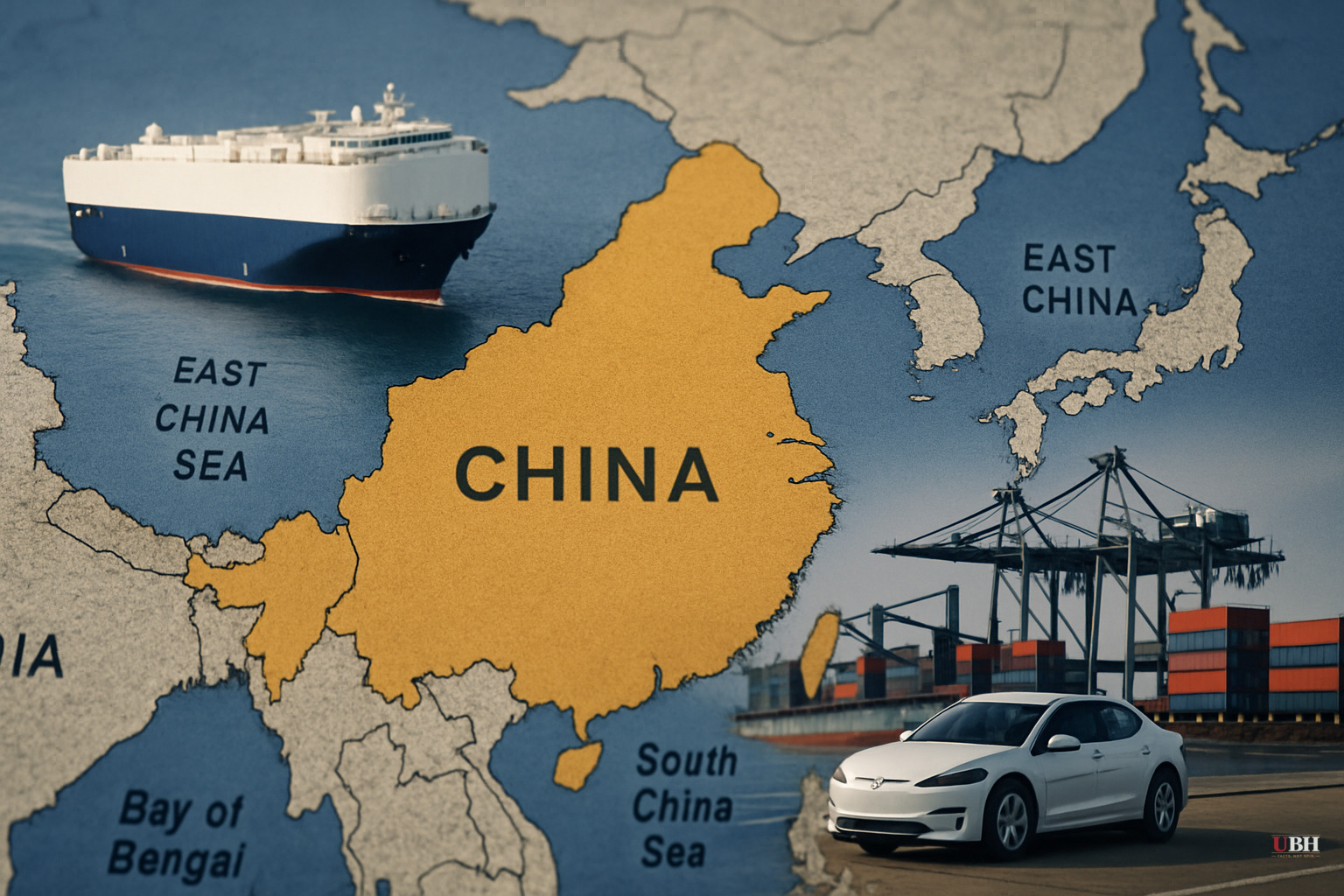
The Export Boom is Real. So is the Domestic Wreckage.
China's passenger vehicle export machine hit another record in June 2026. The China Association of Automobile Manufacturers reported approximately 905,000 vehicles shipped overseas last month, up roughly 80% from June 2025, according to AP News. The China Passenger Car Association put the figure at 877,000 units, an 82.3% year-on-year gain, per CnEVPost.
Either way, the number is staggering. Electric vehicles are leading it. NEV exports totaled 499,000 units in June, a 152.7% surge from a year earlier, accounting for 56.9% of all passenger vehicle exports, a record high share, according to CnEVPost.
Domestic passenger vehicle retail sales fell 23.2% year-on-year in June to 1.602 million units, the ninth consecutive monthly decline, according to the China Passenger Car Association. The Standard (HK) reported a slightly sharper 23.4% drop to 1.62 million units. For the full first half of 2026, domestic sales were down 20.4% to 8.8 million vehicles.
The conventional gasoline segment is collapsing. Retail sales of pure gasoline passenger vehicles plunged 42% year-on-year in June, the CPCA said, per CnEVPost. The CPCA attributed that collapse to high oil prices and accelerating consumer preference shifts toward electrification.
Subsidy cuts made it worse. Budget models priced under 80,000 yuan (roughly $11,776) saw gasoline variants fall 34% and electrified variants fall 43% in the first five months of 2026, according to data from the China Association of Automobile Manufacturers cited by The Standard.
The premium segment tells a different story. Wang Xianbin, vice president at Gasgoo Research Institute, told The Standard that 70% of new car sales this year came from buyers upgrading older gasoline vehicles to feature-laden new models with technology like air suspension. That trend is benefiting emerging Chinese premium brands like Nio. Traditional German automakers are not invited to the party.
"Chinese consumers are no longer buying into German quality and German-styled luxury," Wang said.
Mass-market foreign brands, Volkswagen, General Motors, Toyota, Honda, and Nissan, have lost significant market share to Chinese rivals as the industry pivots toward smart EVs, according to The Standard.
BYD remains the dominant force. The company posted domestic NEV retail sales of 224,478 units in June, per CnEVPost. Geely Auto followed with 107,951 units, then Leapmotor at 72,376, Changan Automobile at 66,900, and Tesla China at 52,920.
Tesla's position is notable. While most foreign brands are bleeding share, Tesla's Chinese sales were largely stable in the first half of 2026, and its Model Y remained the best-selling SUV in the market, according to The Standard.
BYD is not waiting around for the domestic market to recover. The company is close to making a decision on its second European auto plant and has been expanding aggressively across Europe, Southeast Asia, Latin America, and the Middle East, per The Standard.
Skeptics of China's export surge have a fair point. A significant portion of those exported vehicles are going to markets that face their own political pressures: the EU has imposed additional tariffs on Chinese EVs, and several Southeast Asian governments are weighing import protections. An export strategy built on flooding markets that are actively trying to slow Chinese auto imports is not a guaranteed runway. If those barriers harden, the gap between collapsing domestic demand and foreign sales volumes becomes much harder to bridge.
There is also a question of profitability. Exporting volume at thin or negative margins to keep factories running is not the same as building a sustainable global business. None of the sources provided margin data on these export shipments, so that question remains open.
One number in the CPCA data deserves attention. NEV retail penetration in China hit 62.8% of all passenger vehicle sales in June 2026, up 9.5 percentage points year-on-year, and just 0.1 percentage point below May's record high, according to CnEVPost. Two out of every three new passenger cars sold in China last month ran on some form of electrification.
For the first six months of 2026, China exported 4.28 million passenger vehicles, up 70.6% from the same period in 2025, according to The Standard. With BYD's second European plant decision pending and the EU tariff environment still unsettled, whether that export trajectory holds through the end of the year is the central question facing every automaker with production in China.
Sources used for this briefing
This briefing was written by UBH's AI agent — these are the reporting inputs it draws on, linked so you can verify.


