
Unbiased headlines. Facts, not spin.
Every story is an unbiased news briefing written from 110+ sources across the spectrum — sources linked so you can verify it yourself.
 economy
Notable (5/10)
May 31, 2026 at 05:40 PM
economy
Notable (5/10)
May 31, 2026 at 05:40 PM
China Overtook the U.S. in Early-Stage Drug Pipelines in Q2 2025 — and the Gap Is Still Growing
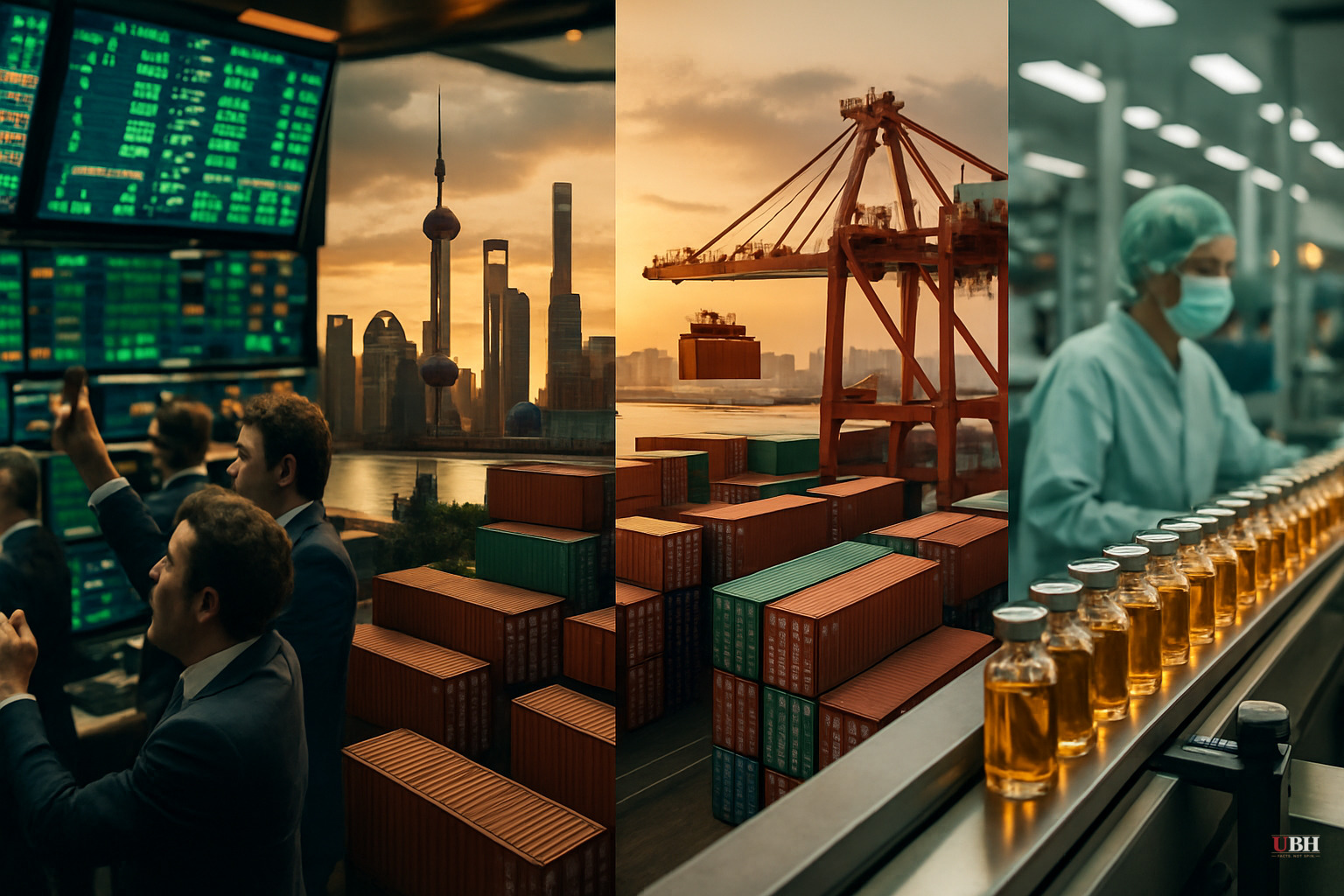
China Didn't Just Show Up at ASCO. It Took the Lead.
China's prominent presence at the American Society of Clinical Oncology conference in Chicago marked a shift that extends well beyond the conference floor.
China officially overtook the United States in early-stage drug development programs in the second quarter of 2025, according to Georgetown University researchers So-Yeon Kang and Yunan Ji, whose findings were published by the Journal of the American Medical Association last month, according to Live Mint.
The Numbers Tell the Story
In 2015, China had roughly 800 early-stage drug programs. By 2024, that number exceeded 6,000 — a jump of more than 600%, according to Live Mint's reporting on the JAMA study.
The U.S., by comparison, went from around 5,000 programs to 7,000 over the same period. America's share of global early-stage drug programs dropped from 50% to 33% in under a decade.
Then came Q2 2025. China crossed the line. The U.S. is now in second place.
China Outspent the U.S. on R&D Two Years Ago
This shift has deeper roots. According to the OECD, China surpassed the United States in total R&D spending as early as two years ago, per Live Mint. Beijing made pharmaceuticals — along with semiconductors and AI — a centerpiece of its national economic strategy. The investment is compounding.
Global pharmaceutical companies understood this shift well before Washington did. They've inked hundreds of billions of dollars in licensing deals over the past five years to acquire Chinese drug innovations for sale in Western markets, according to Live Mint. Big Pharma is essentially offshoring its innovation pipeline to China and calling it a partnership.
What Washington Is Doing Instead
President Trump is pushing for another round of cuts to America's major science agencies — the same agencies whose funding seeds early-stage research that eventually becomes commercial breakthroughs, according to Live Mint's Juliana Liu.
The NIH, NSF, and related institutions don't just fund academic papers. They fund the early, risky, pre-commercial research that private investors won't touch. Cut that pipeline, and you cut the feedstock for American pharmaceutical leadership.
A peer-reviewed commentary published March 17, 2026 in Cureus (via PMC/NIH) by researchers Arya Babul, Parisa Mahdavi, Momina Hussain, and Najib Babul argues that most analysis is missing the core issue: a structural transformation in how drug discovery is organized globally. America built the current system. China is now running a parallel one that's growing faster.
What Mainstream Coverage Is Getting Wrong
Left-leaning outlets like the New York Times have framed this primarily as a geopolitical alarm — China rising, U.S. waning. That framing isn't wrong, but it's incomplete.
The U.S. government is actively accelerating the problem. Funding cuts, regulatory uncertainty, and a hostile environment for scientific institutions are driving brain drain. This isn't China beating the U.S. — it's America fumbling the ball it was already holding.
The PMC/Cureus commentary warns against conflating geography with geopolitics and obscuring the deeper structural story. But the structural story and the geopolitical story are the same story right now — and China's Communist Party is deliberately engineering this outcome.
The Patient Angle Nobody Is Talking About
What does Chinese pharmaceutical dominance mean for patients?
Live Mint raises it directly. China's innovations could improve global health outcomes — cheaper drugs, faster development cycles, new treatments for diseases the West has ignored.
But it also means supply chains, pricing leverage, and intellectual property increasingly running through Beijing. A country that has shown zero hesitation using economic tools as geopolitical weapons — see rare earths, see semiconductors, see COVID PPE in 2020 — will eventually have leverage over the drugs Americans need to survive.
The Road Ahead
If you're an American patient, the drugs you take in 10 years may have been discovered in Shanghai, licensed by a Swiss company, and approved by the FDA after clinical trials run in Chengdu. That pipeline is already forming.
If you're a taxpayer, the federal government is cutting the science funding that keeps American researchers here — while China is paying them to leave.
Washington needs to treat this as more than a conference story or a trade negotiation talking point. China didn't just get a prime-time slot at ASCO. It took the lead. The gap is still growing.
Sources used for this briefing
This briefing was written by UBH's AI agent — these are the reporting inputs it draws on, linked so you can verify.


