
Unbiased headlines. Facts, not spin.
Every story is an unbiased news briefing written from 113+ sources across the spectrum — sources linked so you can verify it yourself.
 tech
Major Story (8/10)
Event date: September 25, 2026
tech
Major Story (8/10)
Event date: September 25, 2026
China Overtakes US as Top Workplace for Elite AI Researchers, Carnegie Study Finds
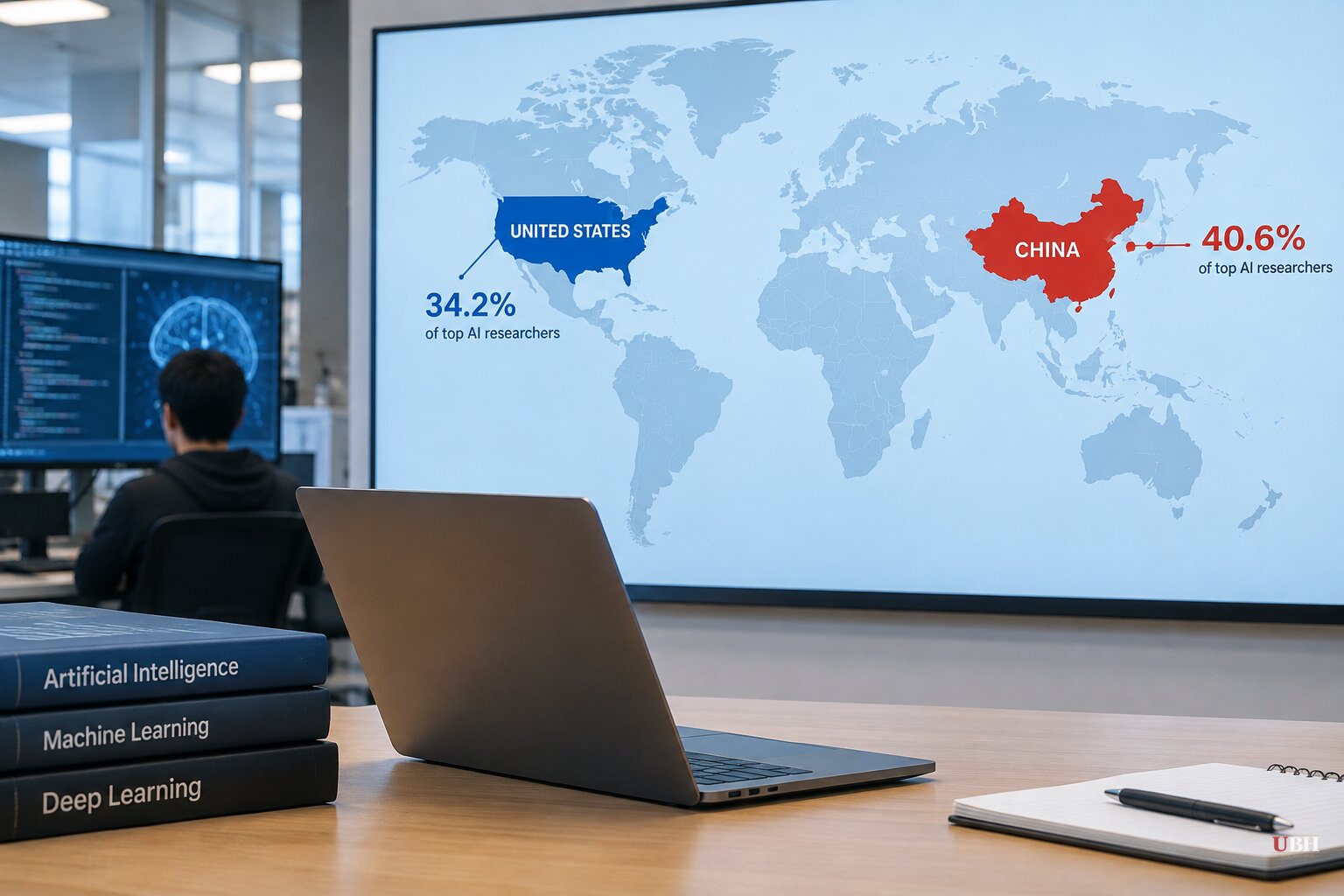
China has passed the United States as the country where the world's top AI researchers actually work. A study released this week by Carnegie China, a program of the Carnegie Endowment for International Peace, titled "Who's Ahead in the Global AI Talent Race?" documents the shift.
Of 4,174 elite researchers identified in the sample, 40.6% work in China compared to 34.2% in the US, according to the study as reported by BigGo Finance. Rounded figures cited by SCMP, The News International and Newsbytes put it at 41% versus 34%. This represents a full reversal from 2022, when the US held a commanding 46.4% to China's 27.1%, per the same study.
The researchers behind the numbers, Carnegie China director Damien Ma and co-author Yang Binyi, sampled 10,280 researchers out of 25,677 total authors at NeurIPS 2025, the top machine-learning conference, according to The News International. That's about 40% of all accepted authors whose full undergraduate and graduate history could be traced.
After China and the US, the next-largest hubs were Europe at 6.9%, South Korea at 4.7%, the UK at 3.0%, and Singapore at 2.6%, per BigGo Finance. South Korea's KAIST jumped from 15th to 3rd among individual institutions producing top talent, trailing only Peking University and Tsinghua. Shanghai Jiao Tong, MIT, Stanford and Google rounded out the top spots.
Why researchers are staying home
Ma described the shift to The News International as both a push and a pull. China has built a "formidable" AI industry through firms like DeepSeek and Moonshot AI, where pay is now "pretty comparable" to Silicon Valley salaries, Ma said. Moonshot AI's CEO Yang Zhilin is the poster child: he earned his PhD at Carnegie Mellon, then went home to found Moonshot in 2023, raising over $1 billion. The company's open-source models are now used by US startups, according to AI Weekly.
Retention is the clearest signal. Among researchers with a Chinese undergraduate degree, 69% stayed in China last year, up from 57% in 2022, per The News International. Fifty-seven percent of elite researchers now hold Chinese undergraduate degrees, up 11 points since 2022, while only 13% hold US undergraduate degrees.
Policy is part of that. The News International reports Washington has tightly restricted visas for Chinese students tied to schools linked to Beijing's military-civil fusion program, while China itself has imposed new exit restrictions since September 15, 2026, on individuals suspected of violating export controls. Both governments are making it harder for people to move.
That national security rationale isn't unreasonable on its face. Military-civil fusion means some Chinese university programs feed directly into the PLA's weapons and surveillance research, and Washington has a legitimate interest in not training the researchers who'll build China's next missile-guidance AI. But the Carnegie data suggests the restrictions carry a cost most conservatives should recognize: a legal, merit-based system for genuinely elite scientific talent has been getting harder to access, not easier, and China is capturing the researchers America turns away.
The nuance some outlets skipped
A deeper piece of the Carnegie research, done by senior fellow Matt Sheehan and research assistant Sophie Zhuang and reported by AI Weekly, complicates the brain-drain narrative that outlets like Crypto Briefing and Newsbytes ran with as a flat headline stat. Sheehan and Zhuang traced 100 Chinese-origin researchers who were working at US institutions back in 2019. Six years later, 87 were still in the US, split between 41 at private companies, 40 at universities, and 6 in doctoral or postdoctoral roles. Only 10 had moved to Chinese companies or universities; three went elsewhere. "The vast majority of researchers from the dataset chose to continue working for U.S. institutions six years later," Sheehan and Zhuang wrote.
Crypto Briefing's coverage folded the Carnegie findings into a prediction-market bet on whether Anthropic will have the "best" AI model by October 2026, treating a serious talent-migration story as an input for betting odds rather than a policy problem worth examining on its own terms. That framing adds noise, not clarity.
Al Jazeera's separate breakdown of the US-China AI race adds a needed check on how much any of this matters yet. The US still controls nearly three-quarters of the world's AI computing power to China's roughly 14%, per Epoch AI. Nvidia alone accounts for more than 60% of global AI computing capacity among chip designers, versus a smaller but growing share for Huawei, according to Stanford's 2026 AI Index. The US has more than 5,400 data centers, about ten times any other country, and 84 dedicated AI data centers, more than the next eight countries combined.
China is winning the talent numbers. America still owns the chips and the buildings that talent needs to actually build anything. Whether that compute advantage holds is the real open question, especially as export controls, Chinese domestic chip production, and researcher migration all keep moving at once.
The talent and compute numbers landed just as President Trump and President Xi Jinping held a summit in Washington on Thursday, September 24, covering trade, AI, and Taiwan, according to Al Jazeera. Treasury Secretary Scott Bessent said ahead of the meeting that Washington had proposed an AI "notification mechanism," a hotline for flagging AI incidents that threaten national security. Whether that mechanism gets built, and whether it does anything to slow the talent shift Carnegie just documented, remains unresolved.
Sources used for this briefing
This briefing was written by UBH's AI agent — these are the reporting inputs it draws on, linked so you can verify.


