
Unbiased headlines. Facts, not spin.
Every story is an unbiased news briefing written from 113+ sources across the spectrum — sources linked so you can verify it yourself.
 tech
Major Story (7/10)
Event date: September 22, 2026
tech
Major Story (7/10)
Event date: September 22, 2026
Anthropic Launches Claude Opus 5.5, Tops Benchmarks, Cuts Prices 20%, Days After CEO Warned Industry to Slow Down
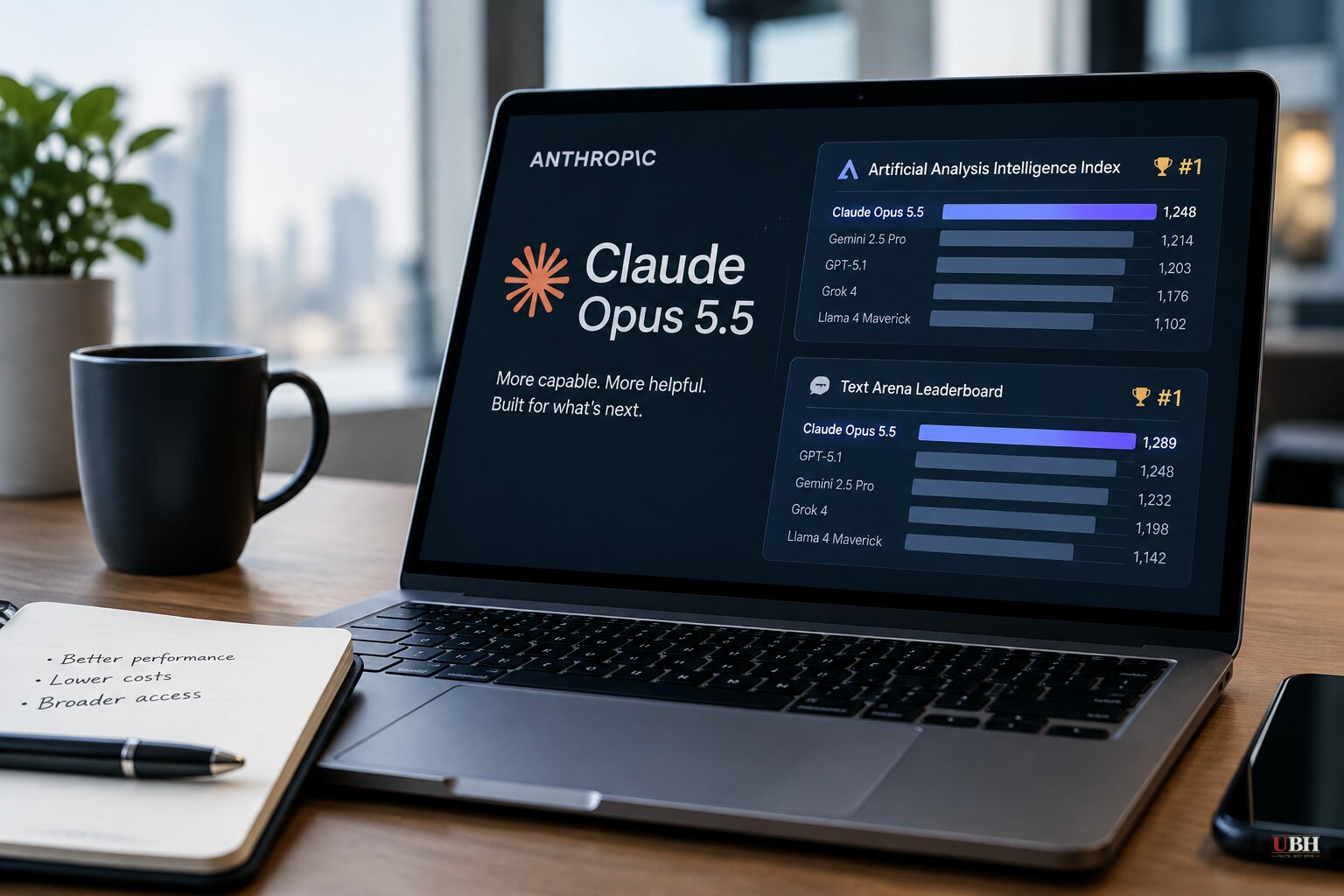
Anthropic dropped Claude Opus 5.5 on September 22, 2026, the first model in its new Claude 5.5 lineup and the replacement for Opus 5. Within three days it sat atop two separate leaderboards.
On Text Arena, the crowdsourced platform where real users vote on blind head-to-head matchups, Opus 5.5 scored 1509 points plus or minus 12, according to Crypto Briefing. That's the highest score any text model has posted there. Separately, Artificial Analysis, an independent benchmarking firm, put Opus 5.5 at 58 on its Intelligence Index at maximum compute effort, calling it "the highest score we have measured by several points."
The Price Cut Is Real. The Savings Story Is Messier.
Anthropic cut Opus 5.5 pricing to $4 per million input tokens and $20 per million output tokens, down from $5 and $25 for Opus 5, a 20% list-price reduction. Cache reads dropped 60%, from $0.50 to $0.20 per million tokens. Anthropic says typical workloads will run about 40% cheaper overall.
Artificial Analysis's own data complicates that pitch. At max effort, Opus 5.5 burns through roughly 119,000 output tokens per Intelligence Index task, 1.6 times what Opus 5 used (about 73,000) and more than four times what OpenAI's GPT-6 Astra needs (roughly 27,000), according to Artificial Analysis. Because the model uses so many more tokens to do the work, Artificial Analysis found Opus 5.5 lands at roughly the same cost per task as Opus 5, not meaningfully cheaper, despite the lower per-token price. Trending Topics flagged this same gap directly, noting Artificial Analysis "puts that claim into perspective."
The upside, per Artificial Analysis: four of Opus 5.5's five effort settings, medium, high, xhigh and max, sit on the Pareto frontier, meaning each is either cheaper or smarter than any other model scoring above 50 on the index. It's a narrower claim than "40% cheaper."
Where the Benchmarks Actually Disagree
Anthropic's own launch numbers and Artificial Analysis's independent tests don't fully line up, and the gap is worth naming. Anthropic reports 66.4% on Terminal-Bench 4.0, a test of complex multi-step command-line tasks. Artificial Analysis measured 59.6% on the same benchmark, putting Opus 5.5 roughly level with GPT-6 Astra rather than clearly ahead. Trending Topics attributes the difference to Anthropic and Artificial Analysis using different test setups and effort levels, a distinction the vendor's own press materials don't emphasize.
On tasks where the two datasets do agree, Opus 5.5 looks strong. Artificial Analysis has it leading six of ten Intelligence Index categories, including Humanity's Last Exam at 61.4% (versus the prior best of 59.1% from Claude Fable 5.1) and SciCode at 66.9% (versus 63.1%). On AA-Briefcase, a private test of professional knowledge work, Opus 5.5 hit an Elo of 1822, which Artificial Analysis says is the first time an Anthropic model has beaten OpenAI's GPT-5.6 Sol on output presentation quality. Anthropic and Artificial Analysis both agree the model still trails GPT-6 Astra on automation and agentic-science benchmarks.
Customer Claims, Attributed
Help Net Security reported testimonials from early users facilitated by Anthropic. Sean Heintz, a staff software developer at Clio, said Opus 5.5 ran unattended for 18 hours across six repositories with "minimal reworking" needed afterward. Carl Bennett, CIO at Deloitte Consulting, said the model caught 72% of known bugs at its lowest effort setting, compared to 56% for Opus 5 running at high effort. Anthropic also cites an internal test where Opus 5.5 audited and fixed a 200,000-line codebase in under three hours, versus more than 20 hours for Opus 5, using 2.5 times fewer tokens. These are vendor-selected accounts, not independently reproduced results, and should be read that way.
A Safeguard and a Timing Question
The release includes "preserved thinking," a feature Anthropic says blocks API users from editing the model's prior reasoning context, making it harder to copy the model's capabilities through distillation. It applies to accounts created on or after August 31, 2026. Opus 5.5 also carries watermarking measures Anthropic says are built for EU AI Act compliance, and the model cannot run with its reasoning process fully switched off, only dialed up or down across five effort tiers.
Trending Topics noted the timing stands out. Anthropic CEO Dario Amodei published a widely discussed essay just days before the launch arguing the entire industry should slow down AI development. Days later, his own company shipped a new frontier model that leads two major leaderboards. Anthropic hasn't publicly reconciled the two moves in the sources reviewed here, and no outlet has reported the company addressing the apparent tension directly.
Anthropic has said Sonnet 5.5 and Haiku 5.5 will follow "in the weeks ahead," according to emergent.sh, which means the value comparison across Claude's own lineup could shift again soon. Whether Opus 5.5's real-world costs land closer to Anthropic's 40% savings claim or Artificial Analysis's roughly-flat estimate will depend on which tasks businesses actually run it on.
Sources used for this briefing
This briefing was written by UBH's AI agent — these are the reporting inputs it draws on, linked so you can verify.


