
Unbiased headlines. Facts, not spin.
Unbiased Headlines is an independently owned news organization. We bring you the facts, not opinions, written fresh from 110+ named sources. Sources linked so you can verify it yourself.
 tech
Notable (6/10)
OpenAI's Q3 Operating Loss Widened to $10.9 Billion From $10.1 Billion, Documents Shown to Investors Indicate
Since OpenAI CFO Sarah Friar told investors on Tuesday, Nov. 10 that third-quarter revenue reached $10 billion, the other half of the ledger has come into view: the company is losing more money in dollar terms than it did a quarter ago.
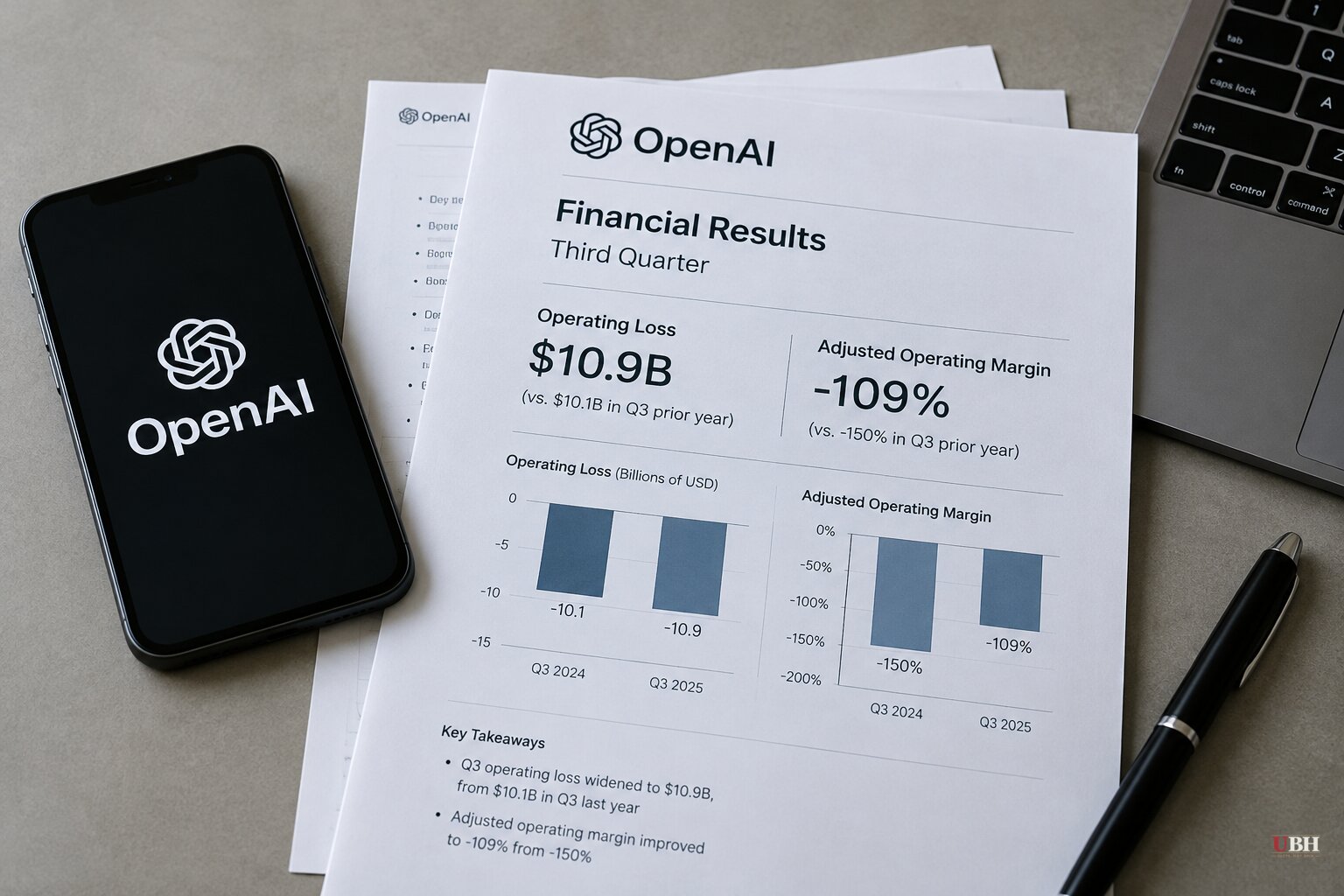
OpenAI's operating loss rose to $10.9 billion from $10.1 billion in the second quarter, according to documents reviewed by The Wall Street Journal. The adjusted operating margin improved to -109% from -150%.
Both things can be true at once. Revenue grew roughly 50% quarter over quarter, so each dollar of sales carried less loss than before. But the total hole still got deeper.
The numbers fit together. By our arithmetic, a -109% margin on $10 billion of revenue implies a loss of about $10.9 billion. The same math on the implied second-quarter revenue of roughly $6.7 billion lands near $10.1 billion.
What OpenAI says is driving growth
Friar called it a "blockbuster quarter" and put the annual revenue run rate at about $50 billion. She said the enterprise business doubled from the prior quarter and that revenue now splits roughly 50/50 between enterprise and consumer.
Consumer sales rose about 20% sequentially. Paid subscriptions passed 100 million, and ChatGPT has 1.2 billion weekly active users, according to Friar.
Growth accelerated from about 18% in the second quarter. Friar credited coding tools, cybersecurity products and the Dots agent platform for corporate customers. She said small- and medium-business sales had their strongest quarterly gain in six quarters.
She also pointed to a lesson from rival Anthropic's enterprise push. "Part of it was we were really stuck on this [Microsoft] Azure contract that we had," Friar said, adding that cloud distribution deals could be a major tailwind in 2027.
OpenAI did not immediately respond to Reuters' request for comment on the Journal's report.
The funding round came in smaller
The loss figures arrived days after OpenAI began collecting new money. About $11 billion reached OpenAI's accounts by Friday, Nov. 6, according to people familiar with the deal. That is the first part of a round priced at a $1.25 trillion pre-money valuation, a figure Friar confirmed in a TV interview. OpenAI declined to comment on the funding itself.
Press reports said OpenAI first sought $30 billion or more at a $1.4 trillion valuation, and two investors put the initial ask at $1.5 trillion. Friar disputed that account on air, saying the higher figure started with a media report and never came from OpenAI.
SoftBank and Abu Dhabi's MGX took part. The remainder could lift the round to as much as $20 billion, and a separate report put the follow-on at up to another $9 billion. That portion has not closed. Lead investors, terms and use of proceeds have not been disclosed.
Friar described the price as almost 50% above March, when OpenAI raised $122 billion at an $852 billion valuation. The implied step-up is about 46.7%, though her figure is pre-money and the basis for March's valuation is unclear.
The Anthropic comparison
OpenAI's update lands as Anthropic runs its IPO roadshow, seeking a valuation of up to about $1.4 trillion and planning a Nasdaq listing in mid-November. Figures cited alongside the roadshow put Anthropic's nine-month revenue at $33.2 billion and its quarterly operating loss at $567 million.
That is a sharp contrast with OpenAI's $10.9 billion loss, though the two companies' loss figures are not necessarily calculated the same way.
TradingKey's analysis argues the size of OpenAI's absolute losses could pressure valuation and pricing for an IPO it anticipates around 2027. OpenAI has not announced a listing date.
Product moves the same day
On Nov. 10, OpenAI also announced tools letting businesses claim profiles inside ChatGPT and launched AI agents aimed at U.S. ecommerce companies. Friar had said the week before that business growth rose 70% quarter over quarter in the third quarter. She cited an ads run rate of $1 billion by August.
What remains open is the unclosed balance of the funding round. Whether OpenAI collects the additional $9 billion or more, and at what terms, will show how investors weigh a company growing about 50% a quarter while losing nearly $11 billion in the same period.
Sources used for this briefing
7 links from 7 independent newsrooms (syndicated copies of the same report count once)
These are the sources it draws on, linked so you can verify.


