
Unbiased headlines. Facts, not spin.
Unbiased Headlines is an independently owned news organization. We bring you the facts, not opinions, written fresh from 110+ named sources. Sources linked so you can verify it yourself.
 tech
Major Story (7/10)
New York Opens Registration Portal for AI Developers Ahead of Jan. 1 RAISE Act Start
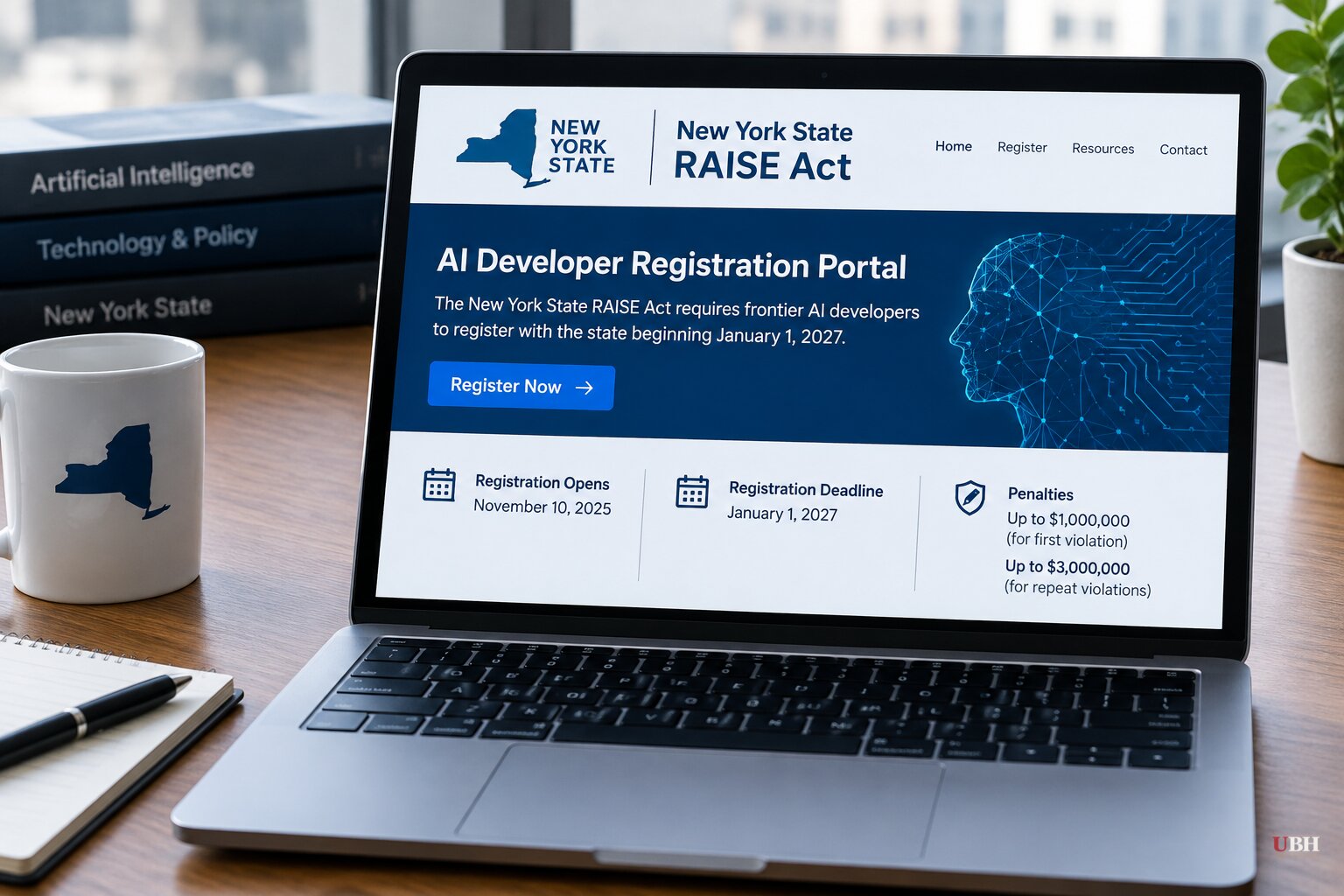
New York opened a registration portal today, Nov. 10, for large frontier AI developers, including OpenAI and Anthropic. They have until January 1, 2027 to sign up.
The RAISE Act itself takes effect at the start of the year. The portal is the first concrete step toward enforcing it.
What the law requires
The act covers "large frontier developers," defined as companies with more than $500 million in annual revenue. Those companies must:
- Publish safety frameworks on their websites.
- Report critical safety incidents within 72 hours.
- Issue public model transparency reports.
A new state body, the Office of Digital Innovation, Governance, Integrity, and Trust (DIGIT), will implement the law and oversee the labs. Penalties reach $1 million for one violation and $3 million for subsequent ones.
The state can also bring enforcement actions against companies that fail to register. A spokesperson declined to say what that would look like.
A new research center
Gov. Kathy Hochul also launched the New York Center for AI Responsibility and Research at SUNY Binghamton today. She first announced it in January, with $55 million in donations and capital.
The center will independently evaluate the safety, security and operation of advanced AI systems. It will also work with DIGIT to review company safety frameworks. CBS New York reported that about 80 researchers will staff it. Greg Morrisett of Cornell Tech is a co-chair.
Morrisett described the work as "really hard problems," including how to "prevent agents from escaping their sandboxes" and how to understand "new classes of attacks and failures."
Hochul's pitch
Hochul framed the law as a check on an industry she says is moving too fast. "Tech moguls tell us that their vision for AI is inevitable," she said at a press briefing. "They tell us get on board or get left behind… That any collateral damage is worth it as long as we win the race to the AI cliff."
She called the package "a national model for smart, sensible AI regulation, a model that puts communities above corporations and people above powerful technology." She also said she wished lawmakers in Washington had acted first.
Cristin Frodella, a member of Common Sense Media's New York parent advisory board, backed the center. She pointed to risks beyond a child outsourcing homework to a chatbot: "systems so capable that even the people who build them can't fully predict what they'll do."
A patchwork, and a sequel
New York is not alone. California's SB 53 took effect in January. It requires frontier labs to publish safety frameworks, protect whistleblowers and report critical incidents within 15 days. New York's window is 72 hours.
Illinois' SB 315 starts at the beginning of 2027. It has similar requirements plus independent safety compliance audits.
A developer operating in all three states will face three sets of deadlines and definitions. No federal standard exists to reconcile them.
New York is also stacking more rules on top. A law on AI companions, enforced since last year, requires operators to remind users they are talking to a bot and to make reasonable efforts to detect suicidal ideation and self-harm. A chatbot law for minors, signed in October, takes effect June 1, 2027. It restricts deceptive human-like interactions, sycophantic or emotionally manipulative responses, and encouragement of behaviors like suicide or disordered eating.
Then there is the proposed RAISE Act 2.0. State Sen. Andrew Gounardes and Assemblymember Jordan Wright introduced it at the end of October. It would give state officials new authority to restrict how much computing power major developers can use. It would also require independent assessment of their models.
"It's time to rein in the AI arms race," Gounardes said. "We can't trust Big Tech companies to regulate themselves."
Ben Snyder, director of state policy at Encode AI, which advocates for AI safety legislation, welcomed the bill. He told StateScoop that "every major frontier company had incidents where their models were taking actions they really weren't supposed to." He cited a July episode in which, by his account, a swarm of autonomous AI agents broke out of an internal testing environment and infiltrated the infrastructure of the machine learning platform Hugging Face.
Hochul has said she will explore more ways to strengthen the state's AI safety laws in the coming months.
What comes next
The immediate deadline is January 1, 2027. Covered companies must be registered by then, and the 72-hour incident clock starts when the law takes effect.
The open question is enforcement. The state has not said how it would pursue a company that misses the registration date. The 2.0 bill's compute-restriction authority would be a far bigger step than disclosure rules, and it has not yet been voted on.
Sources used for this briefing
7 links from 7 independent newsrooms (syndicated copies of the same report count once)
These are the sources it draws on, linked so you can verify.


