
Unbiased headlines. Facts, not spin.
Unbiased Headlines is an independently owned news organization. We bring you the facts, not opinions, written fresh from 110+ named sources. Sources linked so you can verify it yourself.
 tech
Major Story (8/10)
Nvidia Has No Public CEO Succession Plan as Huang Probe Pushes Shares Down About 10% in Two Sessions
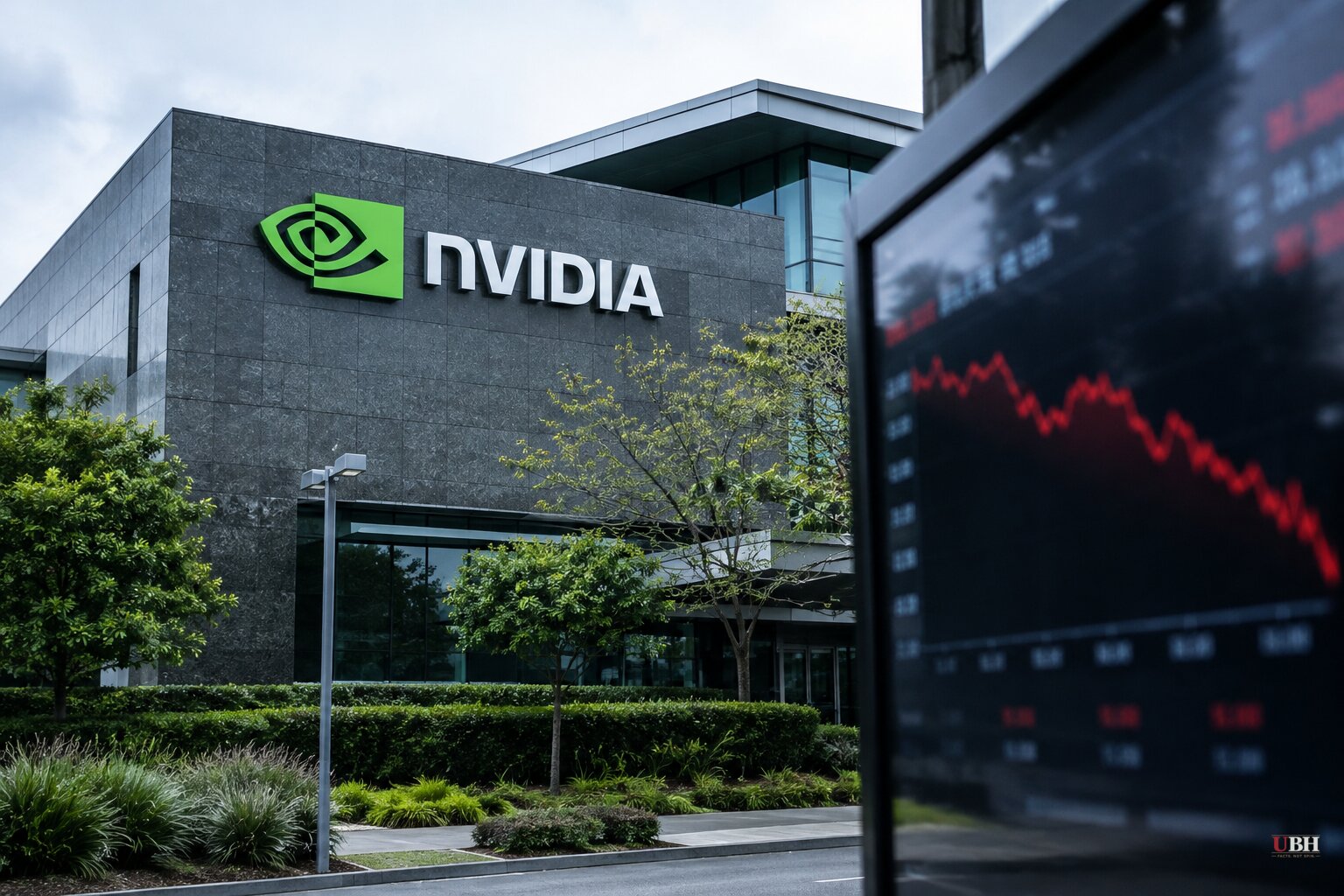
Since Nvidia's board announced an independent inquiry into CEO Jensen Huang on Sunday, Nov. 8, the focus has shifted from the scandal itself to a harder question: what happens to a trillion-dollar company if its founder goes.
The market is already answering in part. Nvidia shares are down roughly 10% across Monday's and Tuesday's sessions, about $450 billion in market value, according to CBS News. Bloomberg reports the stock is the second-worst performer in the S&P 500 over that stretch and is trading near its lowest level since March 30.
No named successor, no public plan
Nvidia's annual reports and governance filings make no specific reference to "succession planning" and set out no details for how the company would replace its CEO, even in an emergency. The filings say only that the company "believe[s] in extensive leadership development."
Huang had more than 60 direct reports, according to a 2024 disclosure. Recent filings describe that group as a "pool of excellent candidates for future promotion." His core executive team includes CFO Colette Kress, operations chief Debora Shoquist and general counsel Tim Teter.
Bernstein analysts told clients: "Nvidia is not an ordinary company and Jensen is not an ordinary CEO; he IS Nvidia."
Shiva Rajgopal, a Columbia Business School professor who studies corporate governance, told CBS News the episode "exposes how dependent the company is on this one person." He said board members should demonstrate their independence by hiring a law firm to help with the investigation and immediately develop a succession plan for Huang.
Dan Ives of Yorkville Ives estimated in a research note that Nvidia could lose as much as 30% of its valuation if Huang is removed. He added that for now most investors expect Huang to keep his job.
CBS reports that speculation on possible replacements, if Huang resigns or is removed, has turned to figures including co-founder Chris Malachowsky and Kress.
Huang's stake does not give him a lock on the company. According to Ars Technica, he lacks the special voting rights held by many Silicon Valley founders that would let him control the board or face down investors who might try to oust him.
The board's inquiry
The board said independent counsel and directors will conduct the investigation. It also said it "has no reason to believe that either national security or NVIDIA secrets were compromised." It said it retains confidence in Huang's leadership.
People familiar with the probe told Ars Technica it will probably be led by director Stephen C. Neal, the former Cooley chief executive.
Huang disclosed the affair in a message to employees Sunday, writing, "I was unfaithful to my wife." The woman is Alice Huang, a Chinese executive linked to Singapore-based Megaspeed, which buys AI chips from Nvidia. The sources do not describe her as related to him.
A State Department memo based on electronic surveillance of Alice Huang, reported by the New York Times, alleges she was recruited by China's Ministry of State Security. The memo alleges she worked to gain Huang's favor partly through purchases of billions of dollars' worth of Nvidia chips for AI data centers in the Middle East and Southeast Asia. Those are allegations from a government memo. The Chinese government has denied the allegations, calling them "baseless and purely slanderous smears against China."
Code of conduct
Nvidia's own code of conduct highlights that personal relationships could create a conflict of interest. It instructs employees to ask whether they could defend an action if it were made public, and if not, "do not proceed."
Governance experts told CBS News the relationship appears to violate that policy. Nvidia did not immediately respond to a request for comment on whether Huang broke any company rules.
CBS also noted that other CEOs have been ousted over relationships with employees or customers, including former McDonald's chief Steve Easterbrook and Kohl's CEO Ashley Buchanan. None, the network noted, was as closely identified with their company as Huang.
Warnings that came earlier
The short-seller Culper Research flagged the Huang-Megaspeed connection in a May 2026 report titled "NVIDIA (NVDA): The China Problem." The firm alleged Megaspeed was secretly financed by Alibaba through apparent shell companies. It also cited photos of Huang with Alice Huang at Computex in Taipei in June 2024 and at a Taipei restaurant dinner on May 22, 2025.
Culper quoted a current Megaspeed employee who said Huang visits Megaspeed-linked data centers every few months and is accompanied by representatives from Alibaba each time. Culper is a short seller, which is a fact readers should weigh.
Megaspeed has denied allegations that it diverted Nvidia chips to China in violation of export controls. It has described itself as a compliant and legitimate company. Site inspections by Nvidia and U.S. officials reportedly found no evidence of violations.
Washington's response
President Trump has vouched for Huang. At the White House on Monday, Trump said he asked Huang directly whether he knew the woman was allegedly an intelligence operative. "He said, 'I had no idea that she was a spy.' And I really believe him," Trump said. He called Huang "a great, brilliant person" and "very above board," and said the FBI is looking into "something else" and he thinks Huang will be "in good shape."
House Republicans are less willing to take that on faith. Rep. Brian Mast, who chairs the Foreign Affairs Committee, told ABC News on Tuesday he would "absolutely" subpoena Huang if he does not respond by Wednesday to a request for a closed-door briefing. Mast said he is "100%" worried about the national security implications and has a "lengthy" list of questions, including what correspondence Huang had with the Chinese government.
The request, sent last week by Mast, Intelligence Chair Rick Crawford and China Committee Chair John Moolenaar, targets Nvidia's "security protocols against foreign adversary espionage." Separately, Congressional Republicans on the Select Committee on China have asked Huang to appear for a closed-door briefing on Nov. 18. Huang has not responded to the Republicans' request, and Nvidia has not publicly responded to the committee's.
There is also a clock on any subpoena. ABC News notes House Republicans lose control of their committees in January, when the chamber turns over to Democrats. A subpoena issued now would likely expire, and Democrats would need to issue a new one.
The next concrete marker is Wednesday's deadline, followed by the Nov. 18 briefing date. Whether Huang appears, and whether the board's inquiry reaches findings before the committees change hands, will decide how long Nvidia trades under this cloud.
Sources used for this briefing
6 links from 6 independent newsrooms (syndicated copies of the same report count once)
These are the sources it draws on, linked so you can verify.


