
Unbiased headlines. Facts, not spin.
Unbiased Headlines is an independently owned news organization. We bring you the facts, not opinions, written fresh from 110+ named sources. Sources linked so you can verify it yourself.
 tech
Major Story (8/10)
N-able Pulls Hosted N-central Offline Worldwide After Researcher Publishes 33 Alleged Zero-Days
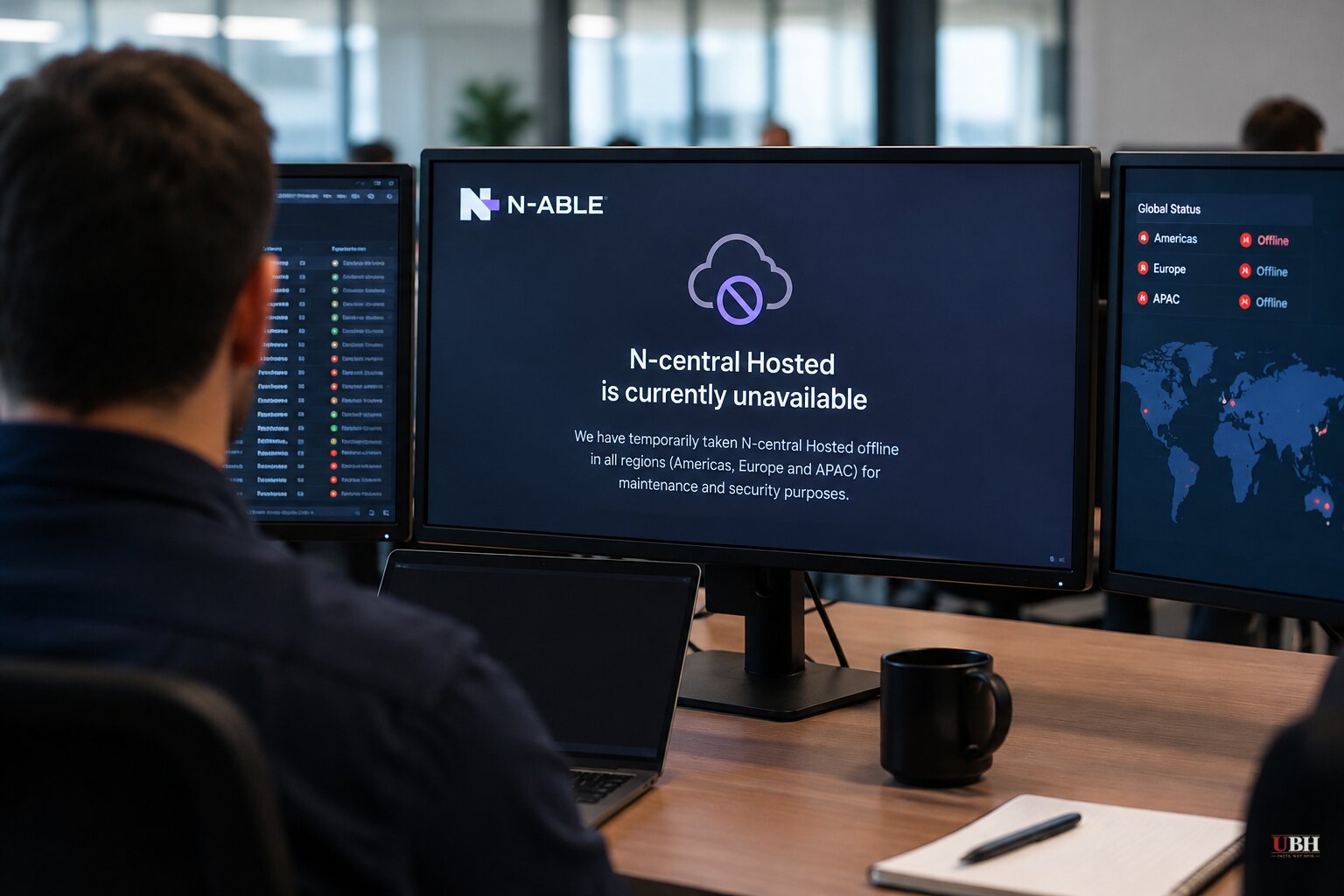
N-able has taken its hosted N-central remote management platform offline in the Americas, Europe and Asia-Pacific. It has also told customers who run N-central on their own servers to shut them down until further notice.
The trigger was a public data dump. Late Sunday, Nov. 8, a security researcher identified as Sean Bales posted a GitHub repository called Able2Shell. It contains write-ups and working proof-of-concept exploits for 33 alleged zero-day flaws in N-central. The repository sits under a GitHub account named Oracle-Security.
N-able declared a critical security incident. It says it is building a hotfix and has not given a date for N-central's return.
What the researcher published
N-central is a remote monitoring and management (RMM) platform. Managed service providers and corporate IT teams use it to patch devices, run scripts and administer customer networks from one console. A compromised server therefore sits on top of every system it manages.
The published flaws include authentication bypasses, credential disclosure, arbitrary file writes, directory traversal, cross-site scripting (XSS), XML external entity (XXE) injection and remote code execution. Security firm Huntress says the 33 issues combine into four exploit chains. Three end in remote code execution and one escalates privileges to root.
Bales told BleepingComputer the most critical chain starts with an unauthenticated XXE flaw in N-central's service-import function. From there an attacker can steal a trusted local session, reset an account password and run commands as the "nable" user. The same chain can create an enabled Default Administrator account with attacker-chosen credentials. Bales posted a video showing the sequence working.
Two other exploits stand out. A stored XSS bug runs commands as root when an administrator views malicious patch metadata. A separate privilege-escalation flaw lets code running as the "nable" user execute commands as root.
Bales says he tested against N-central Appliance 2026.4.0.31, a pre-release build, and believes most or all of the flaws affect earlier versions. He also confirmed to BleepingComputer that AI assistance played a part in finding them.
N-able's position
N-able says it has no evidence of successful exploitation in any customer environment. It does acknowledge "scanning activity associated with the published proof-of-concept code." The company called the disclosure "non-responsible communication of critical vulnerabilities" and described the shutdown as a precaution while it prepares a fix.
Bales has a different account of how it got here. He told BleepingComputer he went public because N-able allegedly failed to patch flaws he had reported in a different product. N-able has not publicly responded to that claim.
The company's cautious stance has a plausible rationale on its face. Working exploit code was public and no patch existed, so pulling the hosted service removed its own customers' exposure while the fix was built. N-able's hosted Ecoverse services under N-able Login, including Asset View, Patching and Vulnerability Management, remain online.
Exploitation attempts
The "no exploitation" statement has limits. Exposure-management firm watchTowr said it observed exploitation attempts against N-central honeypots overnight after the exploits dropped. Honeypots are decoy systems, so that is not evidence of a compromised customer. It does show attackers are trying the code.
TechCrunch asked N-able whether it has the ability to check for compromise, such as through server logs, or has no way to check. The company did not respond.
Censys noted that as of Nov. 9, N-able had not published an affected-version list, fixed versions, CVE identifiers or severity scores for the new issues. The exact scope remains unconfirmed. BleepingComputer has not independently verified all 33 claims. N-able's decision to build a hotfix and shut down its own hosted service supports the view that at least some are real.
A rough year for N-central
This is not the platform's first emergency in 2026. In July and August, attackers exploited an authentication-bypass flaw, CVE-2026-18577, to gain administrative access to N-central deployments. They then pivoted to managed systems through the platform's built-in remote management feature.
In September, N-able patched CVE-2026-86206 and CVE-2026-86207. It then issued a hotfix for CVE-2026-86218, a pre-authentication remote code execution bug that was actively exploited. Huntress saw attackers use compromised N-central servers to push unauthorized scripts and tools into downstream customer environments. Those earlier incidents are separate from Able2Shell.
The pattern in RMM tools is well documented. The software is trusted by everything it touches and runs with high privileges. That is exactly why attackers go after it.
What comes next
N-able's current estimate is that the hotfix will land around midday on Tuesday, Nov. 10. Customers have been told not to bring on-premises servers back online until N-able confirms it is safe.
The open questions are concrete. N-able has not said how many customers are affected or whether it can verify that no one was compromised. It has also not said when hosted N-central will return, or which versions the hotfix will cover.
That last point matters for managed service providers. Many of them run their clients' patching and remote support through this console, and for now that console is dark.
Sources used for this briefing
8 links from 8 independent newsrooms (syndicated copies of the same report count once)
These are the sources it draws on, linked so you can verify.


