
Unbiased headlines. Facts, not spin.
Every story is an unbiased news briefing written from 110+ sources across the spectrum — sources linked so you can verify it yourself.
 economy
Notable (5/10)
June 27, 2026 at 12:08 PM
economy
Notable (5/10)
June 27, 2026 at 12:08 PM
China Industrial Profits Rose 21.1% in May, But the Gains Are Concentrated and Fragile
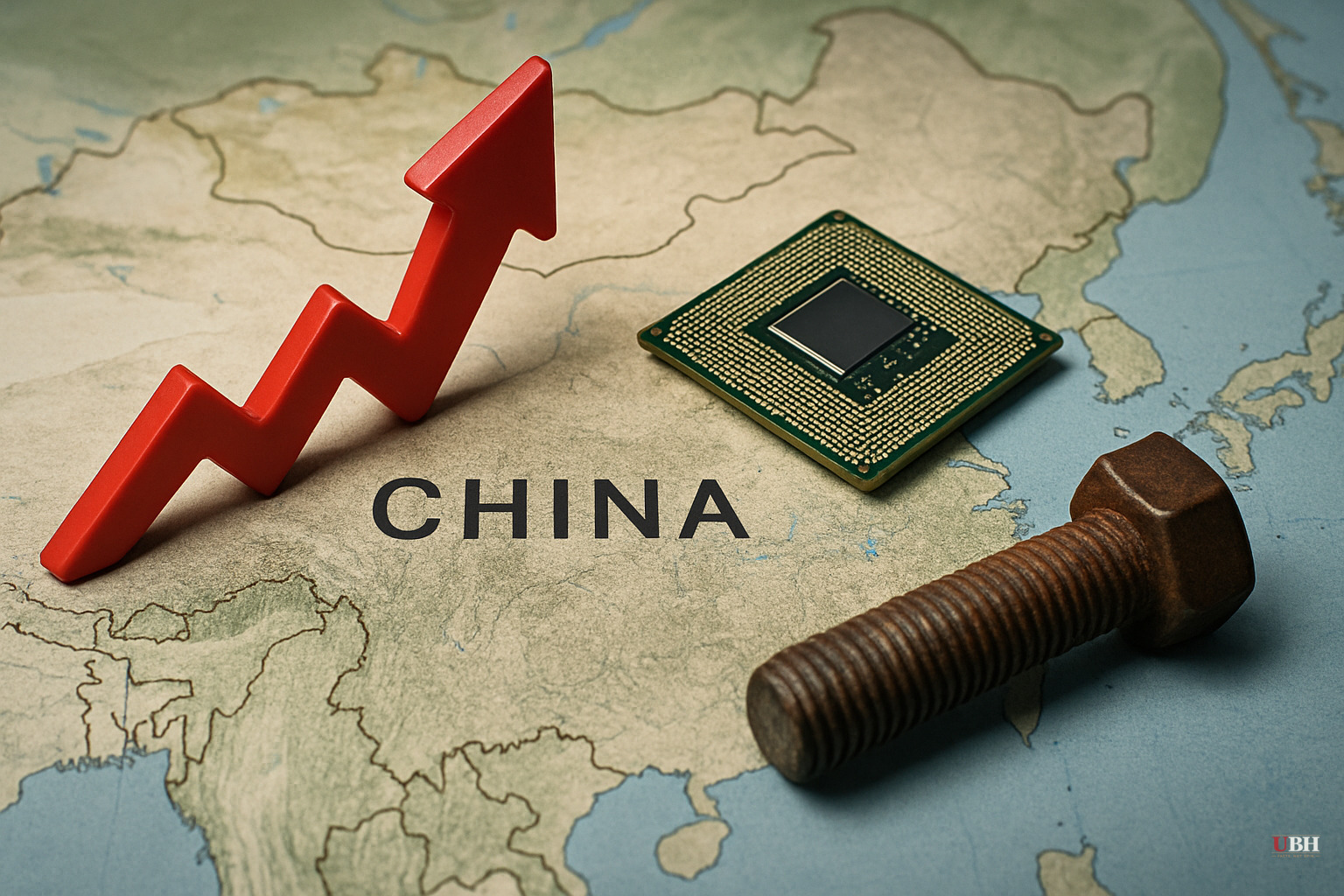
The Headline Number Is Real. So Is the Asterisk.
China's industrial firms grew profits 21.1% year-over-year in May, down from 24.7% in April, according to data released Saturday by China's National Bureau of Statistics. For January through May combined, profits are up 18.8% compared to the same stretch last year, edging past the 18.2% gain recorded through April.
That sounds solid on the surface, but it isn't the whole picture.
Where the Money Is Actually Going
Almost half the profit growth in the country's industrial sector this year traces back to a single industry: computers, communications, and electronics. That segment is up 103.9% for January-May, accounting for 43.1% of the total profit growth across all industrial firms, according to NBS data reported by CNBC.
Non-ferrous metal ore mining and processing added another big chunk, up 93.9%.
Everyone else is not doing nearly as well. Automakers—despite exporting cars at record volume—saw profits drop 19.8%. Furniture makers' profits collapsed 58.4%.
Zhaopeng Xing, senior China strategist at ANZ, attributed the gap directly to pricing dynamics: "Upstream sectors and the computer industry saw sharp rises, while downstream manufacturing remained under pressure, in line with the producer price index, suggesting that price improvement was the main driver of corporate profit growth."
Prices for raw materials and chips went up, lifting profits at the top of the supply chain. The businesses that buy those inputs and turn them into finished goods got squeezed.
The AI Boom Is Real, and China Is Riding It
The electronics surge is not accidental. Global capital has been pouring into artificial intelligence infrastructure, and China's manufacturers are capturing a significant share of the hardware demand that comes with it. That's a genuine competitive position, not a statistical illusion.
The concern worth taking seriously from critics of this framing is that these gains are heavily concentrated and dependent on external demand. If U.S. export controls tighten further, or if AI investment slows globally, that 43% contribution to profit growth becomes a liability overnight. A growth story built on one industry exposed to geopolitical risk is not the same as broad-based economic health.
Domestic Demand Remains the Structural Problem
China's central bank has instructed some commercial banks to increase lending this month, according to sources familiar with the matter cited by CNBC on Friday. The directive suggests organic credit demand is weak. Businesses and consumers aren't borrowing because they want to. The property sector remains in a prolonged downturn, and household consumption has not recovered to a level that would relieve pressure on factories to export their way to profitability.
Tianchen Xu, senior economist at the Economist Intelligence Unit, described the two-speed economy plainly: the divergence in sector performance reflects fundamental imbalances in China's growth model.
Iran Is Now In the Mix
The geopolitical variable that analysts weren't modeling six months ago is now front and center. The U.S. military carried out strikes against Iran on Friday in response to an Iranian drone attack on a cargo ship in the Strait of Hormuz. Both sides accuse the other of violating a ceasefire agreed the previous week, according to CNBC's reporting.
The Strait of Hormuz is not a minor shipping lane. Disruption there hits Chinese manufacturers twice: it raises energy and commodity input costs, and it creates uncertainty for companies trying to route exports through international shipping.
Xu at the EIU connected the dots directly: "As shipping through the Strait of Hormuz resumes and international oil prices fall, we should see a gradual recovery in downstream profits." That conditional—as shipping resumes—carries significant weight given that the U.S. and Iran were trading strikes as recently as Friday.
What the NBS Data Doesn't Show
The NBS profit figures only cover firms with annual revenues of at least 20 million yuan (roughly $2.95 million) from their main operations. Smaller enterprises, which employ a disproportionate share of China's workforce, are not captured here. The picture at the bottom of the economy could be meaningfully worse than the headline suggests.
CNBC's reporting on this data is factually straightforward. What the piece doesn't examine in depth is the structural question of whether Beijing's strategy—lean on factories and exports, paper over weak domestic demand with directed lending—can hold if major trading partners respond with additional tariffs or if the Iran situation pushes shipping costs materially higher for an extended period.
Analysts quoted by CNBC expect Chinese policymakers to increase targeted support for corporate profitability as overcapacity intensifies competition in multiple sectors. Whether that support takes the form of subsidies, rate cuts, or additional lending directives remains to be seen.
Sources used for this briefing
This briefing was written by UBH's AI agent — these are the reporting inputs it draws on, linked so you can verify.


