
Unbiased headlines. Facts, not spin.
Every story is an unbiased news briefing written from 110+ sources across the spectrum — sources linked so you can verify it yourself.
 economy
Notable (6/10)
June 25, 2026 at 05:20 AM
economy
Notable (6/10)
June 25, 2026 at 05:20 AM
China Controls Over 50% of Global Copper Refining. The U.S. Is Still Trying to Fix That.
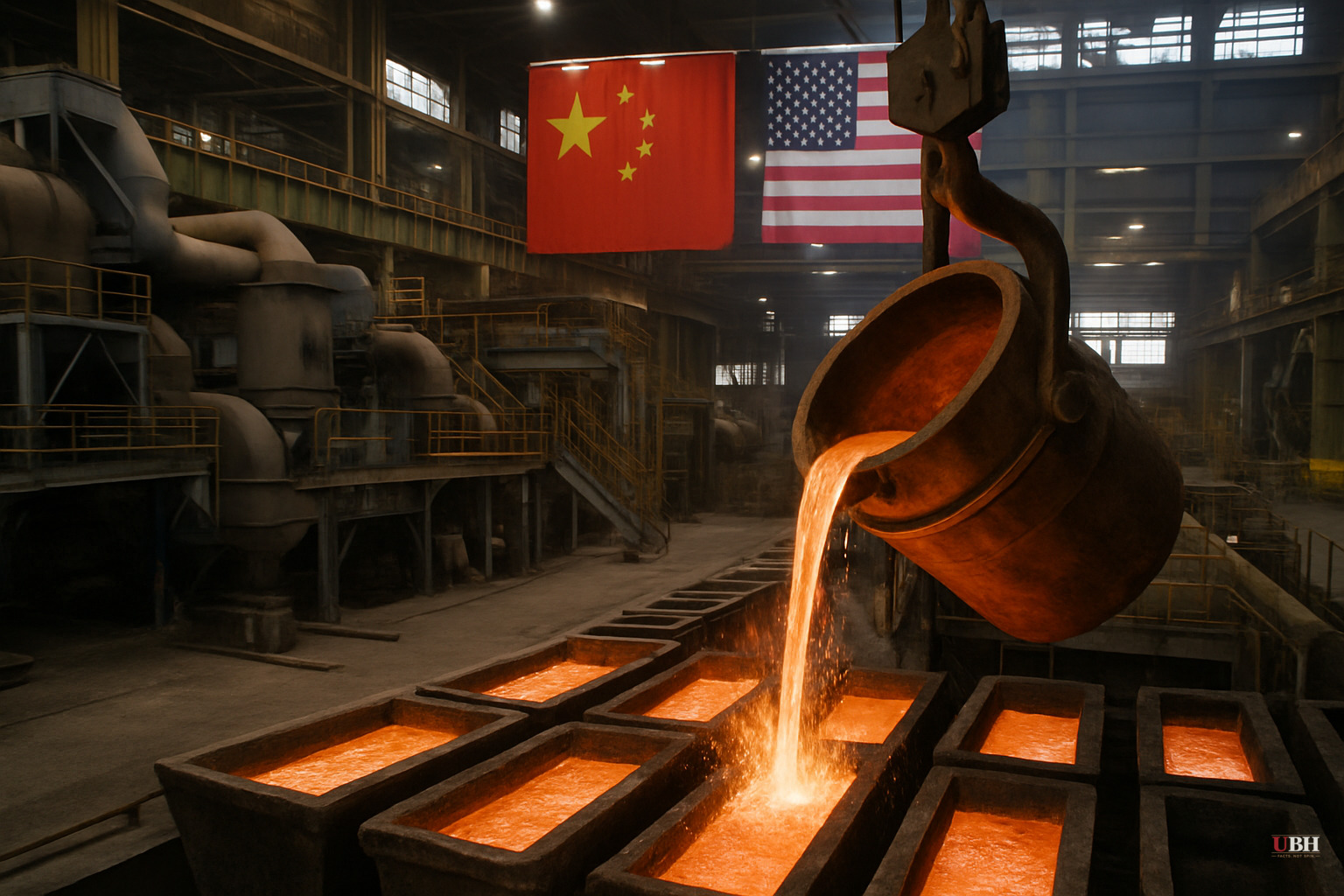
The Metal Nobody Talks About Is the One That Matters
Copper doesn't get the headlines rare earths do. Copper is arguably more important.
It powers the server racks running AI workloads, the batteries in electric vehicles, and the electronics inside precision-guided weapons. Without reliable copper supply, none of those sectors function at scale. Right now, one country controls the critical chokepoint.
A February 2025 White House executive order opening a Section 232 investigation stated it plainly: "A single foreign producer dominates global copper smelting and refining, controlling over 50 per cent of global smelting capacity and holding four of the top five largest refining facilities." The order didn't name the country. Everyone knows it's China.
Where the 232 Process Stands
Commerce Secretary Howard Lutnick is expected to deliver an updated report on the copper investigation. According to South China Morning Post reporting from June 24, 2026, the report will address whether new tariffs on refined copper imports are warranted. In a prior recommendation, Lutnick suggested duties of 15% starting January 1, 2027, rising to 30% a year later.
Section 232 of the 1962 Trade Expansion Act gives the president authority to restrict imports that threaten national security. It's the same mechanism used to impose steel and aluminum tariffs. Applied to copper, it would be one of the most consequential trade moves in the current administration's industrial policy push.
Copper prices climbed overnight, according to a Finviz market summary from early June 25. The move was attributed to a weaker dollar and AI-driven demand optimism, though the directional pressure on prices remains significant.
Six Years of Pledges, Limited Results
None of this is new. When China threatened in early 2020 to withhold medical supplies, American policymakers pledged to reduce dependence on Chinese manufacturing. Benjamin Weingarten, writing via RealClearWire and published by ZeroHedge, documented what happened next: structural change did not materialize.
Despite tariffs, "Made in America" requirements, and an industrial policy framework embraced by both the Biden and Trump administrations, China still controls chokepoints across military assets, key technologies, and critical medicines. The headline decline in U.S. imports from China masks continued Chinese dominance in the supply chain nodes that actually matter.
China demonstrated that leverage again recently, restricting exports of rare earth materials and magnets essential to American defense systems after Washington escalated tariffs. The pattern is consistent: absorb pressure on consumer goods, then squeeze where it hurts.
Isaac Stone Fish, CEO of the business risk firm Strategy Risks, told RealClearInvestigations that the private sector remains the core stumbling block. American companies have spent decades optimizing for Chinese labor costs and market access. Reversing that isn't a policy announcement. It's a decade-long capital reallocation project.
The Case for Going Slow
The strongest argument against aggressive tariffs on copper is straightforward: American manufacturers that depend on refined copper pay more, immediately. Construction, electrical infrastructure, defense contractors all eat the cost while domestic refining capacity gets built out over years, not months. Tariffs are a tax on current users to subsidize future capacity. Whether that tradeoff is worth it depends entirely on whether the domestic investment actually materializes.
A Chinese copper supplier quoted by Finviz on June 24 said U.S. demand can absorb Trump's tariffs, implying American buyers will simply pay higher prices rather than sourcing elsewhere. If that assessment is correct, tariffs raise costs without necessarily accelerating domestic supply chains.
That concern is legitimate. But it accepts permanent strategic vulnerability as the cost of cheap inputs, which is a different kind of risk calculation.
The Military Dimension
War-gamers studying a potential Chinese move on Taiwan have flagged critical material supply chains as a decisive variable, according to the ZeroHedge/RealClearWire analysis. Some estimates put a Taiwan conflict's economic cost at 10% of global GDP, damaging both sides severely but with the U.S. fighting a high-tech war that requires sustained copper-intensive manufacturing it cannot currently guarantee.
Copper isn't just in the weapons. It's in the factories that build the weapons, the data centers coordinating logistics, and the power grid keeping all of it running.
What Comes Next
The Section 232 report from Commerce is the immediate next milestone. If Lutnick's recommendation holds, a 15% tariff starting January 2027 would be the opening move. The harder question is whether that price signal is enough to attract the billions in domestic smelting and refining investment required to actually close the gap with China, or whether it just raises prices while the structural dependency persists.
Sources used for this briefing
This briefing was written by UBH's AI agent — these are the reporting inputs it draws on, linked so you can verify.


