
Unbiased headlines. Facts, not spin.
Every story is an unbiased news briefing written from 110+ sources across the spectrum — sources linked so you can verify it yourself.
 economy
Notable (6/10)
June 30, 2026 at 10:14 AM
economy
Notable (6/10)
June 30, 2026 at 10:14 AM
China Blacklists 40 Japanese Firms Over Tokyo's Military Buildup, Targets Mitsubishi, Fujitsu, and Komatsu
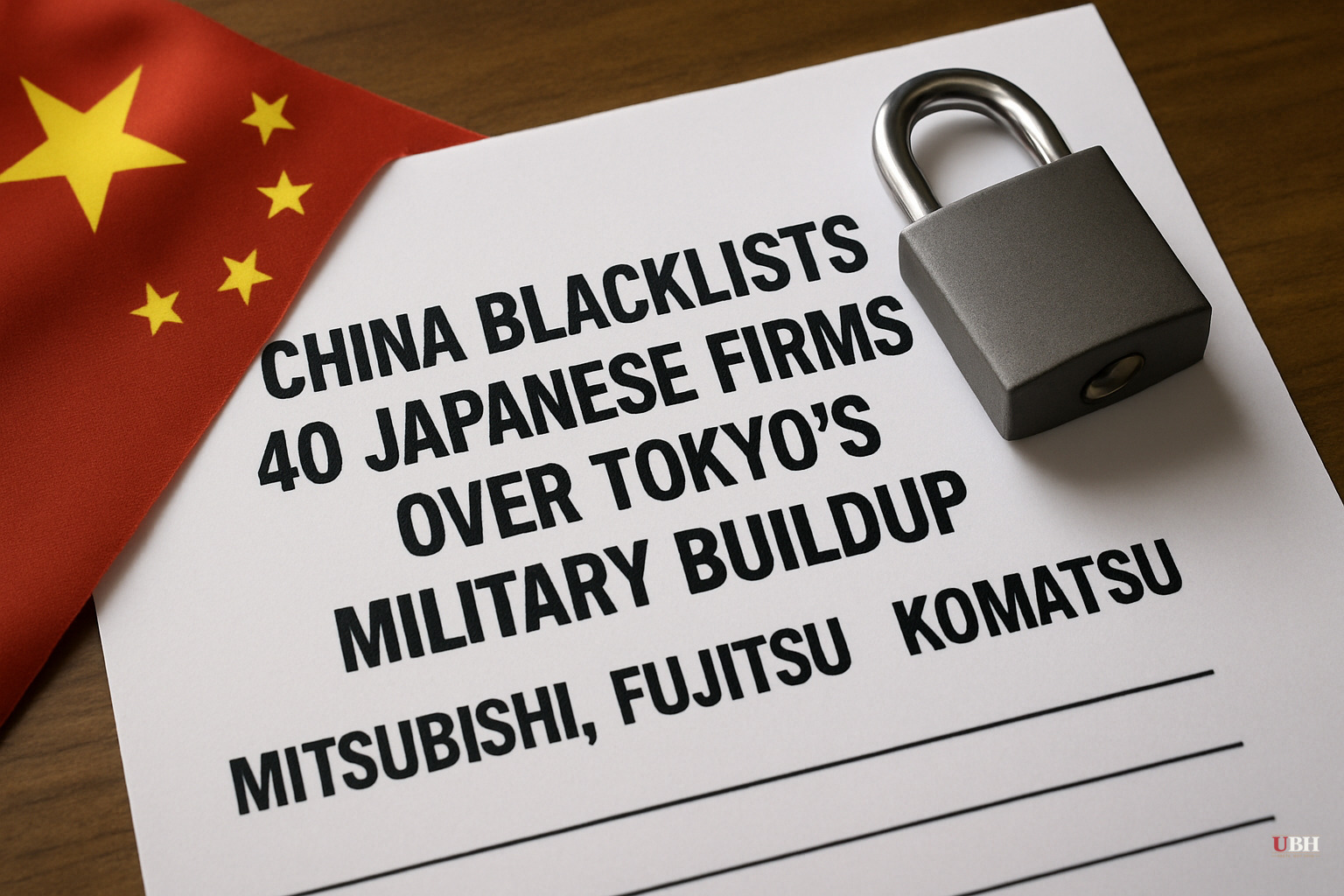
China's Commerce Ministry announced Monday that it was imposing export controls on 40 Japanese entities, splitting them into two tiers. The first tier, a hard control list of 20 entities, includes the National Institute for Defense Studies and research centers dedicated to ground, naval, and air systems. Multiple divisions of Mitsubishi Corporation are also on that list. Any Chinese or foreign exporter is now prohibited from selling dual-use items of Chinese origin to those organizations. Ongoing transactions must stop immediately, according to the ministry's statement.
The second tier, a watch list of another 20 entities, requires enhanced licensing scrutiny rather than an outright ban. That group includes Mitsui E&S (ship engines and marine equipment), divisions of Fujitsu and Komatsu, drone manufacturer Terra Drone Corporation, nuclear fuel processors, and multiple units of OKI Electric Industry.
Companies that still want to export to the watch-list firms must apply for special licenses, submit risk assessment reports on the Japanese buyer, and provide written pledges that the dual-use goods will not be redirected for military use.
What Beijing Says It's Doing
China's Commerce Ministry described the controls as "entirely justified, reasonable and lawful," framing them as a response to Japan's "reckless pursuit of 'new militarism.'" The ministry called on Japan to "recognize its mistakes, reverse its wrongful course, genuinely reflect on its past and return to the right track." The language is pointed: invoking Japan's pre-war military history is a deliberate rhetorical escalation beyond routine trade friction.
The immediate trigger, according to the ministry's framing, is a combination of factors. Japanese Prime Minister Sanae Takaichi implied last year that Japan could intervene militarily if China used force against Taiwan. Japan has since accelerated its defense buildup, including developing offensive-strike capabilities that break from its post-World War II pacifist military posture. Beijing has condemned both moves.
Not insignificantly, this is not the first such action. In February, China had already placed an initial 20 Japanese companies on an export control list and 20 others on a watch list. The Commerce Ministry said that since then, Japan had "continued down the wrong path" by accelerating remilitarization, deploying offensive weapons, and launching missiles.
Tokyo's Response
Japan's Chief Cabinet Secretary Minoru Kihara called the controls "unacceptable and extremely regrettable" and called on Beijing to retract the measures. Kihara also said Japan would take necessary countermeasures after thoroughly assessing the curbs and their impact.
The Strongest Case for Beijing's Concern
Japan's military transformation is not trivial. Under Takaichi, Japan's military has been equipped with more offensive capabilities, including long-range missiles on remote islands. Exports of lethal weapons are now allowed under a new policy. Japan will also revise its defense and security documents by December, which could further increase its defense budget. On the same day Beijing announced the controls, Japan's Ground Self-Defense Force announced the deployment of a Type-12 missile launcher on the southernmost remote island of Minamitorishima, an apparent response to China's growing activity in the Pacific.
From Beijing's vantage point, a rearmed Japan that has explicitly telegraphed willingness to intervene over Taiwan is a genuine strategic shift. George Chen, partner for Greater China at advisory firm The Asia Group, described the measures as functioning more as a "diplomatic message" as Beijing steps up pressure on Tokyo. "From Beijing's perspective, Japan has not taken meaningful actions to stabilize bilateral ties," Chen said. "And concerns are growing in China about deeper defense cooperation between Japan, the United States, and potentially other partners."
That concern, however, does not change what these controls actually do: they restrict civilian companies including Fujitsu and Komatsu from accessing Chinese-origin dual-use goods, a sweeping measure that goes well beyond targeting weapons developers.
What This Means Practically
Dual-use goods span a wide range of industrial inputs: semiconductors, precision manufacturing equipment, certain chemicals, and components with both commercial and military applications. Placing major Japanese industrial conglomerates on a Chinese export-control list forces a supply-chain reckoning for those firms. They will need to audit existing contracts involving Chinese-origin materials and either seek exemptions or replace Chinese suppliers.
The ministry emphasized the curbs affect only a small number of Japanese entities and that the measures only apply to dual-use items, claiming they "do not affect normal Sino-Japanese economic and trade exchanges."
Chen warned that in the short term, Japan–China relations will likely remain fragile "and at risk of slipping further if neither side moves to arrest the downward trend."
The unresolved question is whether Tokyo responds by accelerating its drive to reduce dependence on Chinese industrial inputs—a move that would deepen the decoupling both Washington and Brussels have been encouraging—or whether Japanese industry lobbies for a diplomatic accommodation that pulls Tokyo back from its current defense trajectory.
Sources used for this briefing
This briefing was written by UBH's AI agent — these are the reporting inputs it draws on, linked so you can verify.


