
Unbiased headlines. Facts, not spin.
Every story is an unbiased news briefing written from 110+ sources across the spectrum — sources linked so you can verify it yourself.
 economy
Notable (6/10)
June 22, 2026 at 05:20 AM
economy
Notable (6/10)
June 22, 2026 at 05:20 AM
China Bars MP Materials, Oshkosh Defense and Eight Other U.S. Firms from Receiving Chinese Exports, Excludes 46 More from Government Procurement
Since the U.S.-China trade and technology blacklist dispute escalated earlier this month with the Pentagon's 1260H list update adding Alibaba, Baidu, and BYD, Beijing has now issued its own formal countermeasures, according to CNBC's June 22 reporting.
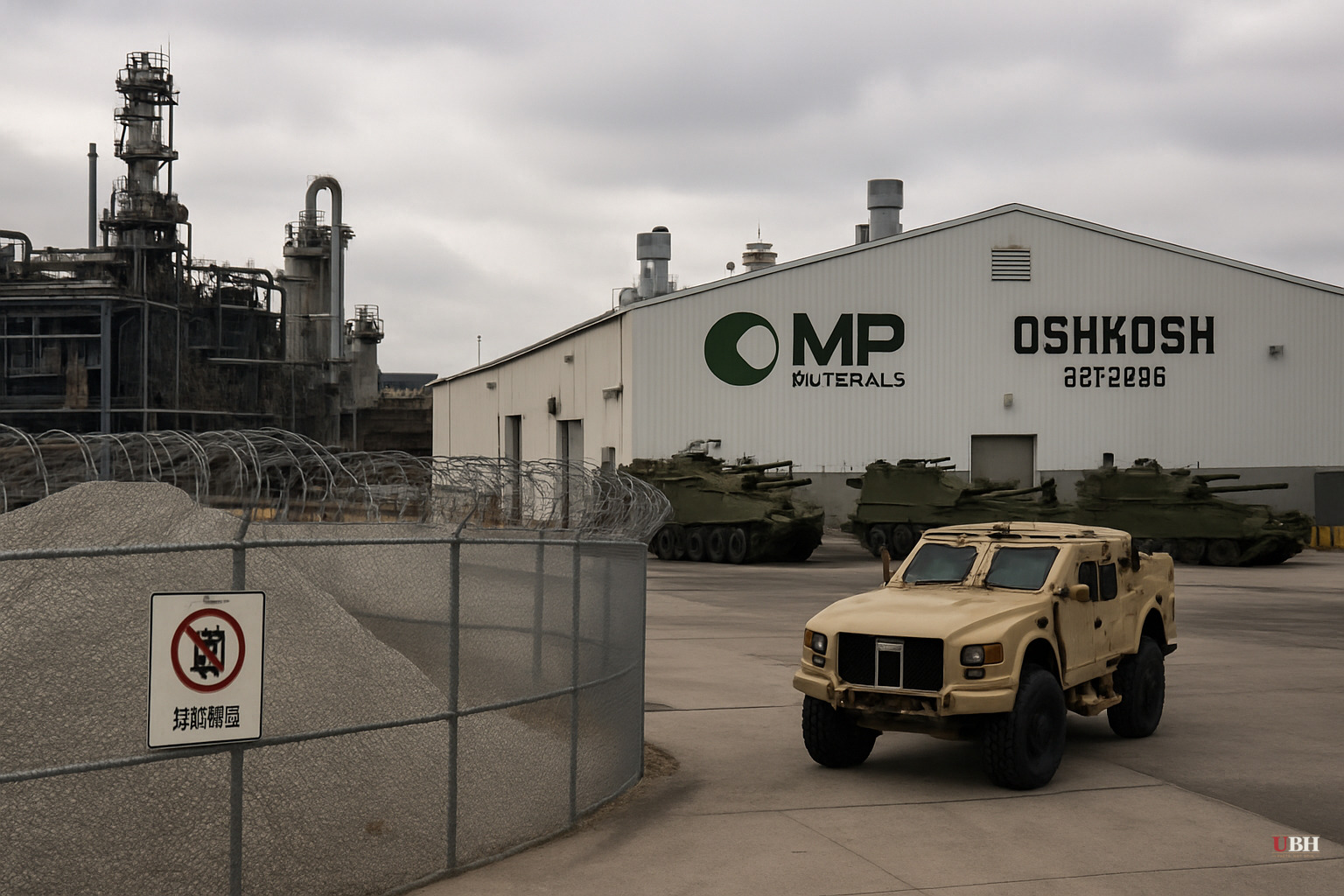
China's Ministry of Commerce placed 10 U.S. entities on its export control list, barring shipments of any dual-use items originating in China to those companies. The named firms include rare earth miners MP Materials Corp and USA Rare Earth, drone makers Teal Drones and Jaia Robotics, electronics manufacturer Aveox Inc, Ball Aerospace & Technologies Corp, and military equipment provider Oshkosh Defense, among others.
In a separate action, China's Finance Ministry excluded 46 U.S. companies, predominantly defense contractors, from participating in Chinese government procurement projects. Foreign-funded, locally registered entities associated with those firms are explicitly exempted from the ban.
Han Shen Lin, China country director at consultancy The Asia Group, told CNBC that most targeted companies have "little or no meaningful business exposure in China." The export controls sting symbolically but don't cut off significant revenue streams for firms like Oshkosh Defense or Ball Aerospace, which do the overwhelming bulk of their business with the U.S. government and Western allies.
Dan Wang, China director at Eurasia Group, called the countermeasures a "model example" of how Beijing will handle mild escalation from Washington while keeping the broader relationship intact. He pointed specifically to last month's Trump-Xi summit as having reset bilateral relations on a more positive footing.
The designation that triggered all of this doesn't impose immediate sanctions. Under the 1260H framework, the U.S. Department of Defense is barred from awarding direct contracts to listed companies starting June 30, with restrictions on indirect procurement following in 2027. The practical effect beyond DoD is softer: the designation signals to other federal agencies and commercial partners that doing business with listed firms carries reputational and regulatory risk.
Several designated Chinese companies have disputed their listings and pledged legal challenges. That approach has worked before. Xiaomi won a court challenge that resulted in its removal from the list, according to CNBC, establishing a legal path that other affected firms are watching closely.
The inclusion of MP Materials and USA Rare Earth on China's export control list stands out. These aren't obscure defense sub-contractors. MP Materials operates the Mountain Pass mine in California, and USA Rare Earth is developing domestic refining capacity specifically to reduce American dependence on Chinese-controlled supply chains.
Barring them from receiving Chinese-origin dual-use exports is pointed. The move doesn't immediately cripple either company's operations, but it signals that Beijing is willing to use rare earth leverage as a rhetorical weapon, even if it hasn't yet deployed it as an economic one.
Critics who think Washington is underreacting have a legitimate point. The pattern here is that the U.S. adds Chinese tech companies to a symbolic list, China responds with its own symbolic list, both sides call it proportionate, and the underlying technology transfer problem goes unaddressed. Alibaba, Baidu, and BYD remain global companies with access to U.S.-developed semiconductor designs, cloud infrastructure partnerships, and Western capital markets. A designation that bars DoD from direct contracts doesn't touch any of that. If the goal is actually limiting Beijing's military-civil fusion strategy, critics argue the 1260H list is a press release, not a policy.
That concern is reasonable. But Eurasia Group's Wang points to the Trump-Xi summit as evidence that both governments currently prefer managed friction to open decoupling. Neither side is pulling the emergency cord.
The DoD's June 30 direct-contract cutoff for newly listed Chinese firms is fast approaching under current law, with the 2027 indirect-procurement restrictions giving affected supply chains more runway. Whether any of the 46 firms newly excluded from Chinese government procurement will pursue legal challenges similar to Xiaomi's remains to be seen.
Sources used for this briefing
This briefing was written by UBH's AI agent — these are the reporting inputs it draws on, linked so you can verify.


