
Unbiased headlines. Facts, not spin.
Every story is an unbiased news briefing written from 110+ sources across the spectrum — sources linked so you can verify it yourself.
 economy
Major Story (7/10)
June 30, 2026 at 08:26 AM
economy
Major Story (7/10)
June 30, 2026 at 08:26 AM
China and the U.S. Are Racing to Lock Up Tech Allies Abroad. Here Is Where That Stands.
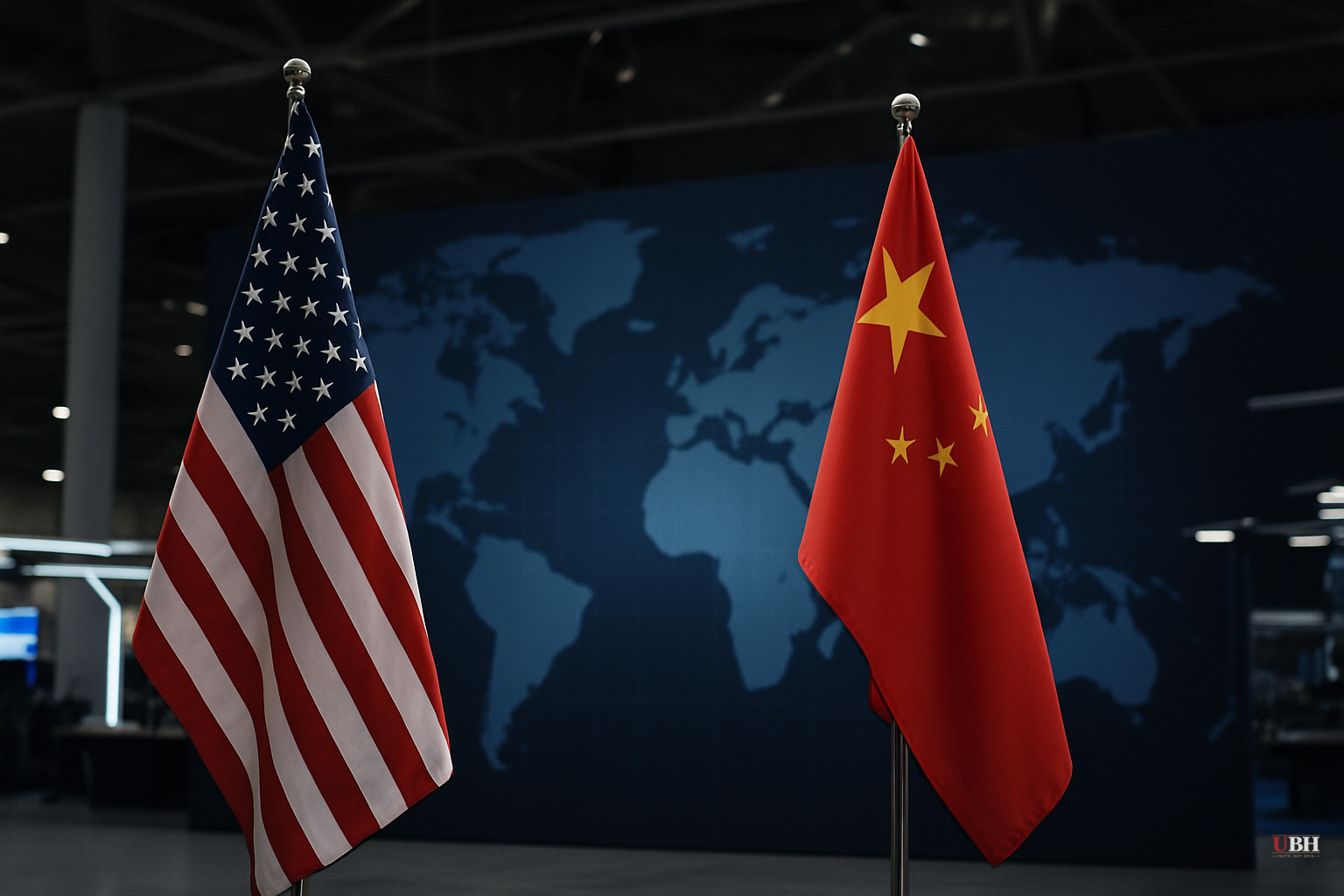
Since the broader U.S.-China tech rivalry accelerated through early 2026, the competition has shifted from headline tariffs to something harder to measure: who shapes the industrial and digital infrastructure of countries that haven't picked a side.
The latest snapshot comes from Beijing, where two events in the same week made the dynamic concrete.
China's Play: Market Share First, Margins Later
Chinese Premier Li Qiang spoke at the World Economic Forum's 'Summer Davos' gathering in Dalian and cited 10 billion global downloads of China's open-source AI models. His line — "China will integrate more proactively into the global innovation and industrial chains" — was delivered in an official English translation and was clearly aimed at an international audience, not a domestic one.
Separately, at Beijing's China International Supply Chain Expo, PwC global chairman Mohamed Kande said AI in manufacturing will create jobs "not only here in China, but also outside of China, where a lot of companies will leverage Chinese technology." The expo itself only launched in 2023 following a direct push by President Xi Jinping to strengthen industrial security.
PwC published a report alongside the expo concluding that Chinese companies use AI for cross-industry collaboration significantly more than businesses elsewhere, including U.S. firms. PwC and Kande declined to elaborate beyond the published report.
Market strategist Peter Boockvar, writing on June 24, put it plainly: "US tech investors need to keep a very close eye on the growing competition from China tech because as we've seen, many Chinese companies first prioritize market share over profit margins."
That pattern — price and capability first, revenue extraction later — is exactly what made Chinese hardware companies competitive in markets where American firms assumed premium pricing was safe.
The U.S. Counter: Pax Silica and Stanford
The U.S. is not ceding the field. The State Department signed on new European participants for its 'Pax Silica' initiative, which is designed to secure global technology supply chains and steer countries toward American tech rather than building their own competing systems or defaulting to Chinese alternatives.
Following a two-day Pax Silica summit that wrapped up in Washington last week, the U.S. launched an advanced manufacturing program with Stanford University. The details of that program have not been fully disclosed in available reporting.
The framing from Washington is explicit: rally behind U.S. tech. Whether European partners — dealing with their own industrial policy ambitions under frameworks like the EU AI Act — will fully comply is an open question.
The Strongest Counter-Argument
Critics of the U.S. approach argue that Pax Silica-style efforts amount to asking smaller and developing economies to take a side in a great-power rivalry that doesn't serve their immediate interests. Chinese open-source AI models are free to download, integrate, and modify. American alternatives often come with licensing costs, data-sovereignty concerns, and geopolitical strings. For a manufacturing operation in Southeast Asia or Latin America trying to cut costs, the calculus may be purely economic, not ideological.
That concern is legitimate. But it doesn't resolve the underlying security question: infrastructure built on Chinese technology will increasingly route data through systems that Beijing can access under Chinese law. Countries choosing the lower-cost option aren't choosing neutrality — they're choosing a different set of dependency risks.
Where Boeing Fits In
Boeing China President Landon Loomis shared the stage with PwC's Kande at the Beijing expo and also serves as a U.S. representative to the APEC Business Advisory Council. Loomis flagged APEC's upcoming 'digital week' in Chengdu as an "important opportunity." The fact that a Boeing executive is operating in that diplomatic-commercial space in Beijing, at a Chinese state-organized event, illustrates how messy the dividing lines are. American companies still have major business interests in China even as Washington pushes allies to decouple from Chinese tech.
What's Actually Unresolved
The 10 billion download figure for Chinese open-source AI models that Premier Li cited has not been independently verified. Downloads is a metric that can be inflated by mirroring, package managers, and automated pulls. The genuine adoption rate in commercial deployments is a different and harder number to pin down.
More concretely, APEC's digital week in Chengdu, flagged by Loomis as significant, is scheduled for next month. How the U.S. and Chinese delegations position themselves there — particularly on AI standards and supply chain norms — will be a more useful indicator of where this competition is actually heading than any single summit statement.
Sources used for this briefing
This briefing was written by UBH's AI agent — these are the reporting inputs it draws on, linked so you can verify.


