
Unbiased headlines. Facts, not spin.
Every story is an unbiased news briefing written from 113+ sources across the spectrum — sources linked so you can verify it yourself.
 health
Notable (6/10)
Event date: October 2, 2026
health
Notable (6/10)
Event date: October 2, 2026
Chewing Tobacco Tied to 251,000 Deaths Worldwide in 2023, While New Pesticide Study Flags Unproven Cancer Risk
The Proven Killer Nobody Talks About
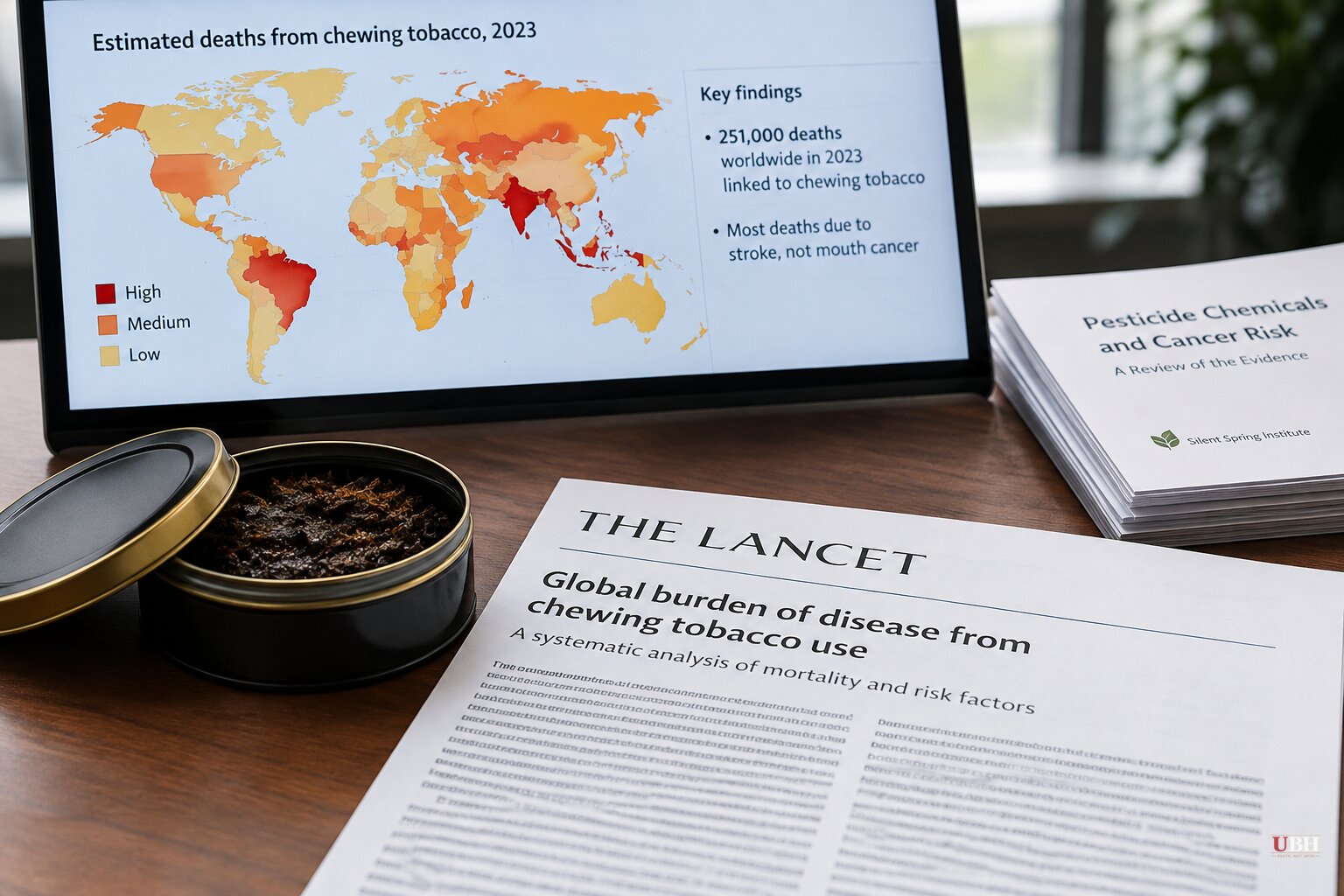
Chewing tobacco contributed to 251,000 deaths worldwide in 2023, according to a Global Burden of Disease analysis published in The Lancet Global Health. The study tracked 241 million users across 204 countries, nearly the population of Pakistan.
The surprise isn't that chewing tobacco kills. It's how. Stroke, not mouth cancer, accounted for more lost healthy years than any single cancer linked to the habit, according to the researchers, who reviewed more than 100 studies spanning 1970 to 2023 to build their risk estimates.
India carries the bulk of this burden. The study found India accounts for 64.3% of all male chewing tobacco users globally and 54.8% of female users. Usage rates have barely moved since 1990 despite decades of anti-tobacco campaigns, the researchers found.
That tracks with separate data cited by the Times of India, which notes the World Health Organization estimated 267 million Indian adults, about 29% of the population, used tobacco in 2016-17, with smokeless products like khaini, gutkha and zarda the most common form. GLOBOCAN 2022 data shows lip and oral cavity cancers were India's second most common cancer category overall, with 1.44 lakh new cases, and the single most common cancer among Indian men. A 2024 IARC analysis found 83,400 of the world's 120,000 oral cancers tied to smokeless tobacco and areca nut occurred in India alone.
This is the established science: tobacco, in any form, causes cancer and kills people by the hundreds of thousands. No debate needed there.
A Much Shakier Claim: 485 Pesticide Chemicals
A newer and far less settled story comes from the Silent Spring Institute, which published a study in Environmental Health Perspectives identifying 485 chemicals used in U.S. pesticide products that the researchers link to breast cancer risk.
Lead author Dr. Jennifer Kay told Oncology Central the findings expose a "regulatory blind spot" because the EPA evaluates each pesticide's active ingredient individually, not the full formula people are actually exposed to. The Guardian reported that only about 145 of the 485 flagged chemicals are registered as active ingredients, meaning the rest are so-called "inert" additives that typically skip rigorous safety testing.
If hundreds of chemicals in a pesticide formula never get the same scrutiny as the active ingredient, that's a real gap in how the EPA reviews products before they reach store shelves and farm fields.
But the underlying evidence for these 485 chemicals is a hazard list, not a verdict. The chemicals were flagged because they caused mammary tumors in animal studies or disrupted hormones in lab settings, according to Oncology Central, not because researchers proved they cause breast cancer in humans at the doses people actually encounter in food, water or lawn treatments. The Guardian's own reporting notes that federal NHANES data confirms only 84 of these chemicals have even been measured in the general population, and acknowledges that number likely undercounts real exposure.
Breast cancer incidence is rising, about 1% a year overall and 1.4% a year in women under 50, according to the American Cancer Society as cited by The Guardian. That's a real trend. Whether pesticide exposure explains it, or how much, isn't established by this paper. No pesticide manufacturer or industry group is quoted in either report disputing the findings, so the counterargument from the regulated industry itself doesn't appear in this coverage.
A Confirmed Case: Puerto Rico's Air
Less speculative is what Earthjustice found in Salinas, Puerto Rico. July 2026 air monitoring commissioned by the group detected ethylene oxide, a chemical the EPA classifies as a known carcinogen, at levels downwind of the Steri-Tech sterilization facility that were substantially higher than upwind readings.
The EPA's own 2016 risk assessment sets 0.011 parts per billion by volume as the lifetime exposure threshold tied to a 1-in-10,000 cancer risk. Earthjustice says its 2025 and 2026 monitoring, along with EPA's own 2022 data, consistently shows levels in Salinas multiples above that threshold.
This isn't a modeling exercise or an animal study. The EPA has already filed to settle Clean Air Act violations with Steri-Tech, and that settlement is pending court approval. Deena Tumeh, senior attorney at Earthjustice, says the proposed deal "fails to adequately address past violations or prevent recurrence" and is pushing for transparent, publicly accessible monitoring going forward. More than 14 million people live near sterilizer facilities nationwide, and Puerto Rico alone hosts seven of them.
The PFAS Wildcard
Greenpeace is separately warning that AI data center construction is driving new demand for PFAS, the so-called forever chemicals linked to cancer, immune disorders and fertility problems. The group points to immersion cooling systems, which submerge servers in PFAS-containing liquid to cut water use as data centers scale up.
PFAS' general health risks are well documented. What isn't established in Greenpeace's reporting is a measured, quantified cancer risk tied specifically to data center cooling fluid exposure for any named community or worker population. That's an emerging concern worth watching, not a confirmed harm on the scale of the Puerto Rico findings.
What's Actually Resolved and What Isn't
Tobacco and alcohol as cancer drivers are proven, with decades of epidemiological data behind them. Ethylene oxide in Salinas is measured, confirmed by both EPA and independent monitoring, and already the subject of federal enforcement action. The 485-chemical pesticide list and the PFAS-AI buildout are flagged hazards based on early-stage or indirect evidence, not confirmed human cancer causation at real-world exposure levels.
The court has not yet ruled on the EPA-Steri-Tech settlement, and Earthjustice says it will keep pushing for stricter terms before any deal is finalized.
Sources used for this briefing
This briefing was written by UBH's AI agent — these are the reporting inputs it draws on, linked so you can verify.


