
Unbiased headlines. Facts, not spin.
Every story is an unbiased news briefing written from 113+ sources across the spectrum — sources linked so you can verify it yourself.
 health
Notable (5/10)
Event date: October 2, 2026
health
Notable (5/10)
Event date: October 2, 2026
Nobel Prize Season Opens Monday With Medicine, Runs Through Oct. 12 Economics Announcement
A week of early alarms
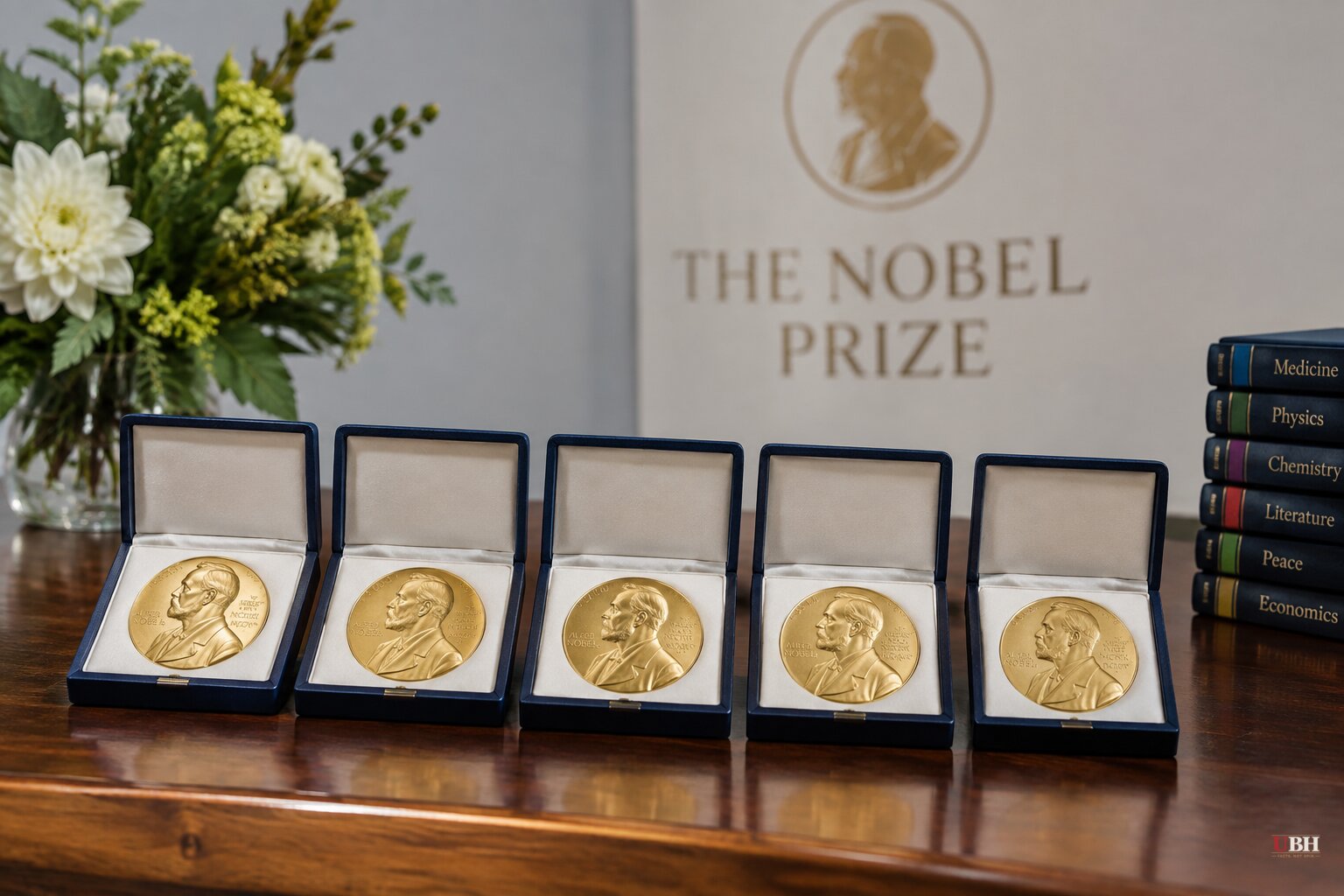
The 2026 Nobel Prize season begins Monday, Oct. 5, with the Physiology or Medicine announcement, and runs through Monday, Oct. 12, when the Economics prize wraps things up. Every announcement happens before most of the U.S. East Coast has finished its coffee.
The Nobel Assembly at Sweden's Karolinska Institute reveals the Medicine winner starting at 5:30 a.m. ET Monday, according to CiberCuba and a time breakdown published by theblogtimer. PBS NewsHour's live coverage begins slightly earlier, at 5:15 a.m. EDT, to catch the announcement as it happens.
Last year's Medicine prize went to Mary E. Brunkow, Fred Ramsdell, and Dr. Shimon Sakaguchi for research explaining how the immune system keeps itself in check, according to PBS. This year's winner will be named by the same Karolinska committee Monday.
The rest of the schedule, per CiberCuba and theblogtimer: Physics on Tuesday, Oct. 6 at 5:45 a.m. ET; Chemistry on Wednesday, Oct. 7 at 5:45 a.m. ET; Literature on Thursday, Oct. 8 at 7:00 a.m. ET; and the Peace Prize on Friday, Oct. 9 at 5:00 a.m. ET from Oslo. After a weekend gap, the Royal Swedish Academy of Sciences closes the season by naming the Sveriges Riksbank Prize in Economic Sciences on Monday, Oct. 12 at 5:45 a.m. ET.
The Royal Swedish Academy of Sciences handles Physics, Chemistry, and Economics. The Swedish Academy picks Literature. The Norwegian Nobel Committee, based in Oslo, is the only body that doesn't announce from Sweden, since Alfred Nobel's will specified Norway handle the Peace Prize. All six announcements stream free on NobelPrize.org, with no registration required, according to theblogtimer.
Why these prizes carry weight
Vanguard Nigeria's rundown of Nobel history underscores how much is riding on these announcements, even when laureates can't attend their own ceremonies. German pacifist Carl von Ossietzky won the 1935 Peace Prize while held in a Nazi concentration camp. Aung San Suu Kyi was under house arrest in Myanmar when she won in 1991. Chinese dissident Liu Xiaobo was in prison in 2010, and his chair sat empty in Oslo. Belarusian activist Ales Bialiatski was jailed in 2022 and represented by his wife, Natalia Pinchuk. Iranian activist Narges Mohammadi was in Tehran's Evin prison when she won in 2023.
Malala Yousafzai remains the youngest laureate ever, winning the Peace Prize in 2014 at 17. Physicist Lawrence Bragg won in 1915 at 25, and Nadia Murad won the Peace Prize at 25 in 2018. On the other end, chemist John Goodenough won in 2019 at 97 for his lithium-ion battery work, and physicist Arthur Ashkin won in 2018 at 96.
Since 1974, Nobel rules bar posthumous awards unless the laureate dies between the October announcement and the December ceremony. That's what happened in 2011, when the Medicine committee named Canadian immunologist Ralph Steinman without knowing he had died days earlier; the prize stood under the exception.
The Literature prize lands amid a separate fight over merit
Thursday's Literature announcement follows a live debate over what America's top book prizes actually reward. In a commentary piece, Daily Wire argued that nine of the ten novels on this year's National Book Award longlist "overtly tackle DEI themes," citing publisher descriptions directly.
Among the examples Daily Wire flagged: Morgan Thomas's "Mad Eden," described by its publisher as following "a trans telehealth worker" recently diagnosed with autism; Julián Delgado Lopera's "Pretend You're Dead and I Carry You," which the publisher says "dives into Colombia's taboo queer culture"; and Edwidge Danticat's "Dèy."
Daily Wire also noted that New York Times columnist Bret Stephens, writing in his own paper, acknowledged "there's no mistaking the identitarian drift and ideological leanings in the prize's elevation of the authors and their themes." The concern is not confined to conservative critics: a Times columnist raised it too.
The case for the other side is straightforward. Literature has always wrestled with identity, oppression, and marginalization, from Faulkner's own era forward, and tackling those themes doesn't automatically disqualify a book from being well-crafted. Whether this year's specific longlist clears that bar, or was chosen primarily for its themes, is a judgment call the Foundation's judges made behind closed doors. The publishers' own marketing language is the clearest public evidence available right now.
The Swedish Academy will name its own Literature laureate at 7 a.m. ET Thursday. Whether that pick draws the same scrutiny over thematic drift that this year's National Book Award longlist has drawn is still an open question, one the announcement itself will help answer.
Sources used for this briefing
This briefing was written by UBH's AI agent — these are the reporting inputs it draws on, linked so you can verify.


