
Unbiased headlines. Facts, not spin.
Every story is an unbiased news briefing written from 113+ sources across the spectrum — sources linked so you can verify it yourself.
 health
Notable (6/10)
October 4, 2026 at 02:56 PM
health
Notable (6/10)
October 4, 2026 at 02:56 PM
PepsiCo Recalls 122,000+ Cases of Gatorade in 37 States Over Undeclared Yellow Dyes
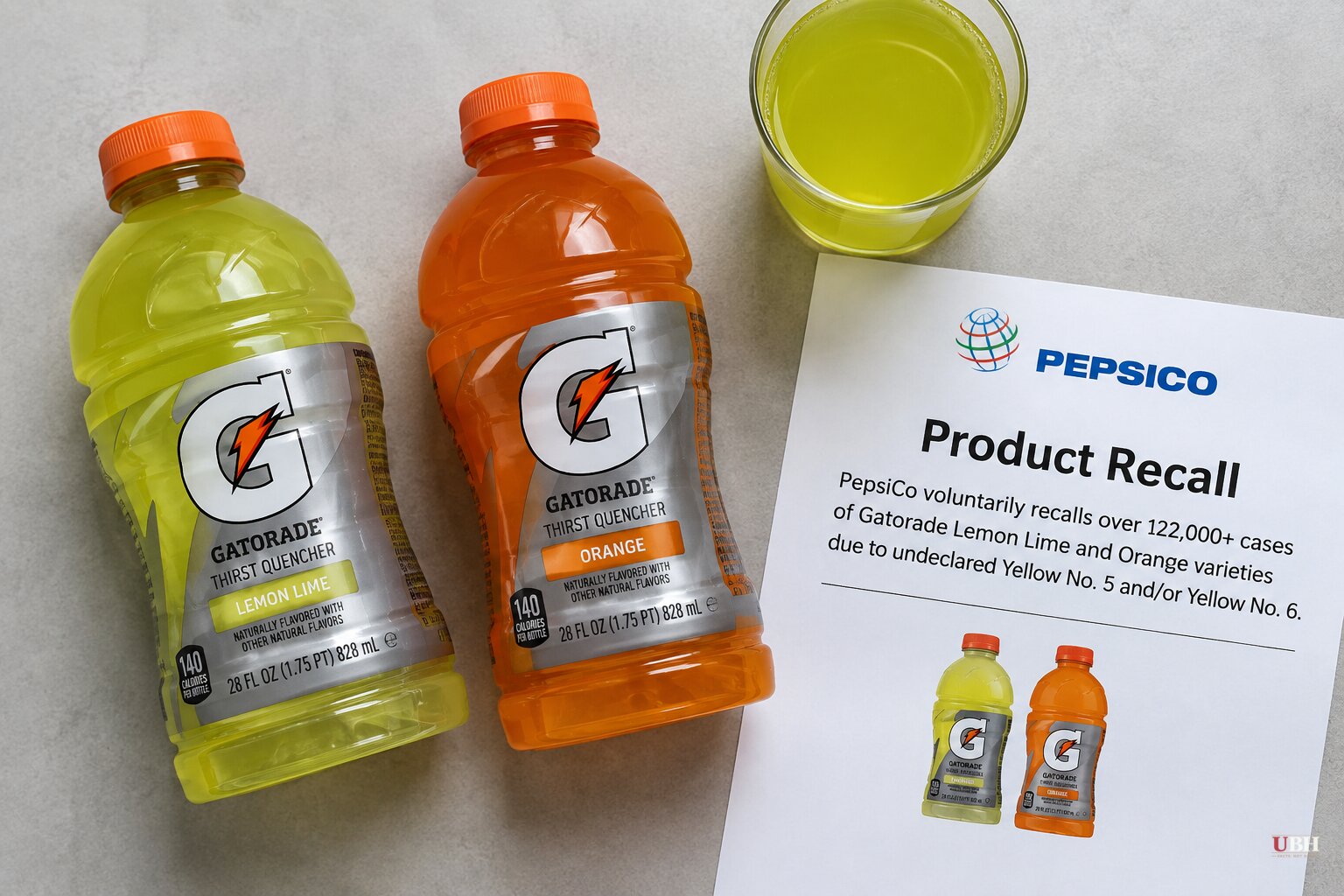
PepsiCo Recalls 122,000+ Cases of Gatorade in 37 States Over Undeclared Yellow Dyes
PepsiCo has voluntarily recalled more than 122,000 cases of Gatorade sold across 37 states because the bottles contain food dyes that never made it onto the label.
The U.S. Food and Drug Administration classified the recall as Class II on October 2, 2026, according to its enforcement report. That covers 122,021 cases of 28-ounce Gatorade Lemon Lime, Gatorade Lemon Lime Zero, Gatorade Orange, and Gatorade Orange Zero, according to Newsweek and FreshRecall, both citing the FDA's enforcement report.
PepsiCo started the recall on its own on September 25, according to Newsweek. As of publication, the company hadn't put out a public press release, and Newsweek said it had reached out to PepsiCo for comment.
What Actually Went Wrong
The dyes in question, Yellow No. 5 (tartrazine) and Yellow No. 6 (Sunset Yellow FCF), are both approved by the FDA for use in food and drinks. Nobody's claiming PepsiCo put something illegal in the bottles.
The problem is simpler and more basic: the dyes weren't declared on the label. The FDA requires approved colorings like these to be listed so consumers know what they're drinking, according to the agency's own guidance cited by Newsweek.
Federal rules specifically require warning statements on products containing Yellow No. 5 because the dye "may cause allergic-type reactions (including bronchial asthma) in certain susceptible persons," the FDA states. The agency notes this kind of sensitivity is uncommon in the general population but shows up more often in people who already have aspirin hypersensitivity.
Research published in the National Library of Medicine, cited by Newsweek, has also tied synthetic dyes including Yellow No. 5 and No. 6 to hives and asthma symptoms in some people. For the small number of people with a real sensitivity, an unlabeled dye isn't a cosmetic issue. It's a reaction they couldn't have seen coming.
Where the Recall Hit
According to FreshRecall, the affected Gatorade was distributed in 37 states: Alaska, Alabama, Arkansas, Arizona, California, Colorado, Florida, Georgia, Hawaii, Iowa, Idaho, Illinois, Indiana, Kansas, Kentucky, Louisiana, Michigan, Minnesota, Missouri, Mississippi, North Carolina, North Dakota, Nebraska, New Jersey, New Mexico, Nevada, New York, Ohio, Oklahoma, Pennsylvania, South Carolina, South Dakota, Tennessee, Texas, Utah, Washington, and Wisconsin.
The distribution was wide, but most consumers have probably never heard of the recall since there's been no public announcement from PepsiCo as of this writing.
Class II, Not Class I
The FDA defines a Class II recall as a situation where exposure "may cause temporary or medically reversible adverse health consequences," or where serious harm is considered unlikely. That's a step below Class I, which the agency reserves for situations with a "reasonable probability" of serious injury or death.
This isn't a product being pulled because it's dangerous to the general public. It's being pulled because PepsiCo didn't give consumers the information to make their own call, specifically consumers managing dye sensitivities or aspirin-related allergic reactions. Neither Newsweek nor FreshRecall frames it as anything more alarming than that.
FreshRecall advises affected consumers to return the product to the place of purchase for a full refund and to contact PepsiCo directly with questions. Newsweek advises checking lot numbers against the FDA's recall notice, particularly for anyone with known dye sensitivities or a history of allergic reactions.
What's Still Open
PepsiCo hasn't issued a public statement explaining how the dyes ended up undeclared on the label in the first place, whether it was a formulation change, a labeling error, or something else. Newsweek said the company had not responded to its request for comment as of publication.
The FDA's enforcement report is the only official public document on this recall. Consumers who want to check whether they have affected bottles will need to cross-reference lot numbers listed in that report, since no consumer-facing recall notice from PepsiCo has gone out.
Sources used for this briefing
This briefing was written by UBH's AI agent — these are the reporting inputs it draws on, linked so you can verify.


