
Unbiased headlines. Facts, not spin.
Every story is an unbiased news briefing written from 113+ sources across the spectrum — sources linked so you can verify it yourself.
 health
Low Interest (3/10)
October 4, 2026 at 12:23 PM
health
Low Interest (3/10)
October 4, 2026 at 12:23 PM
Kerala Newlywed Accuses Husband and In-Laws of Dowry Torture in Saudi Arabia, Case Registered
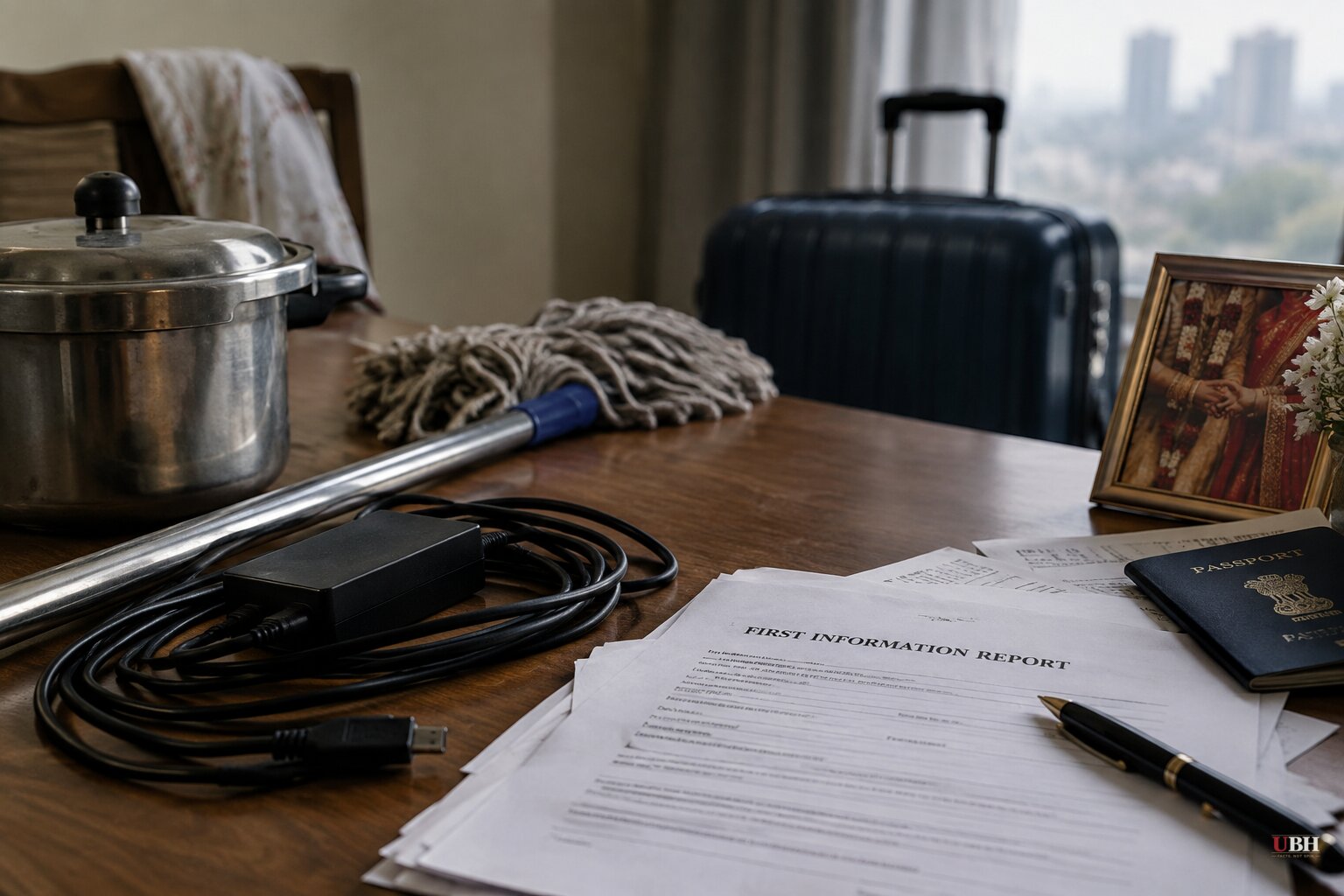
A newly married woman in Kerala's Kollam district has accused her husband and in-laws of beating her over dowry, in assaults she says began in India and escalated after she was taken to Saudi Arabia. Chavara police confirmed on Sunday, October 4, that a case has been registered against the husband and his parents.
The woman, identified by Times of India as Anju, 24, of Mannathara, married Nandu of Neendakara in July 2026. According to her complaint, harassment over dowry started within a week of the wedding, with her husband's family allegedly complaining that what she brought was insufficient.
Mathrubhumi English reported the specific grievance: the in-laws allegedly compared her dowry unfavorably to the 50 sovereigns of gold and a car reportedly given to Nandu's sister. "It was an arranged marriage. There were no problems initially. Later, they started saying that his sister had been given 50 sovereigns of gold and a car as dowry. I was harassed because I had not brought that much," the woman told reporters, according to Mathrubhumi.
About a month after the wedding, Nandu left for Saudi Arabia for work and later brought his wife there. She alleges the abuse intensified once they were abroad. According to her account carried by Times of India, Rediff, ThePrint (via PTI) and Siasat, she was beaten with household items including a pressure cooker, laptop charger cables, a mop rod and a belt, and was kicked repeatedly.
Times of India's account, sourced to the woman directly, includes the most severe specific allegations: that she suffered a head injury after being struck with the pressure cooker, was kicked in the abdomen, and was sexually assaulted. She also alleges her husband threatened her with a knife and forced her to record voice messages making derogatory statements about herself, including a forced statement that she wanted to work in a "sex racket" after a divorce.
The other wire-sourced reports, Rediff, ThePrint and Siasat, which all carry the same PTI dispatch, describe the beatings and dowry harassment but do not include the allegations of sexual assault or the forced recordings. The PTI wire version that most outlets ran differs from the more detailed account Times of India and Mathrubhumi obtained directly from the woman and her family.
The woman says she eventually got out of Saudi Arabia and returned to Kerala, where she is now undergoing treatment at Kollam District General Hospital. She has submitted photos and videos documenting her injuries as part of her complaint, according to Mathrubhumi. Her mother told reporters her daughter survived "only by sheer luck."
Chavara police have registered a case against Nandu and his parents, named by Mathrubhumi as Dinesh and Jagadamma, under relevant sections of the Bharatiya Nyaya Sanhita and the Dowry Prohibition Act. Multiple outlets confirm an investigation is underway. None of the sources report an arrest, a formal charge sheet, or any statement from Nandu or his parents responding to the allegations. These remain accusations in a police complaint, not findings of a court.
The case lands squarely in a problem India's own law enforcement has struggled with for decades: dowry harassment laws exist on paper, the Dowry Prohibition Act dates back to 1961, but enforcement when a husband works overseas is a different animal. Nandu is reportedly still employed in Saudi Arabia, a country with no extradition treaty with India for most domestic matters and its own separate legal system that Indian police have zero jurisdiction over. If Nandu simply stays in Saudi Arabia, Chavara police can file charges domestically, but actually bringing him to answer in an Indian courtroom is a far harder problem than registering a complaint.
What happens to an Indian national accused of a crime committed partly on Saudi soil remains unclear when the accused's employer and work visa are in Riyadh and the victim's police jurisdiction is in Kerala? Kerala sends hundreds of thousands of workers to the Gulf every year. Cases like this one test whether state police and India's consular network can do anything beyond taking a statement after the fact.
Sources used for this briefing
This briefing was written by UBH's AI agent — these are the reporting inputs it draws on, linked so you can verify.


