
Unbiased headlines. Facts, not spin.
Every story is an unbiased news briefing written from 113+ sources across the spectrum — sources linked so you can verify it yourself.
 health
Low Interest (3/10)
October 4, 2026 at 10:03 AM
health
Low Interest (3/10)
October 4, 2026 at 10:03 AM
Woman Discovers Family's Decades of Cancer Deaths Traced to Inherited Lynch Syndrome Mutation
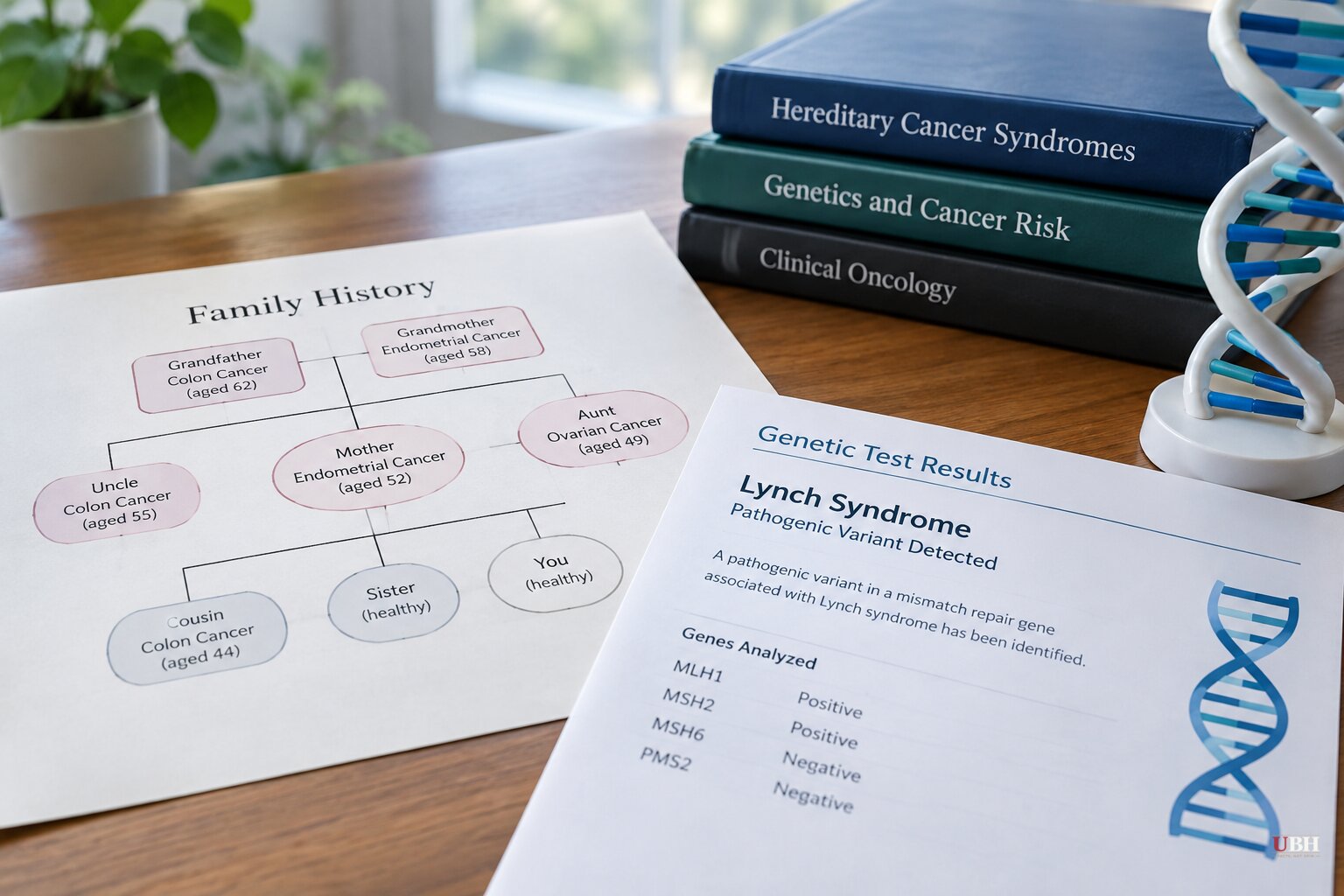
Michelle York's family has been losing people to cancer for generations. Her great-grandmother died of colon cancer. Her grandfather had both stomach and brain cancer. His sisters died from liver, ovarian, and breast cancer. A cousin on her mother's side died of pancreatic cancer.
For years, that was just the family's bad luck. Then, when York was 33, her mother found a possible explanation: Lynch syndrome.
Lynch syndrome is an inherited genetic mutation that raises the risk of multiple cancers, including colorectal, uterine, stomach, ovarian, and pancreatic. For colon cancer specifically, it can push lifetime risk as high as 80%, and the cancers it causes are sometimes more aggressive. An estimated 1 in 300 Americans carries the mutation. Most of them don't find out until after they've already been diagnosed with cancer, because the condition itself produces no symptoms.
York's mother, a nurse at the time, had read about Lynch syndrome through her work and decided to get tested. "She thought: 'Well, what if I do have this and what if my daughter has this?'" York, now 43 and a content creator in Los Angeles, told Business Insider.
The timing mattered. York was already dealing with pelvic pain from complex ovarian cysts, the kind that can contain solid tissue or irregularities that mask a growing tumor. If she also carried the Lynch mutation, those cysts needed closer scrutiny given her elevated ovarian cancer risk.
Her mother tested positive. So did York. So did both of York's siblings and several relatives on her mother's side, including an aunt, uncle, and cousin.
How the test actually works
There are three ways to screen for Lynch syndrome: a saliva sample, a cheek swab, or a blood draw, with blood producing the highest-quality DNA sample. York's version of it was about as low-friction as medical testing gets.
"I spit in a tube — it was a very easy test," she said.
Because her mother had already tested positive, York said her insurer covered the cost. Genetic testing driven by a known familial mutation is treated differently by insurers than a speculative test with no family history behind it, which is part of why York's father skipped testing entirely. He has no cancer history on his side of the family, so there was no clinical basis to screen him.
After the results came back, York and her siblings met with a genetic counselor who walked them through exactly which cancers they were now considered high-risk for and what kind of monitoring that called for.
Living with the diagnosis
York and her relatives who tested positive now get annual cancer screenings. That's the standard of care for confirmed Lynch carriers: more frequent colonoscopies, and depending on the specific cancers in the family, additional screening for uterine, ovarian, or stomach cancer.
York told Business Insider the early years were harder psychologically. "In the beginning, it was a little bit more anxiety-inducing," she said. A decade in, her perspective has shifted. "I think knowledge is power — now, it almost feels comforting because I know that I started doing this young."
That reframing is the core argument genetic counselors make for this kind of testing: a positive result isn't a diagnosis, it's a warning that lets someone catch a tumor at stage one instead of stage four. Lynch syndrome itself doesn't cause cancer with certainty. It raises the odds. Annual screening is the tool that turns a statistical risk into something actionable.
What's still unresolved
The harder question is how many families like York's exist without anyone connecting the dots. With an estimated 1 in 300 Americans carrying the mutation, and most undiagnosed until a cancer diagnosis forces the issue, the gap between prevalence and detection is large.
York's family caught it because her mother happened to work in medicine and read the right research at the right time. Doctors and genetic counselors say that should instead be a standard conversation anytime a patient reports multiple cancers across generations in the same bloodline.
No federal screening mandate exists for Lynch syndrome, and testing eligibility through insurance generally still hinges on an established family history or a prior cancer diagnosis rather than routine proactive screening for the general population.
Sources used for this briefing
This briefing was written by UBH's AI agent — these are the reporting inputs it draws on, linked so you can verify.


