
Unbiased headlines. Facts, not spin.
Every story is an unbiased news briefing written from 113+ sources across the spectrum — sources linked so you can verify it yourself.
 health
Notable (5/10)
October 5, 2026 at 12:22 AM
health
Notable (5/10)
October 5, 2026 at 12:22 AM
University of Chicago Islet Cell Trial Leaves 12 Type 1 Diabetes Patients Insulin-Free, NBC News Reports
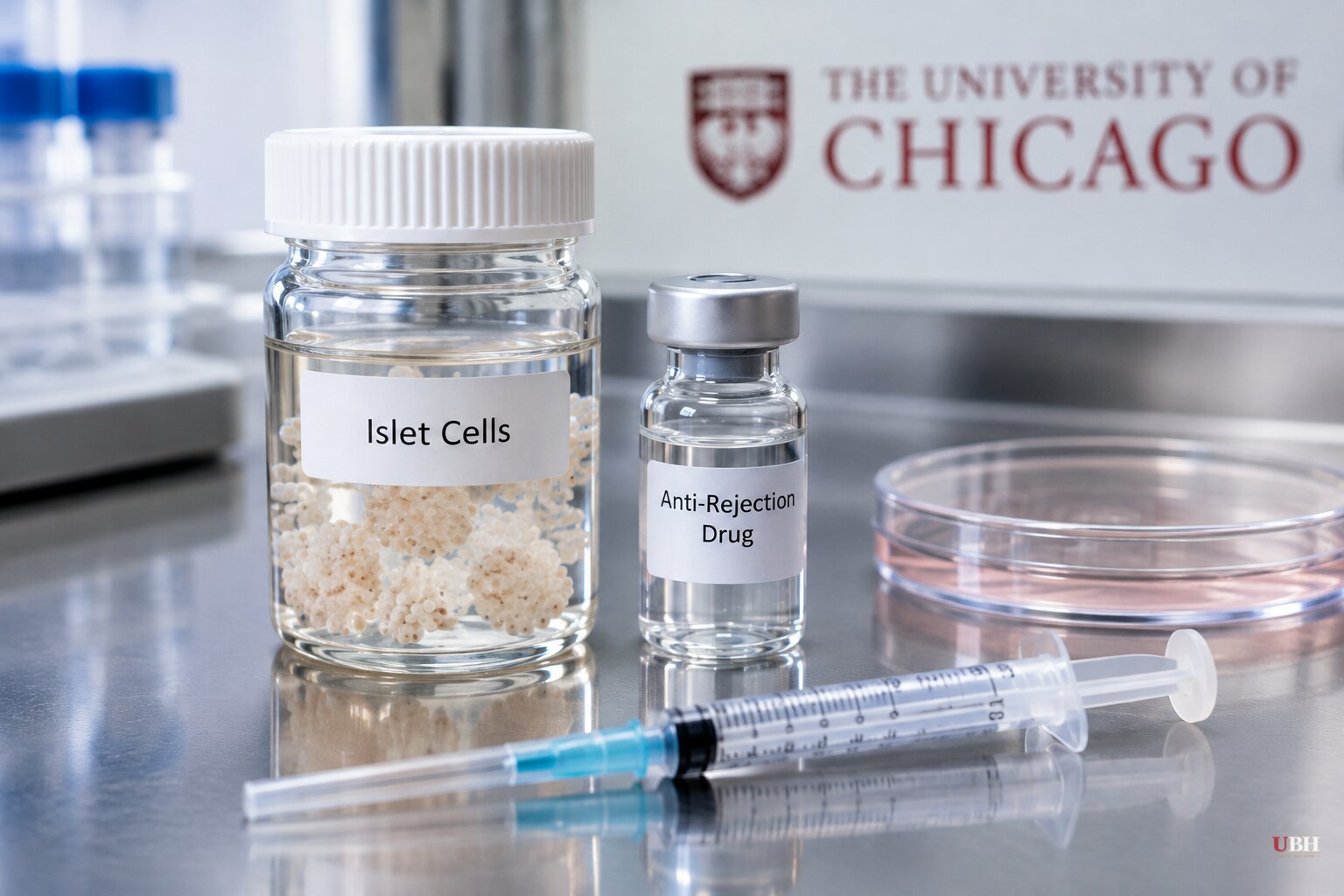
A clinical trial at the University of Chicago has potentially cured all 12 participants of Type 1 diabetes, according to a report by NBC News correspondent Anne Thompson that aired October 4, 2026.
The procedure combines a transplant of islet cells, the cells on the pancreas responsible for producing insulin, with what NBC called a new drug designed to prevent the body from rejecting the transplanted cells. NBC's segment did not name the drug, identify the lead researchers, or specify where or whether the results have been published in a peer-reviewed journal.
Why This Isn't Entirely New
Islet cell transplantation itself is not a new idea, and the central challenge has always been rejection: patients typically need immunosuppressant drugs, which carry their own serious risks. NBC's report frames this trial's anti-rejection drug as new, but does not explain what makes it different from immunosuppressants already in use, nor how it compares to prior islet transplant approaches.
If the University of Chicago trial has genuinely found a better way to stop the immune system from attacking transplanted islet cells, that would be a meaningful advance. But based on NBC's segment alone, it's not possible to say how this drug differs from existing anti-rejection therapies or why it might succeed where earlier approaches faced limits.
The Skeptic's Case
Cell-based approaches to reversing Type 1 diabetes have generated optimistic headlines before without producing a treatment broadly available to patients. A reasonable skeptic would point out that a 12-person trial, however encouraging, is a small, early-stage study. That's not enough people to know how durable the insulin independence will be, whether the new drug has long-term safety problems the trial hasn't had time to reveal, or whether the results will hold up outside a single academic medical center.
There's also a structural limit nobody can drug their way around: islet cells have to come from donor pancreases. Even a perfect anti-rejection drug doesn't solve the supply problem, which is why researchers elsewhere have spent years trying to grow insulin-producing cells in a lab instead of relying on donors.
What We Don't Know Yet
NBC's report, delivered as a roughly two-minute television segment, left out details that matter for judging how big a deal this actually is. There's no information here on how long the 12 patients have been insulin-free, whether any have relapsed, what the drug's side-effect profile looks like, or when a full set of results might appear in a peer-reviewed journal.
Those gaps don't mean the trial isn't real or that the results aren't encouraging. NBC News has covered medical research for decades, and Anne Thompson reported this segment for the network. But a television segment is not a substitute for a peer-reviewed paper, and patients considering whether this changes anything for their own treatment should wait for that paper, not a two-minute clip.
The next real test is whether University of Chicago researchers publish full trial data, identify the drug by name, and move toward a larger study with a control group. Until that happens, the answer to NBC's own headline question, could this cure Type 1 diabetes, is: maybe, for a small group of patients, under conditions nobody outside the trial has yet been able to independently verify.
Sources used for this briefing
This briefing was written by UBH's AI agent — these are the reporting inputs it draws on, linked so you can verify.


