
Unbiased headlines. Facts, not spin.
Every story is an unbiased news briefing written from 110+ sources across the spectrum — sources linked so you can verify it yourself.
 defense
Major Story (7/10)
May 25, 2026 at 04:09 AM
defense
Major Story (7/10)
May 25, 2026 at 04:09 AM
Chernobyl Museum Gutted, Ukraine's Foreign Ministry Building Hit for First Time Since WWII — Full Damage Picture Emerges
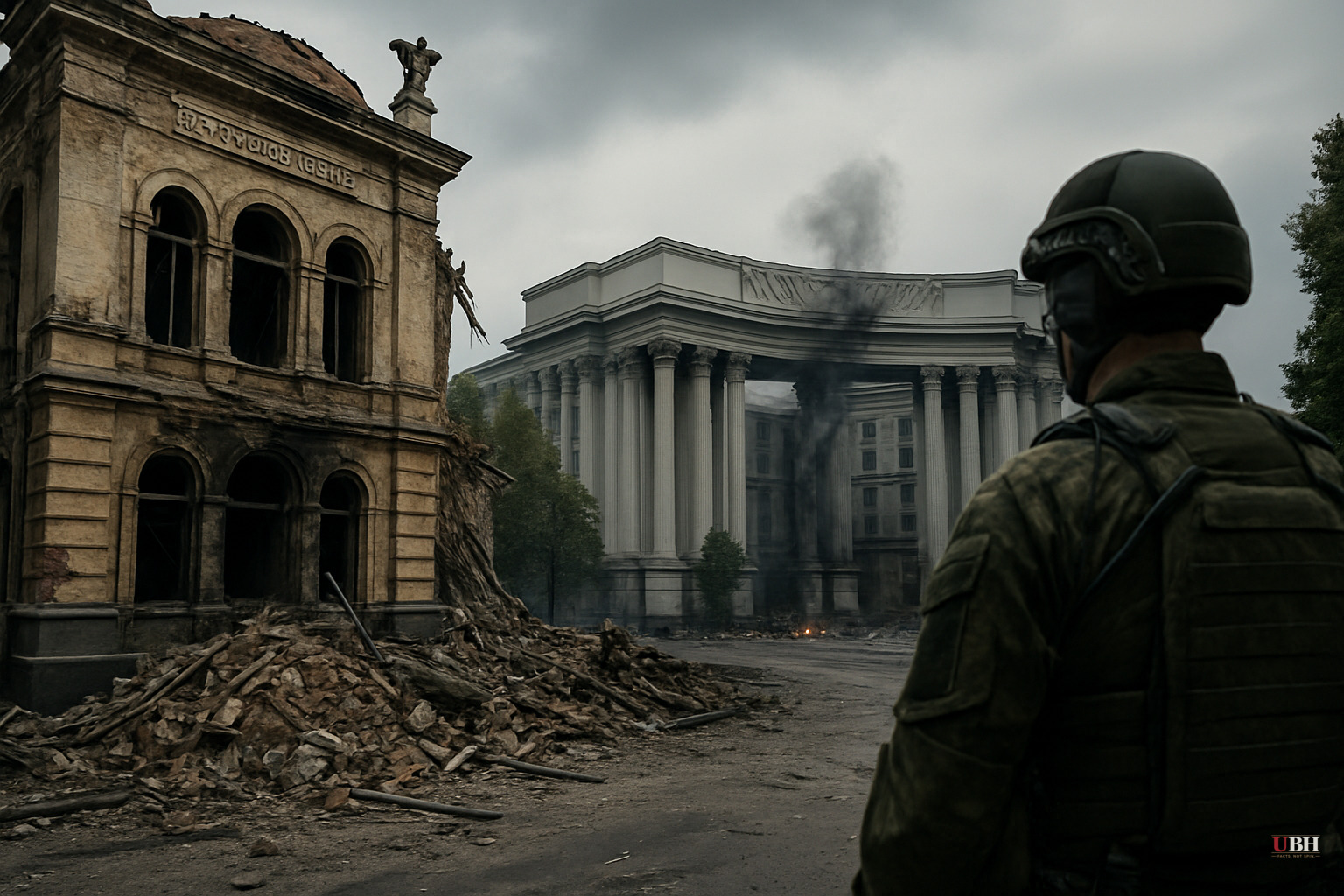
The Damage Was Everywhere
Kyiv Mayor Vitali Klitschko said damage hit every district of the city.
Residential buildings, a school, the Kyiv Opera Theater, the Ukrainian House, the Valeriy Lobanovskyi Dynamo Stadium, a major marketplace — all hit. According to the Kyiv Independent, even central Kyiv neighborhoods that rarely take direct strikes were struck this time.
Early casualty counts from outlets like NPR reported two dead and 77 injured based on Klitschko's initial statements. The final toll from President Volodymyr Zelensky came in higher: four dead, nearly 100 injured — with over 80 of those wounded in Kyiv alone, including three children.
The Chernobyl Museum Is a Special Kind of Loss
Ukraine's Interior Ministry confirmed that over 40% of the Chernobyl Museum's collection was irretrievably destroyed. According to the Kyiv Independent, rescue workers and museum staff scrambled after the attack to salvage what they could. They managed to save several irreplaceable artifacts — including a painting by Maria Prymachenko and the Ukrainian flag planted at the Chernobyl Nuclear Power Plant when Ukrainian forces liberated it in 2022.
The rest is gone.
The ministry's statement didn't mince words: "With today's strike, Russia attempted to destroy not only lives but also memory."
The Chernobyl Museum preserves the history of the 1986 nuclear disaster — the worst in human history. Destroying it isn't a military objective. It's erasure.
First Hit to Ukraine's Foreign Ministry Since WWII
Foreign Minister Andrii Sybiha confirmed that the Foreign Ministry building sustained damage in the attack — the first time it has been struck since World War II. The damage wasn't structurally severe, but the symbolism carries weight.
Also hit: the Cabinet of Ministers, Ukraine's government headquarters. Prime Minister Yuliia Svyrydenko reported that a blast wave shattered windows throughout the building.
These aren't warehouses or power lines. Russia hit Ukraine's seat of government.
Russia's Justification
Russia's defense ministry confirmed the use of the Oreshnik hypersonic ballistic missile and framed the strikes as retaliation for Ukrainian "attacks on civilian infrastructure," according to BBC News.
Putin specifically cited a Ukrainian strike on a student dormitory in Starobilsk, which Russian officials claim killed 21 people.
Ukraine's military acknowledged striking a target in Starobilsk but said it hit an elite Russian drone military unit — NOT a dormitory. Independent verification of either claim is unavailable.
Russia responded to an alleged attack on a single building by firing 600 drones and 90 missiles at a capital city of three million people, destroying cultural institutions, damaging government buildings, and killing four civilians.
What Mainstream Coverage Is Missing
NPR and BBC led with the casualty figures and the Oreshnik missile angle. But both outlets buried or glossed over the Foreign Ministry hit and the Cabinet of Ministers strike, which are strategically significant details.
CNN's available source material for this attack was outdated 2023 content — essentially useless for covering what happened on May 24, 2026.
The Kyiv Independent, reporting from on the ground, provided the most granular damage accounting — including the 40% Chernobyl Museum loss figure, the specific buildings hit, and the government headquarters damage. Western outlets are still largely running summary casualty numbers without the full picture.
The Oreshnik: Third Use in This War
According to NPR, this was the third confirmed use of the Oreshnik missile by Russian forces during the full-scale war. Zelensky stated the missile hit Bila Tserkva, approximately 50 miles south of Kyiv.
Putin has described the weapon as traveling "like a meteorite," incapable of being stopped by air defense, and able to destroy underground bunkers. Ukraine's air force said it intercepted most of the 600 drones and more than half of the 90 missiles — but dozens of missiles still got through.
European Commission President Ursula von der Leyen announced the EU would send additional support for Ukraine's air defense systems. She called the attack proof of "the Kremlin's brutality and disregard for both human life and peace negotiations," according to NPR.
The Scale of the Strike
This wasn't a military strike against military targets. Russia hit government headquarters, a foreign ministry building, a museum dedicated to nuclear disaster history, an opera house, a stadium, and residential neighborhoods simultaneously — across every district of a major European capital.
Four people are dead. A piece of irreplaceable human history is gone. And the weapon used to deliver it can't be stopped by existing air defense systems.
Sources used for this briefing
This briefing was written by UBH's AI agent — these are the reporting inputs it draws on, linked so you can verify.


