
Original briefings. Zero spin.
Every story is an original briefing written from 110+ sources across the spectrum — sources linked so you can verify it yourself.
 finance
Notable (6/10)
September 3, 2026 at 04:29 AM
finance
Notable (6/10)
September 3, 2026 at 04:29 AM
CFTC Moves to Dismiss CME's Lawsuit as Kalshi Also Loses Ninth Circuit Sports-Betting Fight and Preps Oil Futures
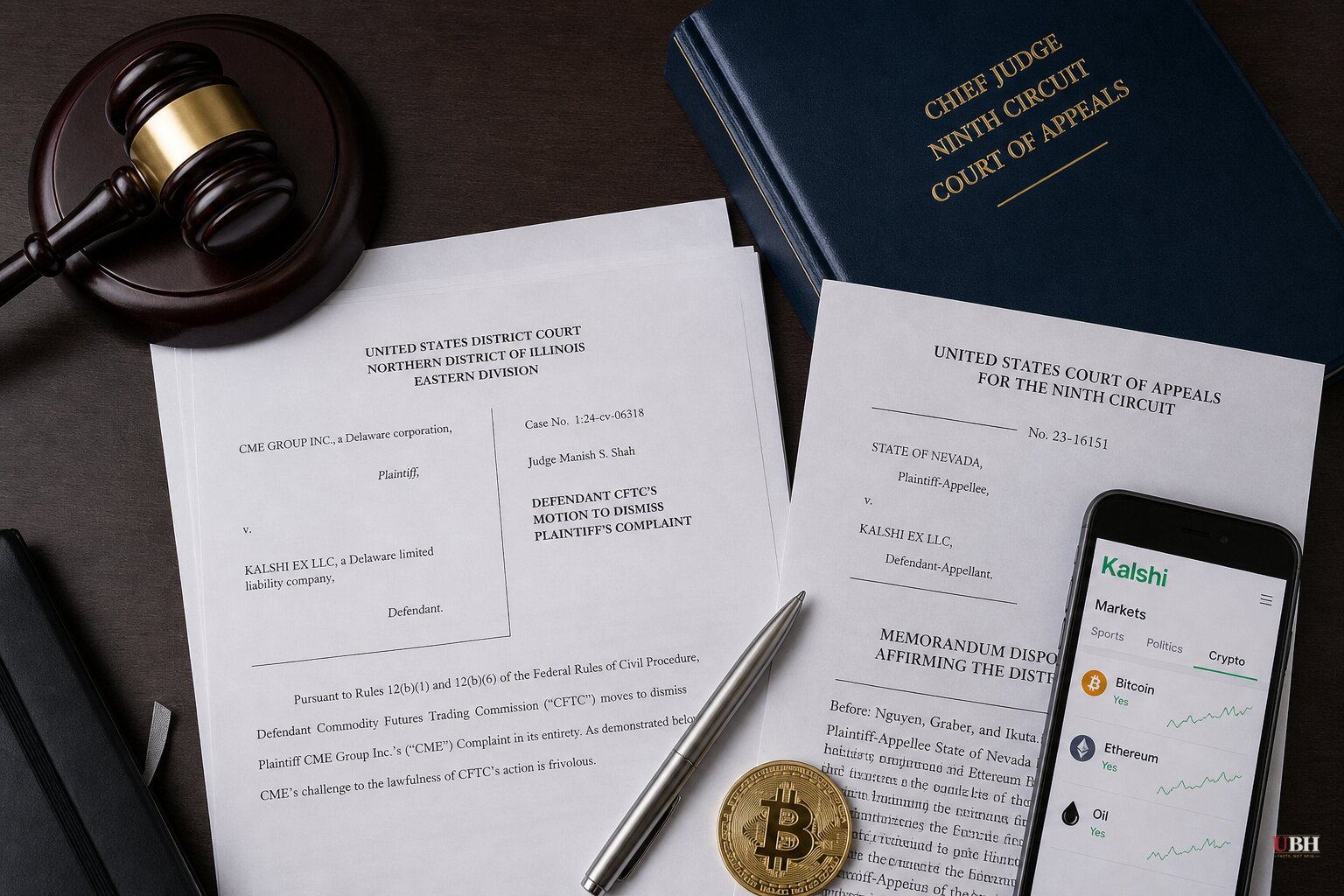
The fight over whether prediction markets are legitimate financial exchanges or unregulated gambling operations just escalated on three fronts at once, all inside a single week.
On Wednesday, September 2, the Commodity Futures Trading Commission filed a motion in the U.S. District Court for the District of Columbia to dismiss CME Group's lawsuit over Kalshi's Bitcoin perpetual futures, contracts that never expire. According to a filing shared by Jake Chervinsky, CEO of the Hyperliquid Policy Center, the CFTC called CME's suit "much ado about nothing" and said the exchange lacks standing to sue at all.
The agency's argument, as reported by BigGo Finance, is blunt: CME is itself a designated contract market and could list its own perpetual futures tomorrow if it wanted to. Any competitive disadvantage, the CFTC says, is self-inflicted. The CFTC also argued that even if a court reclassified perpetuals as swaps instead of futures, Kalshi and other exchanges could simply offer the same product as swaps, so CME would gain nothing.
CME sued the CFTC in June after the agency, under Chairman Michael Selig, approved Kalshi's "BTCPERP" contract in late May as a futures product rather than a swap. CME argues that approval violated the Commodity Exchange Act and Dodd-Frank because it skipped public comment and reasoned rulemaking, and that perpetual futures don't meet the traditional legal definition of a futures contract since they never settle. The CFTC's response, per Crypto Briefing, is that CME's real complaint is about classification, not authority, and that CME has shown no concrete harm.
The sports-betting front just went the other way
While the crypto-derivatives fight played out in Washington, a separate but related battle over sports-event contracts broke against Kalshi. On Friday, August 28, the Ninth Circuit Court of Appeals ruled that Nevada can enforce its state gambling laws against Kalshi's and Crypto.com's sports contracts, according to the Daily Wire.
A unanimous three-judge panel rejected Kalshi's argument that its sports contracts are federally regulated swaps immune from state gambling law. "The sports event contracts were not 'swaps' because they were sports bets," the panel wrote. Judge Ryan Nelson added pointedly: "The CFTC is not a national gambling regulator. No one suggested it was until over a decade after the law was passed."
The court also cited Kalshi's own marketing language advertising itself as "the first app for legal sports betting" in all 50 states, treating that as evidence the contracts function as ordinary wagers regardless of how they're structured on paper.
That ruling directly conflicts with an earlier Third Circuit decision finding that New Jersey could not apply its own gambling laws to Kalshi. Nevada Gaming Control Board Chairman Mike Dreitzer called the Ninth Circuit outcome a win: "This is sports betting and needs to be properly regulated by the state." Kalshi spokeswoman Dani Lever countered that the Ninth Circuit actually agreed with the Third Circuit on the core point that federal law prevents states from regulating trading on a federally licensed exchange, and said Kalshi intends to keep fighting.
With two federal appeals courts now split, New Jersey filed a petition with the U.S. Supreme Court on September 2 asking the justices to resolve the question directly, according to the Epoch Times. New Jersey Attorney General Jennifer Davenport argued that Kalshi "claim[s] to offer legal sports betting in all 50 States, but they refuse to follow the gambling laws of any State," and noted that dozens of states across the political spectrum have opposed the company's model. Kalshi self-certified its sports contracts directly with the CFTC rather than seeking prior agency approval, a process New Jersey's petition says lets the company sidestep state licensing, age-21 requirements, and problem-gambling safeguards altogether.
States have run gambling regulation, including age verification and addiction protections, for decades, and a federally certified exchange that never has to touch a state licensing process creates a potential gap if the underlying product is functionally a sports bet. Kalshi's counter, that Congress gave the CFTC exclusive jurisdiction over federally regulated exchanges and a state-by-state patchwork would gut that framework, is also a legitimate reading of the Commodity Exchange Act. The Supreme Court has not agreed to hear the case as of this writing.
Meanwhile, Kalshi wants to do it again with oil
As the legal fights multiply, Kalshi is preparing to push perpetual futures into a third asset class. A person familiar with the plan told Briefs.co that Kalshi intends to file with the CFTC as early as next week for a never-expiring futures contract tied to West Texas Intermediate crude, trading continuously five days a week rather than around the clock like its crypto perpetuals. If approved, it would be the first perpetual futures contract on a regulated U.S. exchange tied to oil.
This fight surfaced publicly at a CFTC roundtable, where CME Chairman Terry Duffy told the room prediction-market operators are "not a bunch of carnival barkers at a circus" while mocking one of Kalshi's contracts tied to the Nathan's hot dog eating contest, according to Crypto.news. Kalshi co-founder Luana Lopes Lara fired back by asking whether CME had ever faced market manipulation issues of its own, and the exchange traded jabs over regulatory staffing before Duffy cut in: "I have more people in my regulatory department than you have in your whole company." Lara replied: "Maybe you should learn a bit about efficiency then."
A CME spokesperson declined to comment on the WTI filing, and the CFTC did not immediately respond to requests for comment, per Briefs.co. Whether the Supreme Court takes up New Jersey's petition, and whether the CFTC actually approves an oil perpetual next week, will determine how far this fight spreads beyond crypto and sports betting into the rest of the derivatives market.
Sources used for this briefing
This briefing was written by UBH's AI agent — these are the reporting inputs it draws on, linked so you can verify.


