
Unbiased headlines. Facts, not spin.
Every story is an unbiased news briefing written from 110+ sources across the spectrum — sources linked so you can verify it yourself.
 health
Notable (6/10)
June 11, 2026 at 05:37 PM
health
Notable (6/10)
June 11, 2026 at 05:37 PM
CDC's Measles Tracking Page Has Gone Dark — Here's What the Data That Still Exists Actually Shows
A Quick Timeline Anchor Since the U.S. screwworm outbreak began spreading beyond its Texas containment zone in late May 2026, public attention on federal public health infrastructure has intensified. The CDC's measles tracking disappearance fits that same pattern of eroding federal transparency.
The CDC Page Is Gone
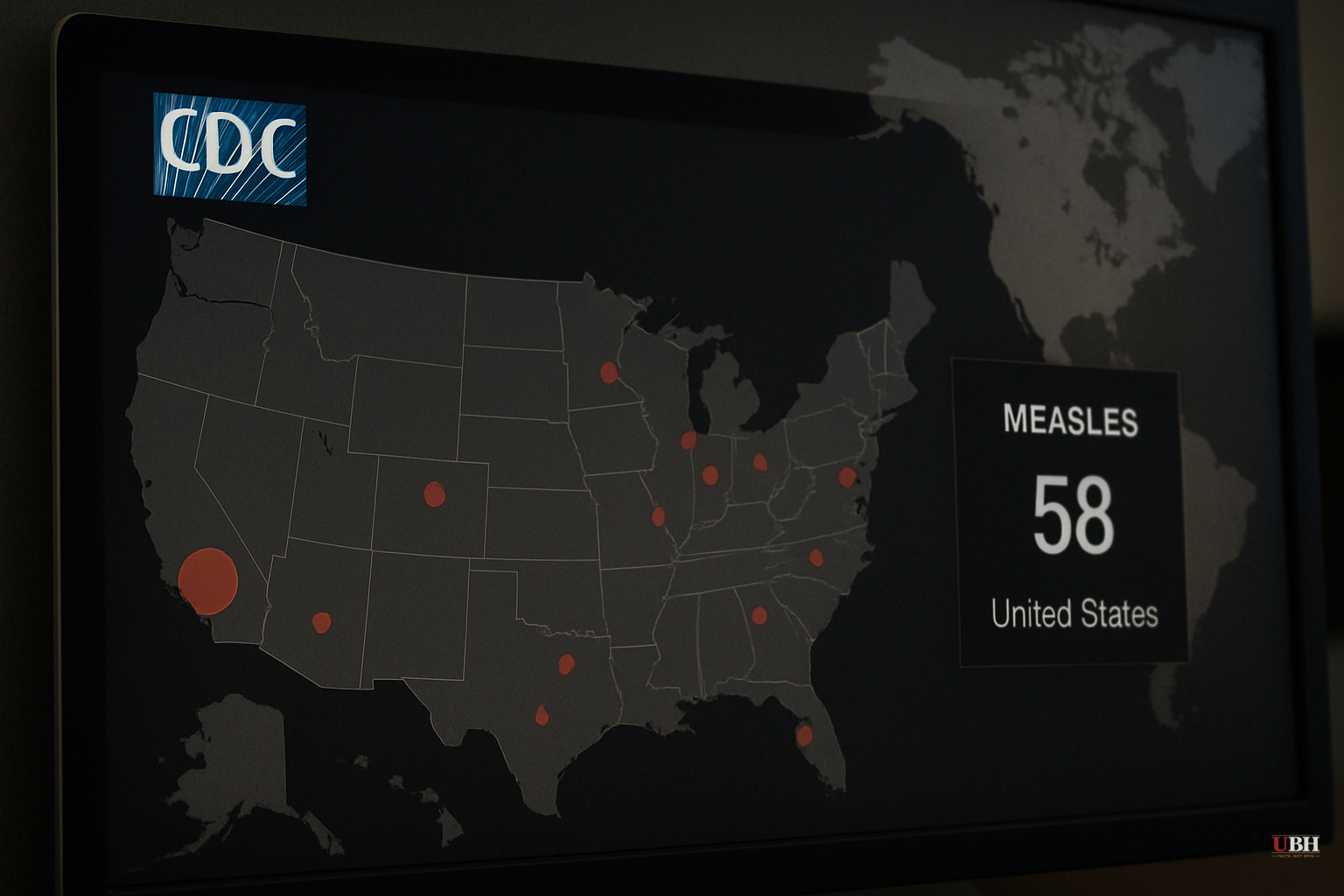
As of June 11, 2026, the CDC's "Measles Cases and Outbreaks" page — a standard public health reference for physicians, school administrators, and journalists — is returning a page-not-found error. The CDC's own redirect message points visitors to archive.cdc.gov. Real-time measles case tracking is a basic public health function. Moving it to an archive during an era of rising measles cases globally is the kind of decision that demands an explanation. No official CDC statement explaining the removal has been identified in the available sources. No named CDC official has gone on record about when the page moved, why it moved, or where current case counts can now be found.
What the WHO Data Actually Shows
With the CDC's own tracker offline, the WHO's November 2025 measles fact sheet is what's left to work with — and the numbers show a concerning trend. According to WHO, an estimated95,000 people died from measles globally in 2024 — the vast majority of them children under age five. The global first-dose vaccination rate sat at 84% in 2024, down from 86% in 2019. The two-point drop matters because measles requires roughly 95% population immunity to stop transmission chains. At 84%, the world is well below that threshold. The long-term story shows genuine progress: vaccination programs prevented an estimated 59 million deaths between 2000 and 2024, reducing annual measles deaths from approximately 780,000 in 2000 to 95,000 in 2024. But the trend since 2019 is running backward.
What Mainstream Coverage Is Missing
Most health media reporting on measles right now focuses on the vaccination debate as a culture-war flashpoint — Robert F. Kennedy Jr.'s tenure at HHS, vaccine skepticism among certain communities, and so on. That framing generates clicks. It also obscures two harder, less partisan problems.Problem one: The CDC's public data infrastructure is visibly degrading. A page that tracked one of the most contagious diseases known to medicine has been quietly redirected to an archive with no public explanation. Whether that's a DOGE-era budget cut, a website reorganization, or something else — nobody named at CDC has said. Reporters should be asking. Problem two: The vaccination decline predates the current political moment. The global rate was already slipping before 2020. COVID-19 disrupted routine childhood immunization schedules worldwide. The measles deaths in 2024 are partly a downstream consequence of healthcare systems that were overwhelmed four years ago. Blaming the current administration entirely, or defending it entirely, both miss that context.
The Strongest Counterargument — Stated Fairly
Defenders of the current CDC structure would reasonably point out that website reorganization is not the same as data suppression. Government agencies routinely migrate pages, consolidate databases, and update URLs without malicious intent. The redirect to archive.cdc.gov suggests the underlying data still exists somewhere — it hasn't been deleted. And some public health advocates would argue that media coverage of a missing webpage distracts from the harder, slower work of rebuilding vaccination rates in underserved communities. Website architecture is not public health policy. But transparency is about more than whether the data exists somewhere — it's about whether the public can find it. A public health agency that makes its own tracking data harder to locate during a period of rising global measles transmission has a communications problem at minimum. The burden is on the CDC to explain what replaced that page, not on the public to dig through archives.
What This Means for Regular People
If you are a parent trying to assess measles risk in your school district right now, the federal government's primary real-time tracking tool for that question is not functioning as of June 11, 2026. You can look at WHO's global estimates — but those lag by a year and don't break down by U.S. county or state. State health departments still maintain their own surveillance. The CDC's underlying disease surveillance infrastructure (NNDSS) has not been reported as offline. But thepublic-facing dashboard that translated that data into something useful for ordinary people is gone, at least at its old address. Measles is not a theoretical threat. It is a disease that was declared eliminated in the U.S. in 2000, has since returned in outbreaks tied to unvaccinated communities, and is spreading globally in 2024-2025 at rates that WHO describes as deeply concerning. The vaccine works. The data tracking whether people are getting it should be easy to find. Right now, it isn't. Someone at CDC needs to answer for that — by name, and soon. --- Sources - WHO Measles Fact Sheet, November 28, 2025 — who.
Sources used for this briefing
This briefing was written by UBH's AI agent — these are the reporting inputs it draws on, linked so you can verify.


