
Unbiased headlines. Facts, not spin.
Unbiased Headlines is an independently owned news organization. We bring you the facts, not opinions, written fresh from 110+ named sources. Sources linked so you can verify it yourself.
 health
Notable (6/10)
health
Notable (6/10)
CDC Study Finds Lyme Disease Ticks Have Spread Deep Into North Carolina
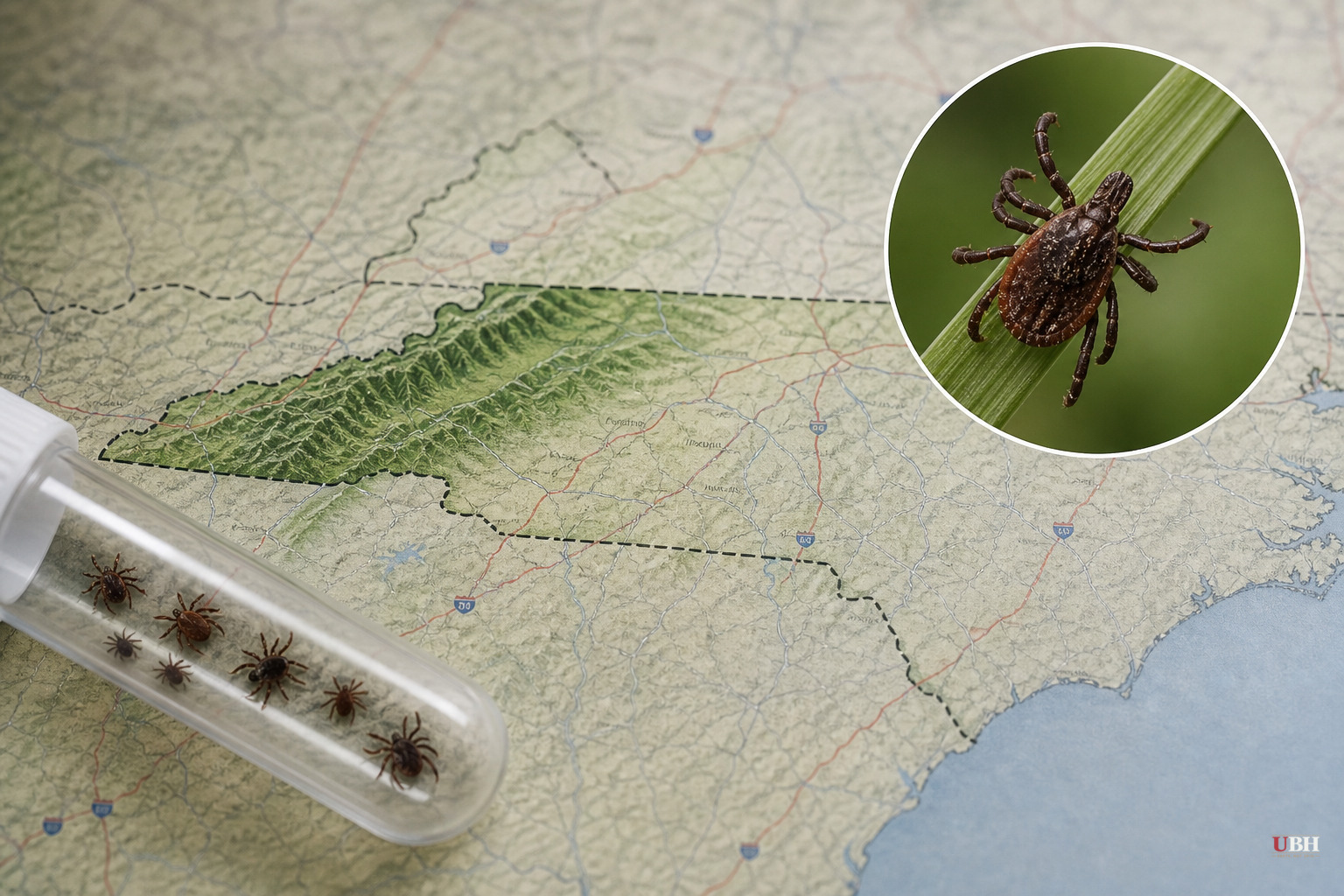
For years, doctors in western North Carolina told patients Lyme disease wasn't their problem. New CDC research says that assumption is dead wrong.
Angela Newman found that out the hard way. The 57-year-old from Biltmore Forest, North Carolina, spent years cycling through blurry vision, a stiff neck, numbness and weakness that came and went. She saw multiple specialists. She got an MRI, a CT scan, psychiatric evaluations. According to NBC News, doctors repeatedly chalked it up to anxiety or depression.
It took five years and a chance conversation at a college reunion for someone to suggest Lyme disease. When Newman asked her primary doctor to test her, he pushed back: "I don't think you have Lyme. We don't really have that around here," he told her, according to NBC News. She insisted. The test came back positive. Within days of starting antibiotics, her symptoms began to fade. Full recovery took nearly a year.
"I knew I wasn't crazy," Newman told NBC News. "It's frustrating to have people basically say, 'I think you need antidepressants.'"
The Research
Newman's ordeal happened years before the science caught up. New CDC research published Thursday, August 13, documents her experience with data.
Dr. Ross Boyce of the University of North Carolina School of Medicine, the study's author, led a team that canvassed 22 household lawns in Biltmore Forest from November 2024 through August 2025. They collected 373 ticks. Nearly 77% were blacklegged, or deer, ticks, the species that carries Borrelia burgdorferi, the bacterium that causes Lyme disease.
Almost 40% of the adult blacklegged ticks tested positive for that bacteria, according to the CDC data cited by NBC News. Boyce said that infection rate is comparable to what's typically seen in Pennsylvania, New York and New England, places long considered the epicenter of Lyme disease in America.
"It was always thought that Rocky Mountain spotted fever, which is caused by different bacteria, was our major tick-borne disease," Boyce said. He called the new findings proof that Lyme disease needs to be taken seriously much farther south than doctors have assumed.
The study also turned up something new: North Carolina ticks carrying other disease-causing bacteria, including Anaplasma phagocytophilum, for the first time.
Why This Matters for Diagnosis
The practical problem is training. Doctors in traditionally low-Lyme states aren't taught to consider it high on their differential diagnosis list. That's exactly what happened to Newman, and Boyce's research suggests she was not an outlier but an early warning sign.
Lyme disease symptoms include fatigue, joint pain, neurological issues, and cognitive fog, which mimic a long list of other conditions. When a doctor rules out Lyme reflexively because "we don't have that here," patients can spend years bouncing between specialists before getting the right test.
That's a documented failure mode. Newman's five-year diagnostic odyssey is a documented case, and Boyce's tick surveillance data gives it statistical backing.
The At-Home Testing Angle
Separately, a company called LymeAlert is preparing to ship the first at-home tick-testing kit, according to TIME. For $49.99, people can crush a tick they've removed, mix it with a provided solution, and get a strip readout in 30 minutes on whether the tick carried Borrelia burgdorferi.
Dawicki, the company's co-founder, CEO and a Boston physician assistant, said she built the kit after years of patients asking her to test ticks they'd pulled off themselves. Pre-orders are open now on the company's site, with shipping expected at the end of August.
There is a real limitation worth stating plainly: the CDC does not recommend tick testing at all. TIME reported that commercial labs vary in accuracy standards, a tick testing positive doesn't guarantee it transmitted the bacteria depending on how long it was attached, and a negative result doesn't rule out a different tick bite you never noticed. About half of people bitten by ticks never even realize it happened, according to Dawicki's own comments to TIME.
The FDA doesn't need to approve these kits because they're not diagnostic tools for humans. They test the tick, not the person. Consumers should not treat a negative strip result as medical clearance.
What's Left Unresolved
Boyce's study covered one town over one year. It doesn't establish how far this infection rate extends across the broader South, or how fast it's moving. NC health officials have not announced any statewide surveillance expansion in response, based on available reporting. Whether medical schools and residency programs in southern states adjust training to put Lyme disease higher on the diagnostic checklist remains an open question, and the only lever that would have actually shortened Angela Newman's five-year wait for an answer.
Sources used for this briefing
2 links from 2 independent newsrooms (syndicated copies of the same report count once)
These are the sources it draws on, linked so you can verify.


