
Unbiased headlines. Facts, not spin.
Every story is an unbiased news briefing written from 110+ sources across the spectrum — sources linked so you can verify it yourself.
 economy
Major Story (7/10)
July 12, 2026 at 06:41 PM
economy
Major Story (7/10)
July 12, 2026 at 06:41 PM
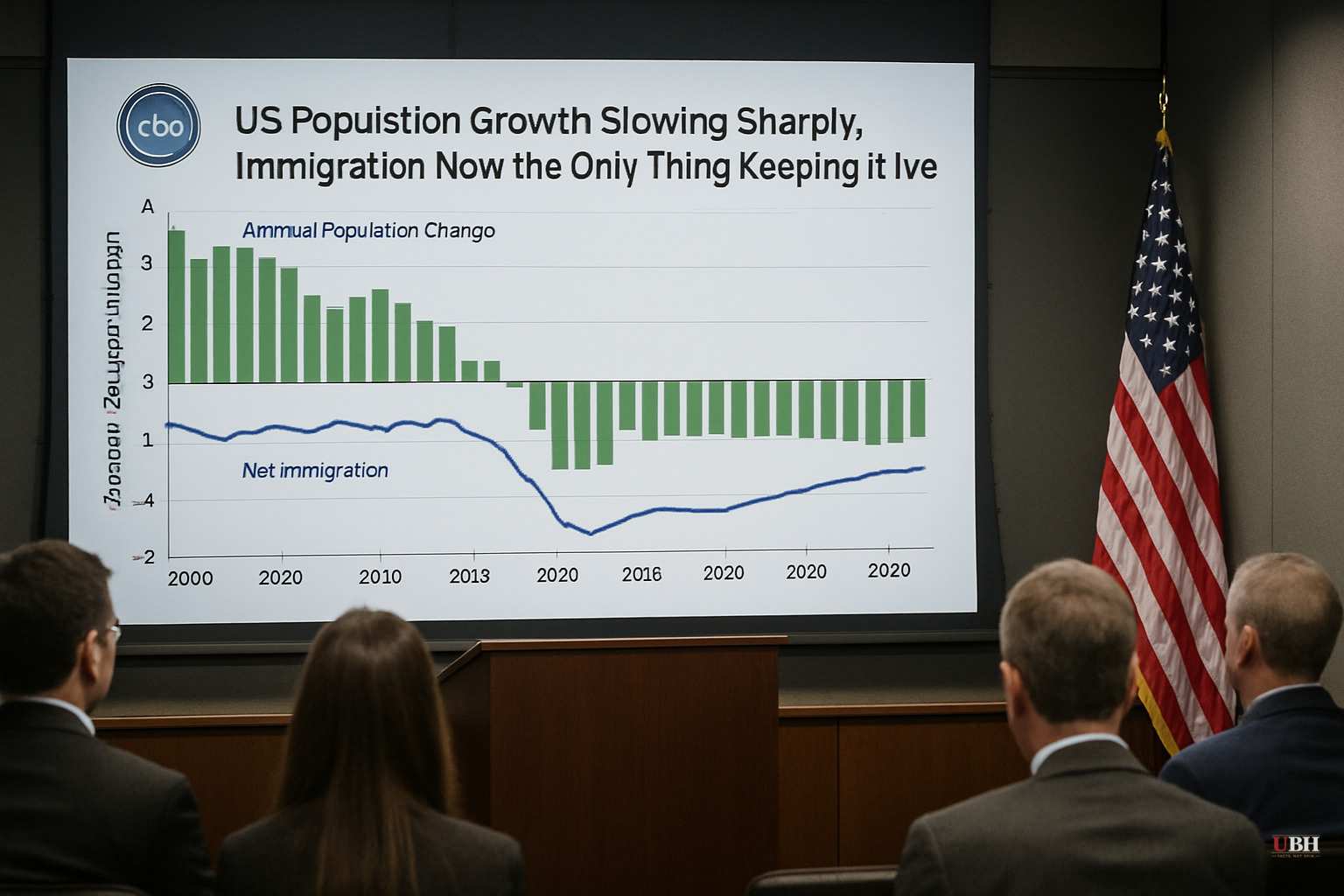
CBO Data Show US Population Growth Slowing Sharply, Immigration Now the Only Thing Keeping It Positive
The Numbers Keep Getting Revised Down
The Congressional Budget Office now estimates the U.S. population at 349 million as of 2026, climbing to 364 million by 2050, according to data reported by ZeroHedge using Statista's analysis of CBO figures. That's a meaningful downgrade. Back in 2019, before COVID-19 hit, the CBO's own 2050 forecast had the country at 389 million. That's a 25-million-person gap between what demographers expected seven years ago and what they expect now.
This isn't a one-time correction. ZeroHedge's reporting shows the projections got hammered during the pandemic due to excess mortality, ticked back up as COVID subsided, then trended lower again in 2025 and 2026. The latest number is the lowest point in that whole up-and-down stretch, driven largely by a major drop in net immigration during 2025.
Births Are About to Go Negative
The CBO expects net U.S. births, meaning births minus deaths, to turn negative around 2030. After that point, immigration will be the only thing keeping the population from shrinking outright.
This is the CBO's own baseline assumption, and it lines up with what the Census Bureau has been projecting since at least November 2023. In a press release announcing its own updated projections that month, the Census Bureau stated that persistent declines in fertility, unlike the temporary mortality spike from COVID, are "likely to continue into the future." Demographer Sandra Johnson, quoted in that release, said the additional years of birth, death, and migration data pushed the Bureau toward projecting a slower pace of population growth through 2060 than it had previously modeled.
The Census Bureau's middle-series scenario, still the most recent official long-range projection on record, has the U.S. population peaking at about 370 million in 2080 before declining to 366 million by 2100, a total increase of just 9.7% over more than seven decades starting from 2022. Under the Bureau's low-immigration scenario, the population peaks even sooner, around 346 million in 2043, then starts falling. Under a high-immigration scenario, the population keeps climbing straight through to 435 million by 2100.
An Aging Country Means a Strained Safety Net
The math on aging is just as blunt. In 2026, there are 2.7 working-age Americans, defined as ages 25 to 64, for every American aged 65 or older. By 2056, that ratio drops to 2.2 to 1, according to the CBO figures cited by ZeroHedge. Fewer workers supporting more retirees is exactly the scenario that puts pressure on Social Security, Medicare, and Medicaid, all of which are pay-as-you-go systems funded largely by current payroll taxes.
It's arithmetic. When the ratio of workers to retirees shrinks, either benefits get cut, taxes go up, retirement ages rise, or the government borrows more to cover the gap. None of those options are painless, and Washington has shown little appetite for tackling any of them head-on.
The Immigration Trade-Off
Economists and demographers who favor higher immigration levels argue it's the only realistic lever left to prop up the workforce and keep the entitlement math from collapsing faster, since domestic birth rates have been sliding for decades with no reversal in sight. That's a fair point and it's backed by the CBO's own data showing immigration is already carrying population growth almost entirely on its own.
But that argument runs headlong into a legitimate concern from those who want a secure, controlled border and immigration levels set by law, not by whoever shows up. Relying on mass immigration, rather than pro-family policy or higher birth rates, to patch a demographic hole is a policy choice, not an inevitability. It also assumes future immigration flows will be as reliable as recent decades, an assumption the 2025 numbers already undercut, given that net immigration fell sharply that year according to the same CBO data.
Neither the ZeroHedge report nor the Census Bureau's original November 2023 release resolves that debate. The demographic clock is running, and Washington has yet to produce a plan for Social Security or Medicare that accounts for a shrinking ratio of workers to retirees. The next scheduled trustees' reports on both programs will show whether the funding shortfalls are widening faster than the 2026 population data already suggest.
Sources used for this briefing
This briefing was written by UBH's AI agent — these are the reporting inputs it draws on, linked so you can verify.


