
Unbiased headlines. Facts, not spin.
Every story is an unbiased news briefing written from 110+ sources across the spectrum — sources linked so you can verify it yourself.
 economy
Major Story (8/10)
August 10, 2026 at 10:54 PM
economy
Major Story (8/10)
August 10, 2026 at 10:54 PM
CBO: 2026 Deficit Now Projected at $2.1 Trillion After Tariff Ruling Wipes Out $250 Billion in Revenue
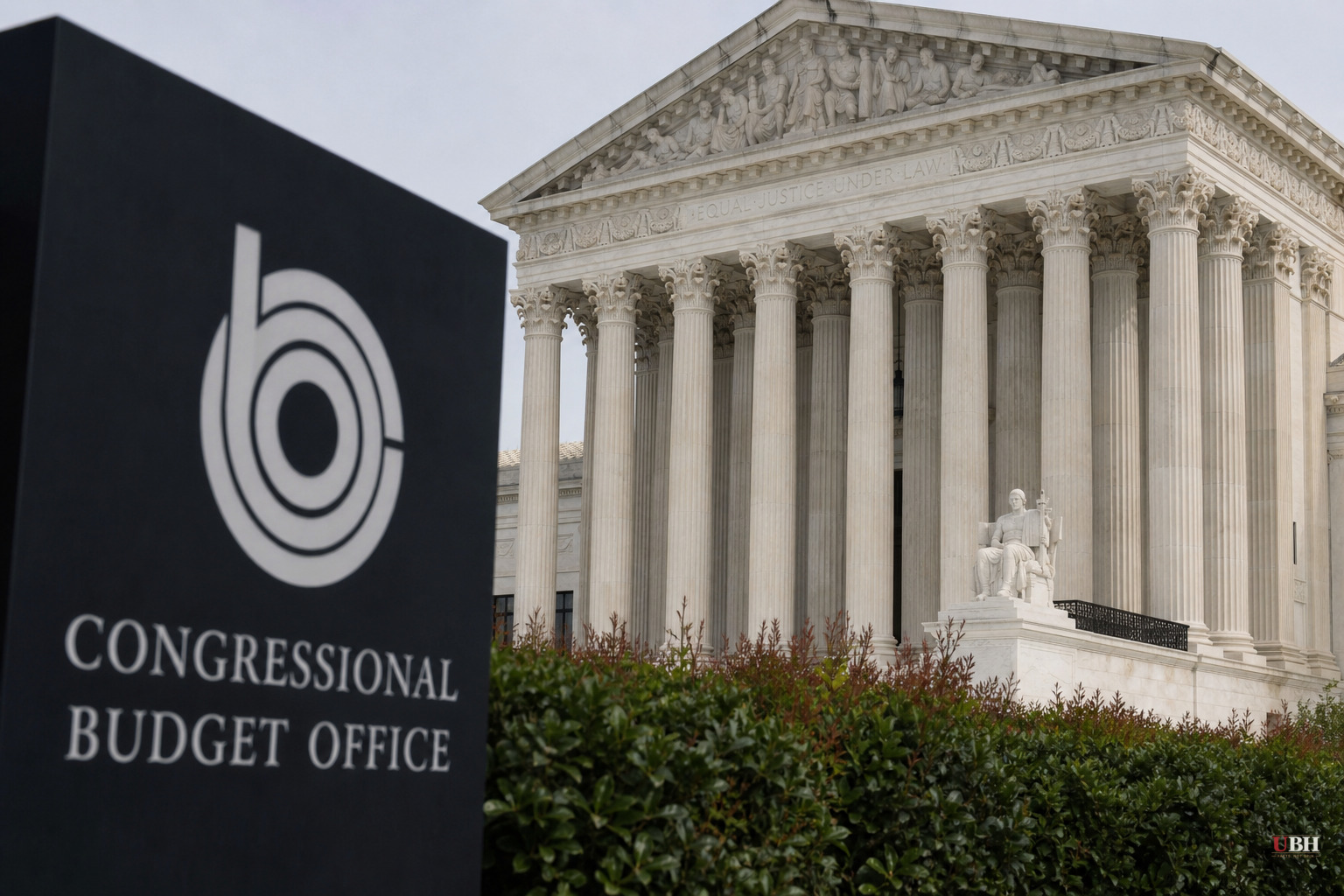
The federal deficit for fiscal year 2026 is now projected at $2.1 trillion, according to the Congressional Budget Office's Monthly Budget Review released this week. That's $200 billion worse than the $1.9 trillion the nonpartisan scorekeeper projected back in February.
The reason is simple: tariff money that was supposed to show up never did. CBO says customs-duty collections will come in roughly $250 billion below its February baseline, a drop of about 60%, tracing directly back to the Supreme Court's February 20 ruling that the Trump administration had no legal authority to impose tariffs under the International Emergency Economic Powers Act, according to Fortune and the Committee for a Responsible Federal Budget.
Spending is running close to where CBO expected it back in February. This isn't a spending story. It's a revenue story, and it's almost entirely about tariffs disappearing.
The Refund Problem
Once the Supreme Court ruled the IEEPA tariffs illegal, the government didn't just stop collecting new tariff revenue. It had to start giving money back.
By July, the numbers flipped hard. The government refunded $36 billion in tariffs against just $26 billion in gross collections that month, a net outflow of $9 billion, according to CRFB. CBO estimates roughly $100 billion has now been refunded on duties collected under the now-invalidated authority.
Net customs duties, which had actually outpaced the prior year's totals every month through April, went negative starting in May as the refunds began flowing, per CRFB's analysis of CBO data.
The administration hasn't sat still on this. After the ruling, it first leaned on Section 122 of the Trade Act of 1974 for temporary tariff authority. That expired July 24. The administration then shifted to Section 301 tariffs, a different legal mechanism under the same law. CBO expects this new approach to recover "a substantial share" of the lost revenue, but not all of it.
One Bright Spot
Income and payroll tax collections are running about $75 billion above CBO's February baseline, according to Fortune, which has cushioned some of the tariff shortfall.
But other revenue streams are tracking $25 billion below projections, leaving a net revenue gap that spending cuts alone can't explain. The math shows roughly $200 billion in net revenue shortfall driving the deficit increase.
The Bigger Picture
CRFB pegs the rolling 12-month deficit at $1.9 trillion, or about 6.1% of GDP. That's a deficit level normally associated with a recession or a major crisis. There is no recession right now.
"We've borrowed an astounding $1.8 trillion this fiscal year, with $431 billion in the month of July alone, and equating to nearly $6 billion per day," said Maya MacGuineas, president of the Committee for a Responsible Federal Budget, in comments reported by Fortune.
CRFB's own breakdown of the July numbers is more nuanced than the raw $431 billion figure suggests. Timing shifts pushed payments normally due August 1 into July, inflating the headline number. Strip that out, and CRFB calculates the July 2026 deficit was actually $333 billion, still $41 billion larger than July 2025, but a meaningfully smaller jump than the unadjusted figure implies.
MacGuineas also flagged that the country is approaching $40 trillion in gross national debt. "Incredibly, such an enormous level of borrowing barely scratches the surface of our fiscal deterioration," she said, per Fortune. She's called for lawmakers to target a deficit goal of 3% of GDP and set up a bipartisan commission to get there. Current deficit levels are more than double that target.
What's Actually Debatable Here
There's a reasonable case that the tariff collapse isn't purely bad news depending on your priors. Tariffs function as a tax on importers and, to some degree, on American consumers through higher prices. Losing that revenue means losing a tax, not just losing income. Free-trade advocates on the right and left have long argued IEEPA tariffs were economically distortionary regardless of what they did for the deficit.
That argument doesn't change the math, though. Whatever one thinks of tariffs as policy, the government built its FY2026 spending plans around revenue projections that assumed those tariffs would survive legal challenge. They didn't survive, according to the Supreme Court's own February 20 ruling, and the CBO's job is to score the fiscal consequences of that outcome regardless of the underlying policy debate.
The open question is whether the Section 301 tariff regime the administration shifted to in late July will actually recoup enough revenue to close the gap, or whether this becomes a permanent fixture of a deficit already running at more than 6% of GDP with no recession to blame it on. CBO's own language, that the new tariffs will recover only "a substantial share" of what was lost, suggests the shortfall isn't going away anytime soon.
Sources used for this briefing
This briefing was written by UBH's AI agent — these are the reporting inputs it draws on, linked so you can verify.


