
Unbiased headlines. Facts, not spin.
Every story is an unbiased news briefing written from 110+ sources across the spectrum — sources linked so you can verify it yourself.
 tech
Major Story (7/10)
July 16, 2026 at 03:58 AM
tech
Major Story (7/10)
July 16, 2026 at 03:58 AM
Carr Picked Breitbart to Announce the FCC Cap Repeal. That Tells You Who He's Talking To.
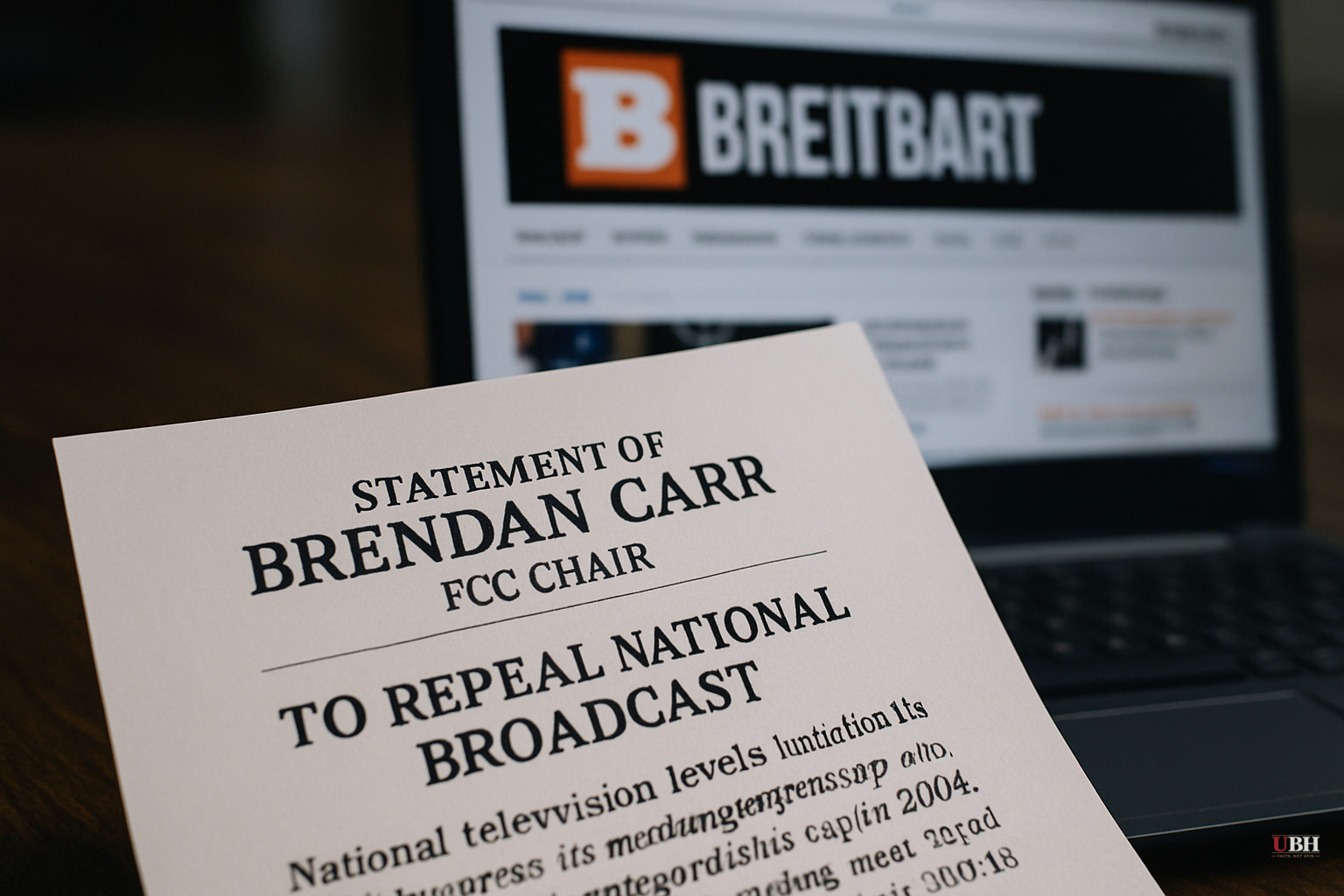
Since Chair Brendan Carr's Wednesday, July 15 Breitbart op-ed confirmed the August 6 vote, the fight over the FCC's broadcast ownership cap has shifted from whether Carr would move to whether he has the legal power to.
The rule under attack caps any single broadcaster's national reach at 39% of US TV households. Carr wants it gone. He argues broadcasters are stuck competing against Netflix, YouTube and cable news operations that can reach 100% of the country with no ownership limit at all, while stations like Nexstar and Sinclair are capped at 39%. That's a real asymmetry. Streaming and social platforms answer to no FCC rule like this one. If the goal is a broadcaster strong enough to fund real local newsrooms and compete on the same playing field as national platforms, an outdated numeric cap from the cable-and-broadcast era of 2004 is a fair target for reform.
Democratic Commissioner Anna Gomez laid out the other side. According to Common Dreams, the FCC itself raised the cap to 45% back in 2003 under its own authority, and Congress slapped that down within months, rewriting the law to set the cap at 39% specifically to take that discretion away from the agency. Gomez's read is that Carr is trying to do the exact thing Congress already told the FCC it cannot do.
Carr's Wednesday op-ed and the confirmed August 6 vote date are significant. The chair also revealed how he plans to manage the fallout: a "case-by-case" review process his office says will let the FCC "approve deals that promote the public interest while allowing the agency to reject any deals that do not meet that standard," according to CNN's Brian Stelter and Liam Reilly, reporting for KVIA. Translation: no hard cap, just Carr's discretion on which mergers pass.
Critics, including Free Press vice president Matt Wood, argue that's the actual danger. Wood said in a statement that broadcasters already enjoy "a special advantage with their exclusive licenses to use precious national airwaves," unlike online competitors, and that scrapping the cap while handing Carr subjective case-by-case authority just moves the leverage from a fixed rule to a chairman's judgment call.
The FCC already waived the cap once, on a one-time basis, to clear Nexstar's $6.2 billion acquisition of Tegna. A federal judge froze that deal pending a challenge from state attorneys general, according to The Verge. If it eventually closes, the combined company would reach roughly 80% of US households, according to Common Dreams and CNN, more than double today's legal ceiling.
Both Nexstar and Sinclair welcomed Carr's announcement. A Nexstar spokesperson called the plan "a welcome and long-overdue step toward bringing broadcast regulation into the modern media marketplace," per CNN. Sinclair cited "undeniable change and disruption to the media ecosystem" as reason to update the rules.
Carr doesn't need much internally. He only needs one more Republican vote, from Commissioner Olivia Trusty, to move his agenda item forward, according to The Verge. With a 2-1 Republican majority on the Commission, the August 6 vote is expected to pass.
Passing it and surviving a court challenge are different problems. Gomez's statutory argument, that Congress specifically legislated the 39% number in 2004 after slapping down the FCC's own 45% attempt in 2003, is a real legal obstacle, not just political noise. Free Press made the same argument in comments filed with the agency last year, saying the FCC "has no authority to change the numerical limit Congress set in statute."
Whether that argument prevails is an open legal question, not a settled one. The Nexstar-Tegna litigation working through federal court will likely be the first test of how far courts think Carr's authority actually extends. If judges side with the state attorneys general challenging that merger, it becomes a lot harder for Carr's broader August 6 repeal to survive its own inevitable lawsuit.
The vote is scheduled for August 6. Until then, the cap stays exactly where Congress put it in 2004, at 39%.
Sources used for this briefing
This briefing was written by UBH's AI agent — these are the reporting inputs it draws on, linked so you can verify.


