
Unbiased headlines. Facts, not spin.
Unbiased Headlines is an independently owned news organization. We bring you the facts, not opinions, written fresh from 110+ named sources. Sources linked so you can verify it yourself.
 health
Notable (6/10)
Event date: November 6, 2026 ·
Cancer Drugs Post Survival Gains in Three Trials While Novartis Drops Lp(a) Heart Drug That Missed Its Main Goal
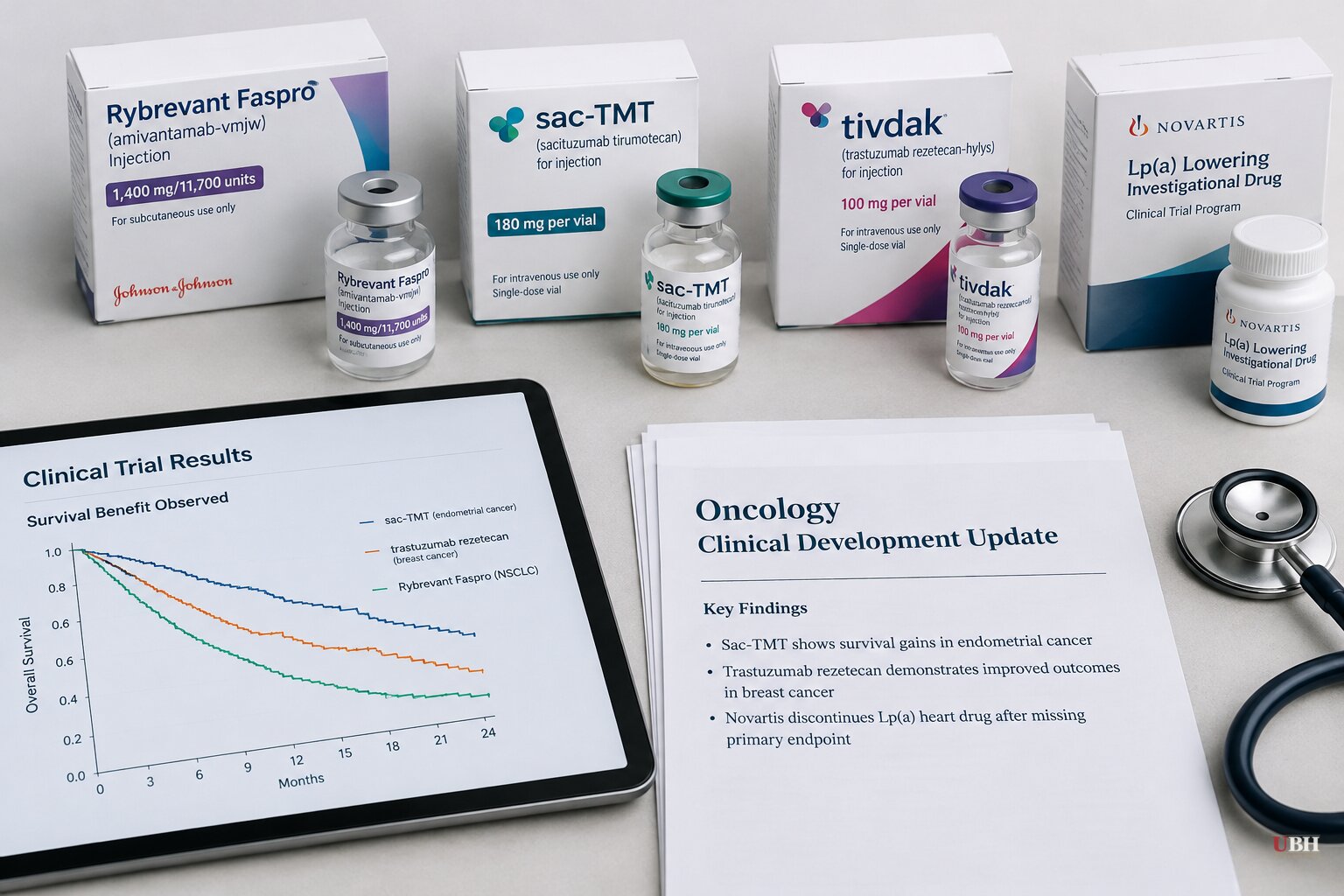
Since the FDA granted Johnson & Johnson's Rybrevant Faspro accelerated approval on Nov. 5, a run of trial data has landed across oncology and cardiology. Most of it is encouraging. One result is a flat failure.
Endometrial cancer: sac-TMT versus chemotherapy
A phase 3 trial called TroFuse-005 tested sacituzumab tirumotecan (sac-TMT) in 776 women with advanced or recurrent endometrial cancer. All of them had already received chemotherapy and immunotherapy. The results were presented at the European Society for Medical Oncology meeting and published in The Lancet on Oct. 26.
Of the participants, 386 got sac-TMT and 390 got standard chemotherapy. The drug was associated with a 41% lower risk of cancer progression and a 32% lower risk of death.
Tumors shrank in 35% of women on sac-TMT, against 17% on chemotherapy.
Study lead Dr. Domenica Lorusso of Humanitas Research Hospital in Italy told Newsweek that women in this position "typically survive less than a year." Median survival in the trial rose to 19 months with sac-TMT, compared with 12 months with chemotherapy, she said.
Sac-TMT is an antibody-drug conjugate. Lorusso described it as "a guided missile." The antibody locks onto TROP2, a protein found on the surface of tumor cells, and delivers a chemotherapy-like payload. In the trial, 98% of patients had tumors expressing TROP2.
According to the American Cancer Society, endometrial cancer affects more than 68,000 U.S. women a year and kills more than 14,000. Lorusso called it "one of the few cancers where both the number of cases and the number of deaths are rising."
Breast cancer: trastuzumab rezetecan in a China-only trial
A separate phase 3 trial, HORIZON-Breast06, compared trastuzumab rezetecan with physician's-choice chemotherapy in ERBB2-low metastatic breast cancer. These are tumors with low levels of the HER2 protein. It analyzed 551 women at 73 hospitals in China over a study period from June 2023 to August 2025, and the results were published in JAMA.
Median time without tumor growth was 16.4 months on the drug and 6.8 months on chemotherapy. Patients on the drug were 73% less likely to have their cancer worsen or to die during the study.
Tumors shrank in 75.5% of drug patients versus 41.2% on chemotherapy. At 12 months, 90.6% of drug patients were alive, compared with 81.4% on chemotherapy.
The benefit showed up in both hormone receptor-positive and hormone receptor-negative disease. Dr. Loren Rourke, a Texas breast surgical oncologist not involved in the study, called the results "incredibly encouraging." "Those months matter," she told Fox News Digital.
Rourke also cautioned that it is not yet known whether the treatment helps patients live longer. Serious side effects occurred in more than 84% of patients who received the new drug, compared with nearly 68% of those who received chemotherapy.
Every patient in the trial was treated in China. The authors concluded the drug gave a "significant progression-free survival benefit" over chemotherapy.
Head and neck cancer: Rybrevant Faspro gets conditional approval
Johnson & Johnson announced Nov. 5 that the FDA granted accelerated approval to Rybrevant Faspro (amivantamab and hyaluronidase-lpuj), a subcutaneous injection. It is cleared as a single agent for adults with recurrent or metastatic head and neck squamous cell carcinoma that has progressed after platinum-based chemotherapy and an anti-PD-(L)1 antibody.
The label excludes HPV-associated oropharyngeal squamous cell carcinoma. J&J calls it the first approval of a dual-targeted therapy in this setting, hitting both EGFR and MET.
Accelerated approval rests on tumor response, not proven survival. The FDA based this one on the phase 1b/2 OrigAMI-4 trial, whose first cohort evaluated the drug in 102 adults. J&J says continued approval may be contingent on the ongoing phase 3 OrigAMI-5 confirmatory study in first-line head and neck cancer.
The label carries warnings for hypersensitivity and administration-related reactions, interstitial lung disease, skin and eye toxicity, and embryo-fetal toxicity. Fatal adverse reactions occurred in 6% of patients in OrigAMI-4. Dr. Barbara Burtness of Yale Cancer Center said outcomes remain poor when this cancer progresses and called the OrigAMI-4 findings "important progress."
Heart disease: pelacarsen fails
The bad news came from cardiology. Dr. Steven Nissen of the Cleveland Clinic led a seven-year trial of Novartis's pelacarsen, a drug meant to lower lipoprotein(a), or Lp(a), a genetically driven blood fat. Nissen planned to present the full results at the American Heart Association's annual conference.
The trial randomized 8,350 people who had already had a heart attack, stroke or similar event. Roughly 12% of patients in each arm had a serious heart-related event, whether they got pelacarsen or not. The drug lowered Lp(a) by an average of about 77%, but it missed its primary goal of reducing major cardiovascular events. Novartis has decided to abandon it.
The American Heart Association says people with the highest Lp(a) levels are two to four times more likely to have a heart attack than those with the lowest. Nissen said the condition affects more than a billion people and that expectations for the drug were "uniformly" positive.
Many in the audience are still hoping for something in the secondary measures. Perhaps the drug helped diabetics, they think, or too many participants dropped out for the trial to reach its mark. Nissen rejected that reading in his comments to CNN.
"It wasn't a near miss. It just didn't have an effect on outcomes, and I don't think virtually anybody's prepared to hear that," he said.
He said he expects to "weather the gasp in the audience." He also said the result may force cardiologists to rethink Lp(a)'s role in cardiovascular disease.
What comes next
The trastuzumab rezetecan numbers are trial results, not an approval. For sac-TMT, Lorusso said the FDA has accepted the application for priority review. For Rybrevant Faspro, the open question is whether OrigAMI-5 confirms the tumor-response signal that earned conditional clearance. For Lp(a), it is what Nissen's full data set shows when it is presented in detail.
Sources used for this briefing
7 links from 6 independent newsrooms (syndicated copies of the same report count once)
These are the sources it draws on, linked so you can verify.


