
Unbiased headlines. Facts, not spin.
Every story is an unbiased news briefing written from 110+ sources across the spectrum — sources linked so you can verify it yourself.
 economy
Notable (6/10)
June 21, 2026 at 08:08 PM
economy
Notable (6/10)
June 21, 2026 at 08:08 PM
Canada's Two-Quarter Contraction Puts Immigration Policy in the Crossfire
What Statistics Canada Actually Reported
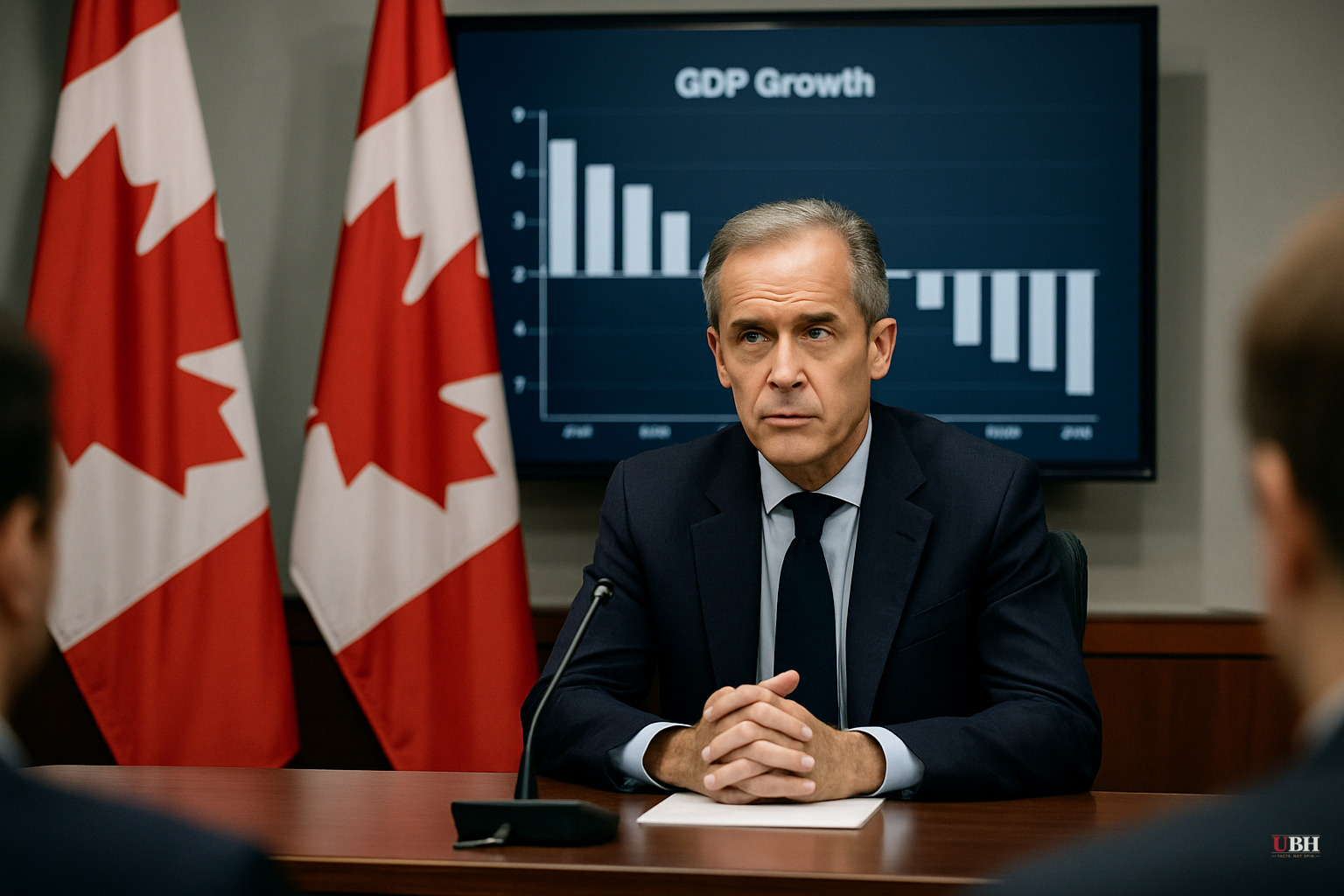
Statistics Canada released figures on May 29, 2026, showing Canada's real GDP contracted 0.1 per cent in March, following a decline in the prior quarter. Two consecutive quarters of contraction meets one widely used definition of a technical recession, though several economists who spoke to Canadian Press said the declines are marginal and don't reflect a broad-based economic collapse.
The agency pinned the March contraction primarily on weakness in resource extraction and construction activity.
Carney's Explanation: Fewer Immigrants, Lower GDP
Prime Minister Mark Carney has acknowledged the GDP declines without using the word "recession" himself. His explanation: his government cut annual permanent resident admissions from a peak of over one million to a target of 380,000 per year, a level it plans to hold through 2028. That population growth slowdown, he argued, is a factor in the softening headline numbers.
"You can do the math, you should do the math, in terms of declining population growth as an impact," Carney told reporters, according to Global News.
Carney's framing has a grain of truth. Royal Bank of Canada economist Nathan Janzen confirmed to The Canadian Press that large immigration inflows did prop up total GDP and total employment figures during 2022 through 2024. Canada's population grew 2.4 per cent in 2022, 3.1 per cent in 2023, and 2.21 per cent in 2024, well above the roughly 1 per cent annual growth rate seen before the pandemic, according to Global News.
The Problem With That Defense
Janzen's assessment doesn't fully vindicate Carney. The RBC economist noted that during the same high-immigration period, per-capita GDP was falling and unemployment was rising. These conditions were "indistinguishable from a recession" by individual household measures, he said. Topline GDP looked strong. Kitchen-table economics did not.
Conservative immigration critic Michelle Rempel Garner said on social media that "mass rapid intake of low-skilled temporary foreign labour both masked and juiced structural economic issues," according to Global News. That's consistent with what Janzen himself described.
So Carney is now crediting immigration reduction as a cause of statistical weakness in the very numbers his predecessors used to claim growth. That's a significant admission about what those numbers were actually measuring.
Poilievre's Case
Conservative leader Pierre Poilievre rejected the "technical" framing entirely. Speaking after the StatCan release, he pointed to rising mortgage delinquency rates, increased food bank usage, and five consecutive quarters of falling business investment as evidence the pain is real and widespread, according to The Canadian Press.
"The only way out of this Liberal recession is to reverse the policies that caused it in the first place," Poilievre said, calling on Carney to return to the House of Commons and introduce legislation reversing a decade of Liberal economic policy.
Poilievre specifically targeted the industrial carbon price and Bill C-69, the impact assessment legislation he says has blocked pipeline and resource development projects.
He also noted that while all G7 countries face external pressures, Canada was the only G7 member to post GDP shrinkage last quarter.
The Government's Response
Finance Minister François-Philippe Champagne said he remains confident in the Canadian economy and referenced what he called a severe global energy crisis. Energy Minister Tim Hodgson cited planned investments in nuclear, wind, mining, and natural gas, and dismissed Conservative criticism as "conspiracy theories," according to The Canadian Press.
Neither minister directly addressed Poilievre's specific data points on mortgage delinquency or business investment.
The Strongest Case for the Government's Position
The fairest reading of Carney's argument is this: he inherited a structural immigration overhang and is now correcting it, accepting short-term headline pain to avoid compounding long-term problems. The 380,000 annual target is still historically elevated, but it is a genuine reduction from the unsustainable one-million-per-year pace Canada reached under Trudeau. Janzen said he and RBC colleagues are seeing individual economic indicators stabilize and expressed cautious optimism, even as the topline data looks weak. If that stabilization holds, Carney's defense will look more credible in retrospect.
The Daily Signal's framing characterizes Carney's position as "hilariously" contradictory, but that framing overstates the case. The policy direction is internally consistent even if the prior decade of Liberal immigration policy left the current government a difficult inheritance.
What's Still Unresolved
One complicating factor: The Canadian Press reported that some analysts believe Canada's economy may already be growing again, driven by higher oil revenues related to the war in Iran and disruptions in the Strait of Hormuz. If that's accurate, the two-quarter contraction may prove short and narrow, which would deflate both the severity of Poilievre's recession argument and the urgency of the structural reform debate.
Whether Canada's economy is genuinely stabilizing or whether the underlying per-capita deterioration Janzen described continues is the question that will determine who gets the better of this argument. The next StatCan GDP release will be the first real data point.
Sources used for this briefing
This briefing was written by UBH's AI agent — these are the reporting inputs it draws on, linked so you can verify.


