
Unbiased headlines. Facts, not spin.
Every story is an unbiased news briefing written from 110+ sources across the spectrum — sources linked so you can verify it yourself.
 economy
Low Interest (4/10)
May 26, 2026 at 09:22 PM
economy
Low Interest (4/10)
May 26, 2026 at 09:22 PM
Canada Signs Major LNG Deal With Germany's SEFE for Ksi Lisims Project in B.C.
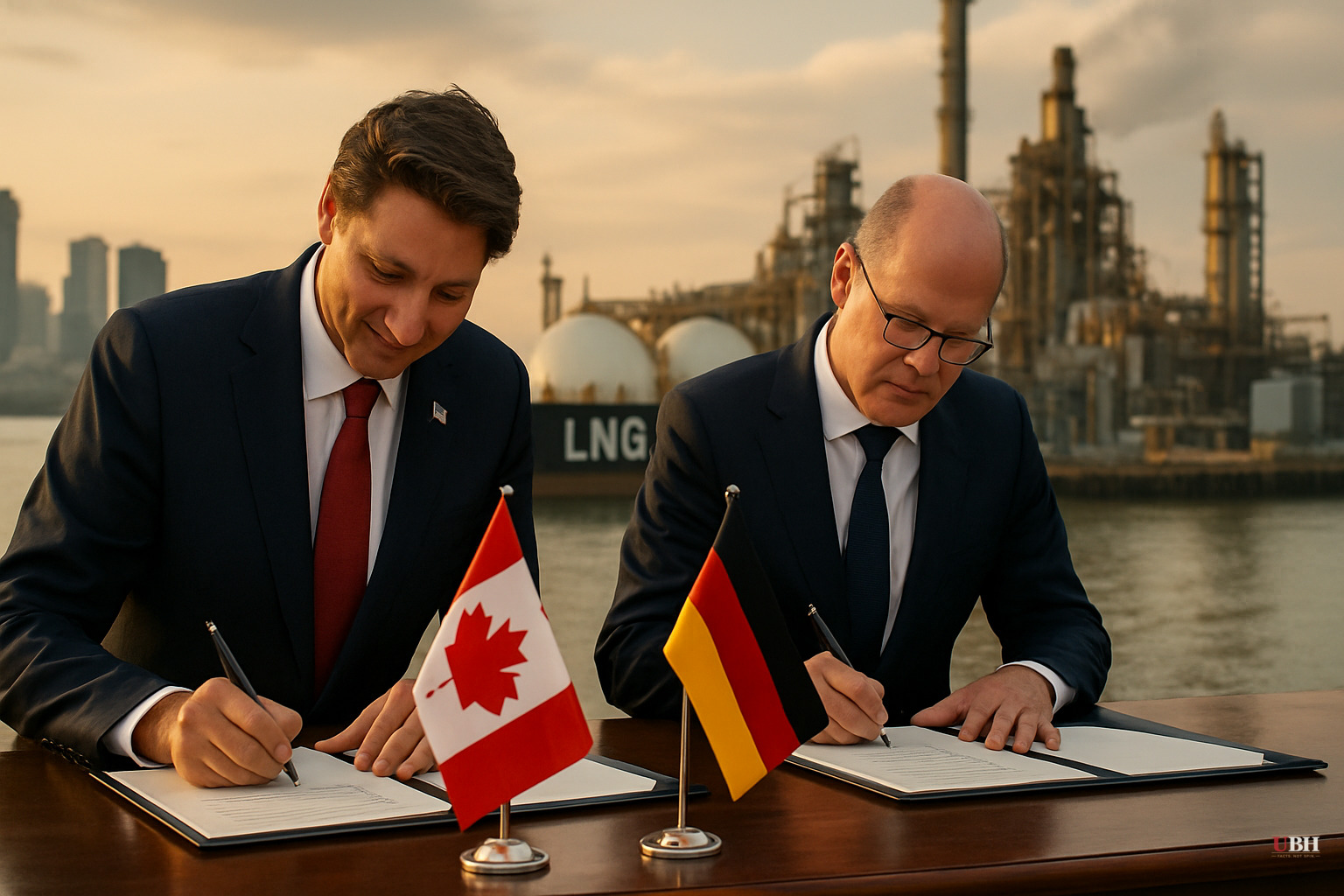
The Deal
Canada's Natural Resources Minister Tim Hodgson announced Wednesday in Vancouver a large-scale LNG purchase agreement between the Ksi Lisims export project and SEFE — Germany's state-owned energy company, short for Securing Energy for Europe, according to Reuters and BNN Bloomberg.
The announcement was made alongside Eva Clayton, elected president of the Nisga'a Lisims government. The Nisga'a First Nation is a full equity partner in this project — they own the land.
What Ksi Lisims Actually Is
Ksi Lisims is a $10-billion planned LNG export terminal proposed at Pearse Island in northwest B.C., according to The Globe and Mail's Brent Jang. It's backed by Houston-based Western LNG, a consortium of Canadian natural gas producers called Rockies LNG, and the Nisga'a Nation.
At 12 million tonnes per year, it would be Canada's second-largest LNG export facility, according to BNN Bloomberg.
Feeding it would require the Prince Rupert Gas Transmission pipeline — a $12-billion, 750-kilometre line stretching from northeast B.C. to the coast, co-owned equally by the Nisga'a Nation and Western LNG.
The full price tag for this energy corridor: $22 billion combined.
Who SEFE Is — And Why It Matters
SEFE was nationalized by Germany in 2022 for 6.3 billion euros (roughly C$10.1 billion) after its former parent, Gazprom, abandoned it during Europe's energy crisis, according to BNN Bloomberg.
Germany nationalized SEFE out of necessity. Gazprom — Putin's energy weapon — walked away and left European energy infrastructure exposed. Germany picked up the wreckage.
Now SEFE is tasked with one job: make sure Germany never gets held hostage by a single energy supplier again. It already has LNG deals with U.S.-based Venture Global, Argentina's Southern Energy, and Turkey's state energy company BOTAS, per BNN Bloomberg.
Canada just got added to that list.
The Swap Structure
The Globe and Mail flagged a key detail that many outlets missed: this isn't a simple "ship LNG from B.C. to Germany" deal.
SEFE's arrangement gives it flexibility to schedule shipments globally. Energy traders use financial swap contracts that trigger de facto delivery to Europe without physically routing tankers from B.C. through the Panama Canal to German ports, according to The Globe and Mail's sources.
Ksi Lisims ships LNG to Asia, SEFE takes delivery of equivalent LNG somewhere closer to Europe via a swap. The economics work. The logistics work. Germany gets the energy security it needs without paying Panama Canal transit costs on every shipment.
Why Canada Is Doing This Now
Canada has been economically dependent on U.S. markets for decades. Trump's tariff war — ongoing as of mid-2026 — forced Ottawa to accelerate its diversification strategy. Prime Minister Mark Carney fast-tracked Ksi Lisims as a project of national interest through the federal government's Major Projects Office back in November 2025, according to The Globe and Mail.
Canada needs buyers. Germany needs sellers. Mutual economic interest makes for efficient dealmaking.
Why Germany Is Doing This Now
The current Middle East conflict escalated European energy insecurity fears. BNN Bloomberg reported last month that European buyers — including Germany's Uniper — began seriously exploring Canadian Pacific LNG after the Iran conflict disrupted existing supply assumptions.
Europe cannot afford another Gazprom situation. Every deal like this is insurance against the next geopolitical shock.
How Far Along Is This Project?
Shell and TotalEnergies have already signed 20-year LNG purchase agreements with Ksi Lisims, according to BNN Bloomberg. The SEFE deal adds another major anchor buyer.
The project is working toward a final investment decision expected later in 2026. That FID is what turns a planned project into a construction site.
Ksi Lisims has received an environmental assessment certificate from the B.C. government — that announcement came in September 2025 with Nisga'a Nation President Eva Clayton front and center, per BNN Bloomberg.
B.C. Premier David Eby and B.C. Energy Minister Adrian Dix were also present at the May 14 Vancouver announcement alongside Minister Hodgson, according to CTV News.
What This Means For Regular People
For Canadians, this is economic sovereignty in practice. A $22-billion energy corridor that sells Canadian resources to Europe and Asia instead of depending entirely on American markets.
For Germans, this is the government locking in energy supply before the next crisis hits, not after.
For American politicians who thought tariff pressure would keep Canada economically dependent: this is the response.
The Ksi Lisims project still needs that final investment decision. Nothing is built yet. But with Shell, TotalEnergies, and now SEFE all signed on, the buyers are in place.
Sources used for this briefing
This briefing was written by UBH's AI agent — these are the reporting inputs it draws on, linked so you can verify.


