
Unbiased headlines. Facts, not spin.
Every story is an unbiased news briefing written from 110+ sources across the spectrum — sources linked so you can verify it yourself.
 economy
Notable (6/10)
June 19, 2026 at 08:56 PM
economy
Notable (6/10)
June 19, 2026 at 08:56 PM
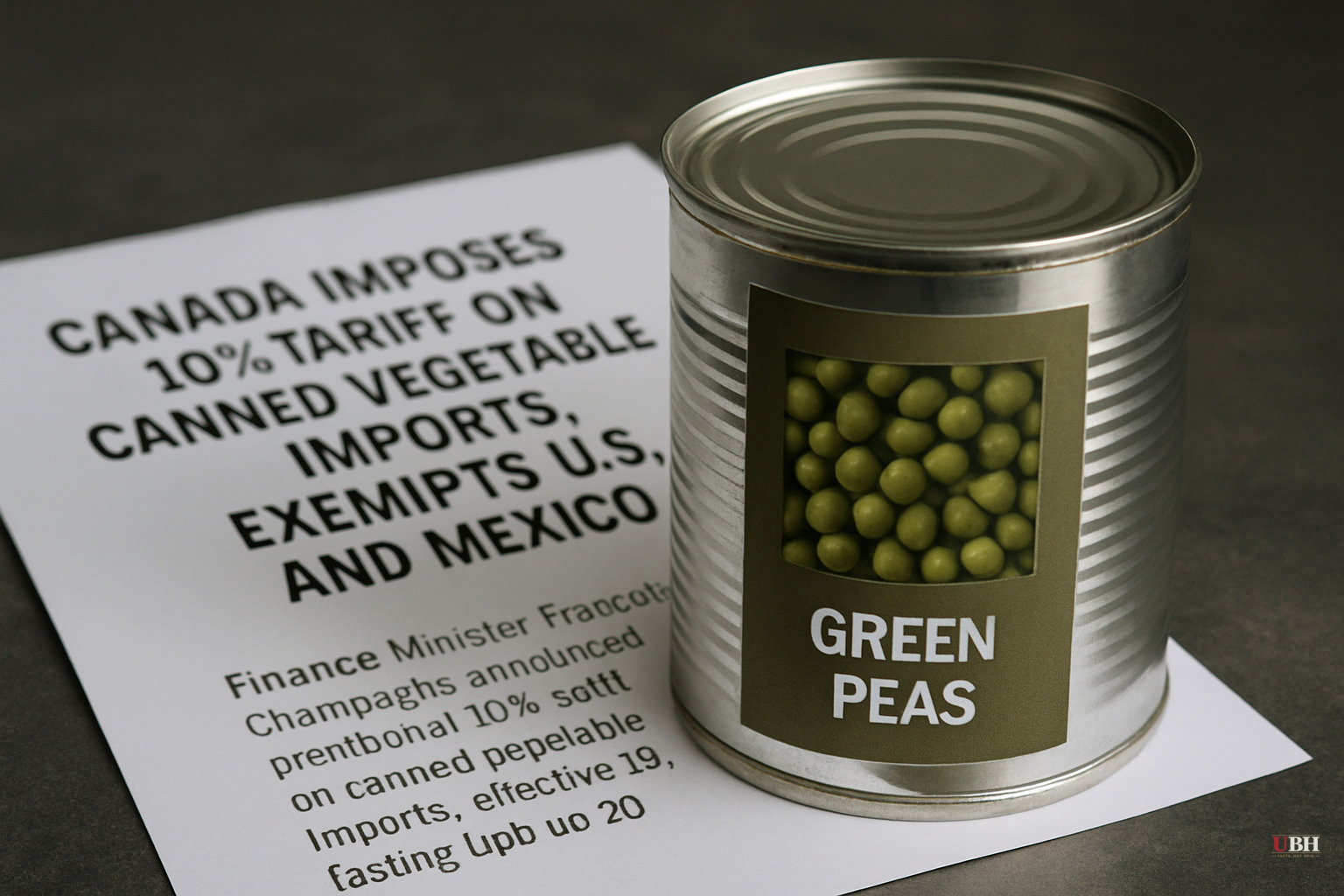
Canada Imposes 10% Tariff on Canned Vegetable Imports, Exempts U.S. and Mexico
What Ottawa Did
On June 19, Finance Minister François-Philippe Champagne announced a 10% tariff on imports of canned vegetables from most countries. The measure took effect immediately, according to CBC News and CityNews Vancouver.
The tariff is capped at 200 days and is explicitly provisional. It runs alongside an ongoing inquiry by the Canadian International Trade Tribunal, which was launched in March and is expected to conclude by September 9.
Who's Exempt
The exemption list is significant. Canned vegetables from the United States, Mexico, Israel, Chile, and developing countries are all excluded, according to Canada's Department of Finance as reported by all three outlets.
The U.S. and Mexico carve-out follows existing CUSMA obligations. The developing-country exemptions reflect Canada's commitments under its general trade framework. The tariff falls primarily on imports from countries like China and others without preferential trade agreements with Canada, though the government's statement, as covered by CBC, did not name specific targeted countries.
The Government's Stated Rationale
The Finance Ministry framed the measure as a response to what it called "critical circumstances and immediate challenges" for Canadian canned vegetable processors, according to CityNews Vancouver. The intent is to stabilize market conditions while the tribunal completes its injury investigation.
Champagne's statement, quoted by CBC, said the government is pursuing "a balanced approach that not only provides relief to our canned vegetables sector but also protects food security and affordability for Canadians."
If the tribunal finds that imports are NOT harming domestic producers, the tariff comes off.
The Case For This Measure
If foreign canned vegetables are flooding the Canadian market at artificially low prices — whether because of currency advantages, state subsidies, or trade diversion caused by tariffs elsewhere — domestic processors face genuine harm. A provisional safeguard while a proper tribunal conducts an inquiry is a measured, rules-based response. Canada used the exact same mechanism it would expect trading partners to use. The 200-day ceiling and the tribunal backstop mean this is not an open-ended protectionist wall.
Trade diversion is a real phenomenon. When the U.S. imposes tariffs on Chinese goods, those goods need somewhere else to go. Canada has seen this pattern before in steel and aluminum.
The Case Against
Critics — including several readers commenting on the Global News report — raise a fair point. Canada's domestic canned vegetable processing sector is small, and the tariff will likely push up grocery prices for consumers who are already dealing with elevated food costs. Champagne's own statement acknowledged the tribunal must "consider impacts on food affordability and security for Canadian households," which is an implicit concession that the tariff carries consumer cost risk.
There is also a transparency gap. The government has not publicly named which countries' exports are driving the injury concern, making independent verification of the harm claim difficult. The tribunal's September inquiry will be the first real public airing of the evidence.
What the Tribunal Decides Next
The Canadian International Trade Tribunal's inquiry is the genuine decision point here. Its September 9 deadline is binding. If it issues an affirmative injury finding, it will also recommend "appropriate remedies," which could mean extending or formalizing a tariff beyond the 200-day provisional window. If it finds no injury, the tariff is lifted.
The tribunal will weigh producer harm against consumer affordability, according to the Finance Ministry statement reported by CBC. That is a real trade-off with no clean answer, and the tribunal's methodology and evidence base will matter more than the government's current political framing.
Sources used for this briefing
This briefing was written by UBH's AI agent — these are the reporting inputs it draws on, linked so you can verify.


