
Unbiased headlines. Facts, not spin.
Every story is an unbiased news briefing written from 110+ sources across the spectrum — sources linked so you can verify it yourself.
 economy
Notable (6/10)
June 20, 2026 at 12:40 AM
economy
Notable (6/10)
June 20, 2026 at 12:40 AM
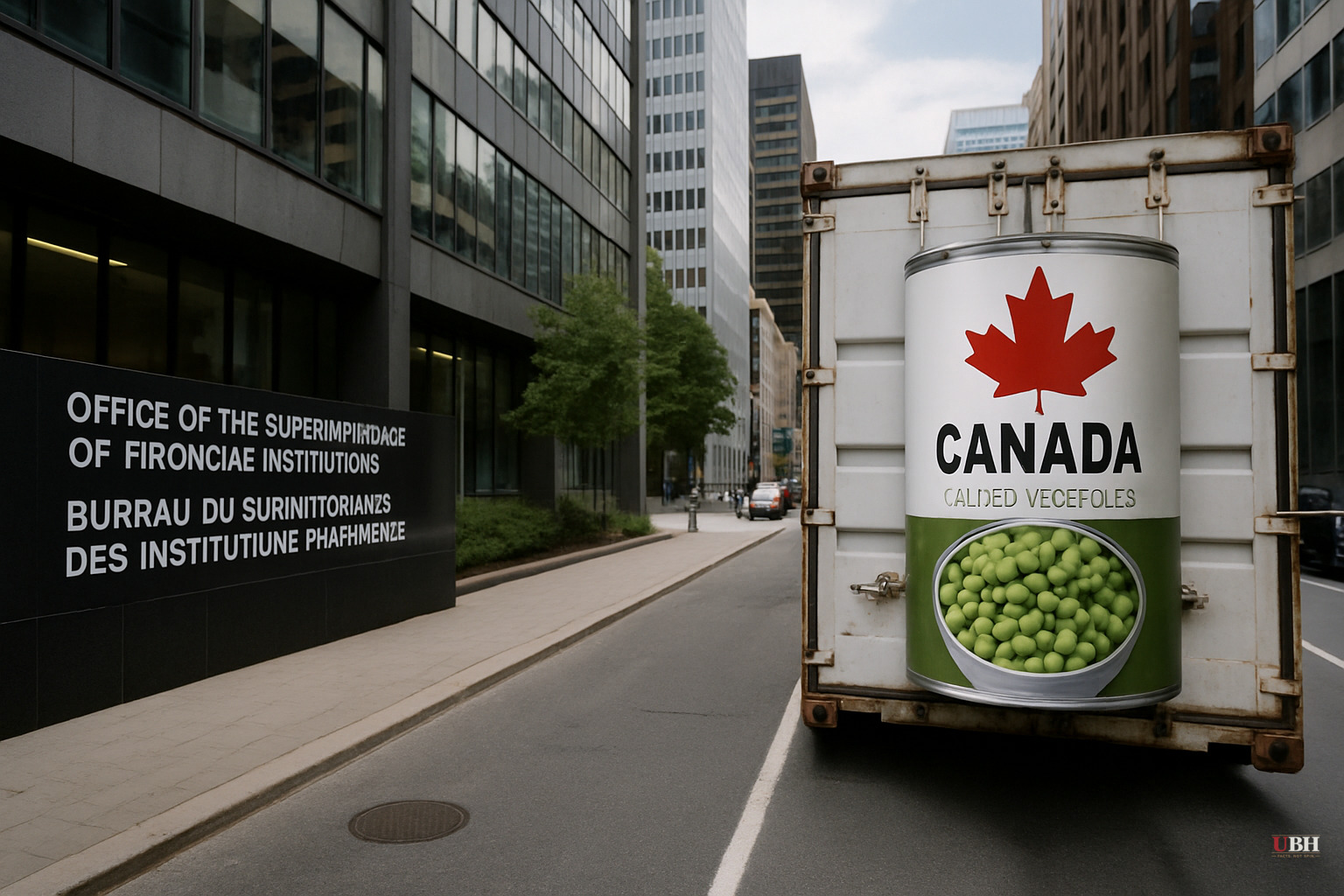
Canada Cuts Bank Capital Buffer and Adds Canned Vegetable Tariff, Both Effective Friday
Since this story was last covered on June 19, both measures have been formally confirmed and are now in effect as of today.
OSFI Loosens the Capital Leash
The Office of the Superintendent of Financial Institutions cut the domestic stability buffer from 3.5% to 3% of risk-weighted assets, effective Friday. The last change to the buffer was an increase of 50 basis points in June 2023, according to Morningstar's reporting by Robb M. Stewart. That makes this the first reduction in three years.
The practical effect: Canada's six largest banks — Bank of Montreal, Bank of Nova Scotia, CIBC, National Bank of Canada, Royal Bank of Canada, and Toronto-Dominion Bank — now have roughly C$74 billion ($52 billion USD) in deployable excess capital, according to OSFI. The regulator also lowered the top end of the buffer's allowable range by a full percentage point, resetting it to a band of zero to 3%.
Superintendent Peter Routledge put the intent plainly. "We're sending a message to the banks that there's enough health and strength in the banking system to take risk and we don't want to stand in the way of it," he told Bloomberg. Routledge also framed it as a structural response: Canada's economy is adapting to shifts in U.S. trade policy, slower immigration, and the advance of artificial intelligence.
The banks are NOT in distress. All six comfortably exceed even the new 11% minimum CET1 requirement, with an average ratio of 13.5% across the sector as of the end of April, per Morningstar. That range ran from 13% to 14.3%, even as the banks continued share buybacks and raised most quarterly dividends.
OSFI estimates the released capital could support an expansion in risk-weighted assets of up to C$673 billion, a number that reflects maximum theoretical capacity, not a commitment.
The Case for Caution
The strongest legitimate concern is whether loosening capital requirements accelerates risk-taking in a housing market that is already heavily indebted. The domestic stability buffer was built precisely to guard against Canadian households' notoriously high debt loads and asset-price imbalances. Critics of this move argue that cutting the buffer during a period of structural economic uncertainty — tariff disruption, slowing immigration, AI-driven labor disruption — is exactly the wrong moment to give banks more room to run.
That concern deserves a straight answer. OSFI acknowledged it directly. At 3%, the regulator still judges the buffer "sufficient" given current systemic risks. The banks' average CET1 ratio of 13.5% is 2.5 percentage points above the new minimum. There is real cushion here. Whether that cushion survives a sharp housing correction or a recession is the question the buffer exists to answer, and OSFI is betting the answer is yes.
Canned Vegetables Get a 10% Wall
Separately, Finance Minister François-Philippe Champagne announced a 10% provisional safeguard tariff on canned vegetable imports, effective immediately Friday, lasting a maximum of 200 days. Exemptions apply to the U.S., Mexico, Israel, Chile, and developing countries, per CBC News.
The measure is explicitly provisional. The Canadian International Trade Tribunal is conducting an ongoing injury inquiry and is expected to conclude by September 9. If the tribunal finds imports are NOT harming Canadian processors, the tariff comes off. If it issues an affirmative injury finding, it will recommend permanent remedies while weighing food affordability for Canadian consumers, the Finance Ministry said.
Champagne described the goal as "a balanced approach that not only provides relief to our canned vegetables sector but also protects food security and affordability for Canadians."
The U.S. exemption is notable given the broader trade tension between the two countries. It reflects Canada's continuing obligations under CUSMA and the political calculation that adding new friction with Washington over canned corn is not worth it.
Two Moves, One Direction
The capital buffer cut and the vegetable tariff come from different regulatory corners, but both point toward the same governing posture from the Carney government: protect domestic industry and push Canadian capital into Canadian priorities. Prime Minister Mark Carney has been explicit about wanting to reduce economic dependence on the United States, and OSFI's Routledge framed the bank capital move directly within that agenda.
The Financial Post reported analyst reaction to the OSFI cut as "a positive surprise." While the regulator cannot legally direct banks on where to deploy capital, the signal was unmistakable. How much of that C$74 billion flows into defense, infrastructure, and AI versus mortgage lending or share buybacks is entirely up to the banks themselves. OSFI has no enforcement mechanism to ensure the capital lands where the government wants it.
Routledge said he "anticipates" the banks will use the capacity responsibly. Whether they do, and whether Canadian households end up better served or more leveraged, will not be clear until the tribunal reports in September and the banks disclose their next round of lending data.
Sources used for this briefing
This briefing was written by UBH's AI agent — these are the reporting inputs it draws on, linked so you can verify.


