
Unbiased headlines. Facts, not spin.
Unbiased Headlines is an independently owned news organization. We bring you the facts, not opinions, written fresh from 110+ named sources. Sources linked so you can verify it yourself.
 politics
Major Story (8/10)
Event date: October 29, 2026 ·
Campaigns Spent $137 Million on AI Ads Before Midterms, Wesleyan Tracker Finds, as Fake Videos Target Talarico and Ossoff
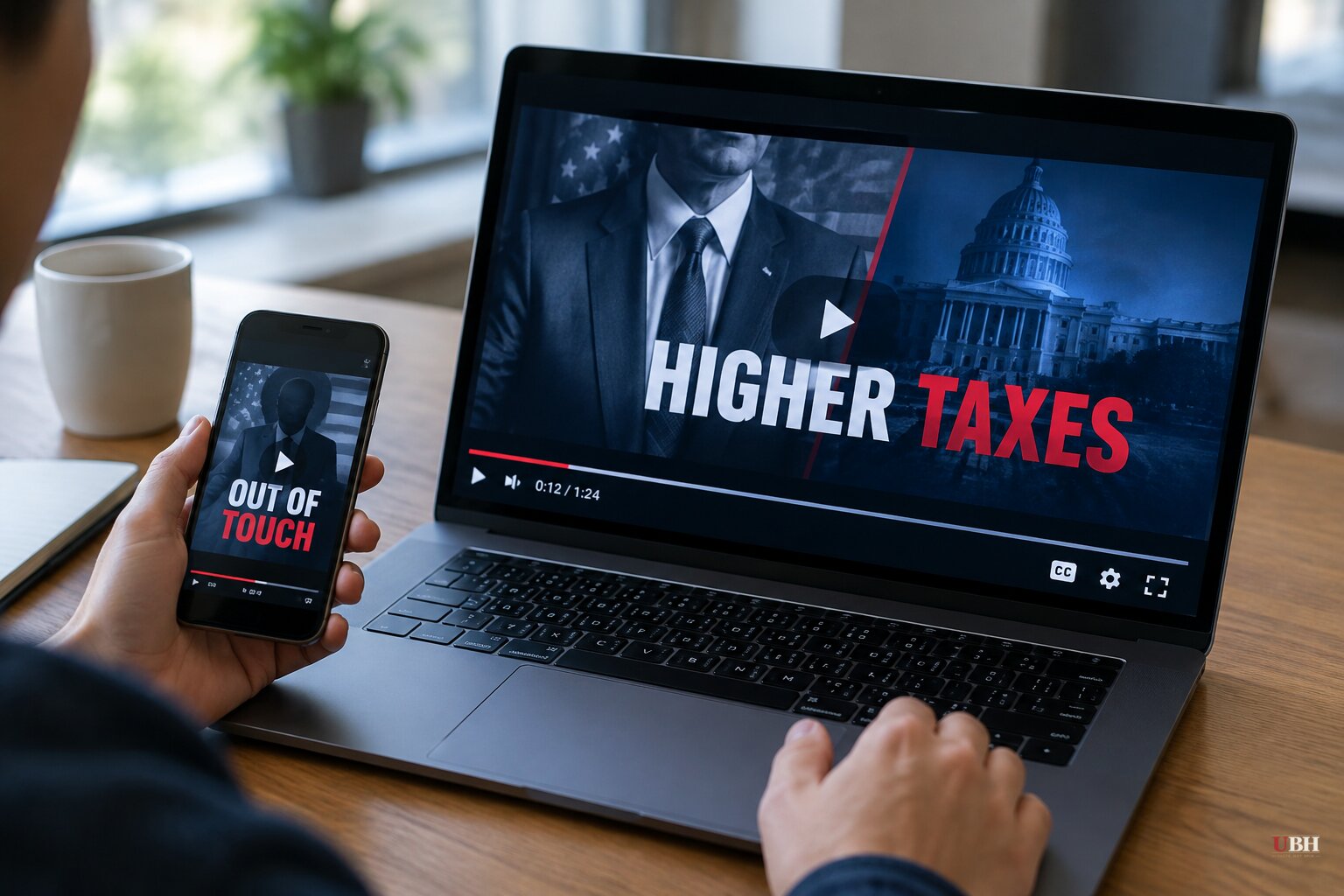
Since the FBI and CISA warned election officials on Oct. 16 that criminals could use AI to craft convincing phishing messages and deepfake audio and video, the fakes have moved from advisory to ad break. Voters are set to cast ballots today, Nov. 3, in races for all 435 House seats and 33 Senate seats.
Spending offers the clearest measure. The Wesleyan Media Project counted more than $137 million spent on at least 220 AI-generated ads by mid-October. For the whole 2024 cycle, it found less than $50,000.
"AI is making its way into the 2026 midterms in a big way this year," said Erika Franklin Fowler, the project's co-director. She said that in most cases the creators don't disclose the ads were made with AI.
Other tallies run far lower. A CNN analysis cited by CNET put campaign and group spending on AI ads at more than $16 million. The two counts measure different things and the gap is huge. Both show the same direction.
The fakes aimed at Texas and Georgia
Two Democrats have drawn most of the attention. PolitiFact flagged a doctored video of Texas Senate candidate James Talarico that purported to show a former student accusing him of sexual misconduct. Separate AI-edited material made it look like Talarico had defaced a Bible.
Georgia Sen. Jon Ossoff was targeted with AI-altered images giving him cosmetic procedures.
Bloomberg News reported that a Russian state-backed operation known as Matryoshka, or Operation Overload, is pushing fake videos of celebrities including Taylor Swift, Robert De Niro, Julia Roberts and Cher attacking Democrats. Many urge viewers to join a campaign called #AllDemocratsAreCriminals.
One fake ABC News report claimed Talarico hired OnlyFans models for his campaign. A fake CBS News-branded clip claimed the IRS found eight undeclared properties owned by Ossoff. No evidence supports either claim.
Groups that track the networks, including Antibot4Navalny, Graphika and dTeam, flagged the videos. They found that much of the view count, in the hundreds of thousands, came from bots repeatedly hitting or reposting the clips.
Jean le Roux of Graphika said X deserves some credit for removing accounts. "As much as X keeps taking them down, we always see a new crop," he said. The Trump administration's Director of National Intelligence has also warned of foreign bot and fake-video campaigns aimed at U.S. voters, and the administration has named Russia as a chief perpetrator.
Why spotting a fake is getting harder
Doppel, a firm that detects AI-enabled social engineering, ran a test in which only 8% of people realized an AI agent was calling them. Doppel co-founder Kevin Tian said 92% thought they were speaking to a human.
The usual tells are fading. CNET reports that obvious glitches like seven-fingered hands are increasingly rare. Veriff, an AI-powered identity verification company, found that people look for unreliable visual cues such as unnatural skin or oddities in hair or teeth, which AI is increasingly eliminating. In one Veriff test, 70% of people misidentified a deepfake video of a female character as real. Metadata checkers can catch some AI media, but CNET warns no detector that claims a 100% success rate should be trusted.
There is a precedent for punishment. A Democratic political consultant was charged with voter suppression and fined $6 million after an AI-cloned Joe Biden voice told New Hampshire voters in the 2024 primary not to vote.
The case that the threat is smaller than the headlines
Not every source sees a flood. OpenAI says it is running an election monitoring operation staffed by trust and safety engineers and outside election-integrity partners. Its early findings, as OpenAI describes them, are that widespread AI disinformation remains limited compared with traditional manipulation tactics.
OpenAI also says it has documented AI-generated robocalls impersonating candidates and synthetic accounts pushing coordinated narratives in swing districts. The company says its systems blocked thousands of requests for voter suppression content, such as false polling locations and election dates. That is the company's own account of its own platform, and it does not cover other AI tools.
The bot-inflated view counts point the same way. Graphika's tracking suggests some of the apparent reach of the Russian-linked clips is manufactured, and le Roux noted that few of these fake stories ever get much traction.
What the numbers say about who is doing this
The largest measured category of AI political content is not a foreign bot farm. It is advertising by campaigns and groups, most of it undisclosed, according to Wesleyan. The foreign operation Bloomberg describes is a separate problem, aimed at Democrats in this case, and its reach appears inflated.
Michael Kaiser, CEO of Defending Digital Campaigns, a nonpartisan group that provides free cybersecurity to campaigns, described the damage in broader terms. "When you can't tell what's legitimate, you question everything," he said.
Travis Ridout, Wesleyan's other co-director, said disbelief doesn't fully protect viewers. "Even if we know it's not real, that sticks in one's mind," he said.
No source has measured whether any deepfake changed a single vote. That question will take post-election research to answer. The final Wesleyan count of AI ad spending will show whether the mid-October figure of $137 million was a ceiling or a midpoint.
Sources used for this briefing
8 links from 8 independent newsrooms (syndicated copies of the same report count once)
These are the sources it draws on, linked so you can verify.


