
Unbiased headlines. Facts, not spin.
Unbiased Headlines is an independently owned news organization. We bring you the facts, not opinions, written fresh from 110+ named sources. Sources linked so you can verify it yourself.
 politics
Major Story (7/10)
Event date: October 27, 2026 ·
CISA and Pentagon Mobilize on Election Security Before Tuesday's Midterms, but Election Experts Say Federal Information Sharing Has Frayed
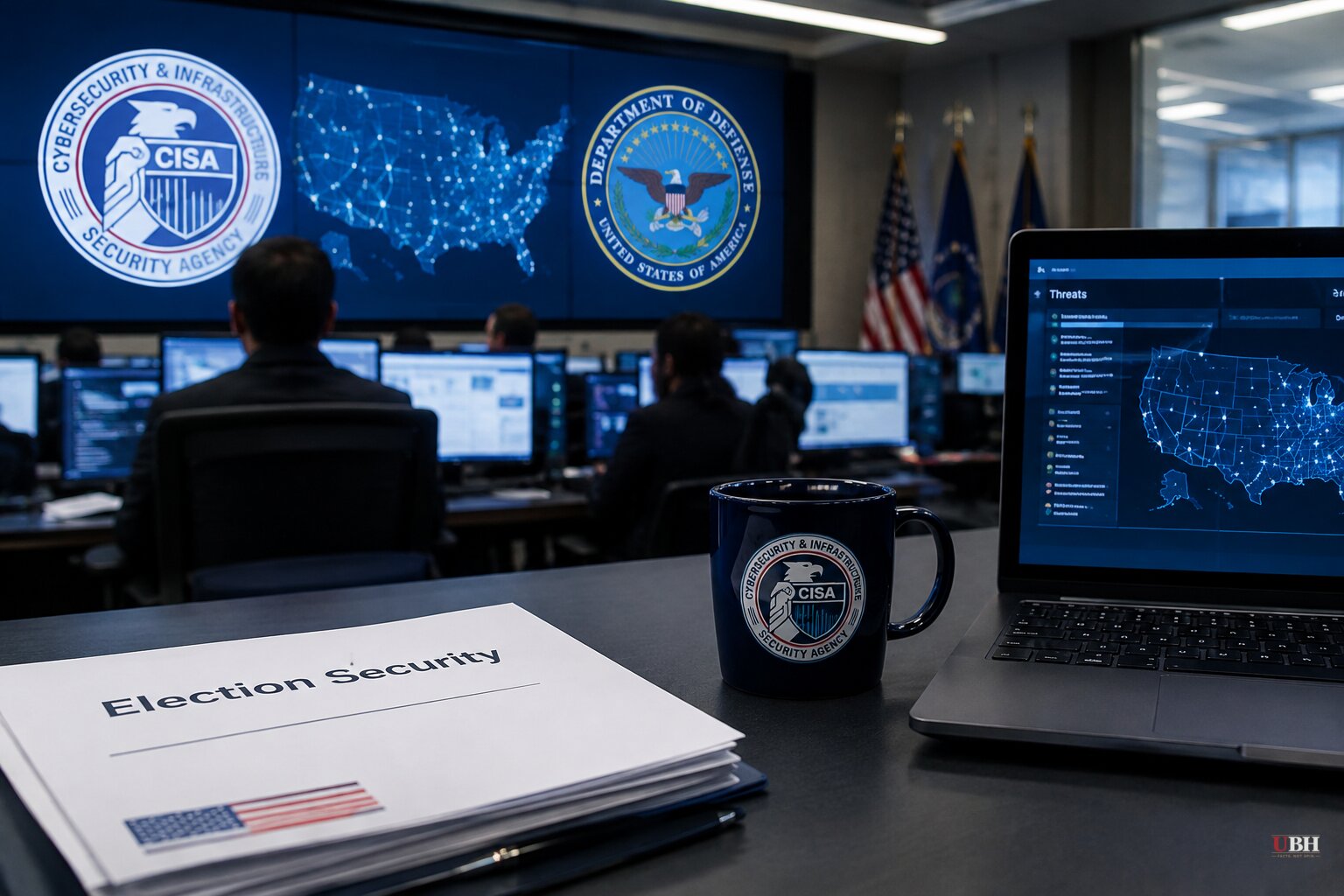
Since Secretary Markwayne Mullin tasked the Cybersecurity and Infrastructure Security Agency in July with developing an Election Infrastructure Security Plan, Washington has rolled out a string of election security moves. The midterms are tomorrow, Tuesday, Nov. 3. The open question is whether federal agencies and local election offices are actually talking to each other.
What Washington has announced
On Monday, Oct. 26, CISA released a new strategy called CISA 2030. Acting Director Nick Andersen said in a statement: "I call on every company and organization in the critical infrastructure community—from owners and operators to vendors and technology manufacturers—to act now."
The strategy moves the agency from a passive defense posture toward what it describes as an aggressive, anticipatory stance. The goal is to identify, mitigate and reduce malicious access to critical infrastructure.
The deadlines are long. Within 180 days of the strategy's release, CISA will provide a plan to implement it and measure its results, and within a year the agency will report on its progress.
CISA's election-specific document runs 13 pages. It warns that election officials, candidates and their political organizations are attractive targets to malicious cyber criminals because of their access to voter registration data, current government officials, or sensitive campaign information. It also outlines no-cost services the agency offers to state and local officials. "Election security is not a partisan issue. Election security is national security," the document says.
The Pentagon has its own order. In a September directive, Secretary of War Pete Hegseth told the entire Defense Intelligence Enterprise to "mobilize every authorized asset, capability, and partnership" against foreign election threats. He calls it a "no-fail mission." The directive reaches beyond Cyber Command and the NSA to agencies responsible for military and geospatial intelligence.
The Department of War declined to give Fox News Digital additional details about how the order is being implemented. Cyber Command declined an interview request. How much the directive changed existing operations is unclear.
The military's role also largely stops at the U.S. border. State and local officials run elections, and agencies such as the FBI and the Department of Homeland Security handle the domestic side. Cyber Command and the NSA have spent years tracking and disrupting foreign threats around American elections; the effort took its current shape ahead of the 2018 midterms.
Election officials describe a broken pipeline
Election security experts see a gap between the announcements and the working relationships. CNN spoke with nearly a dozen of them, and they said the channels for federal officials to communicate foreign threats to election officials are at their weakest since the 2016 vote.
Ryan Macias, a longtime election security expert and former consultant to CISA, said: "The relationship between elections officials and the federal government has broken down. In many cases, the elections officials don't even know who to contact when [a cyber or physical] incident occurs."
David Becker, co-founder of the nonprofit Center for Election Innovation and Research, put it more bluntly. "I don't know a single election official — Democrat or Republican — who is actively sharing cybersecurity information with the feds this time around," he said. He added that this is "in stark contrast to the past four federal elections."
A mid-October classified briefing for election officials, the first since the 2024 presidential election cycle, was marred by technical difficulties when federal officials were unable to get the video call to work. It was rescheduled and occurred without those difficulties, according to CNN.
People familiar with the matter also told CNN that a last-minute DHS effort to create an online platform to share threat intelligence lacks anywhere near the same credibility with election officials as in past cycles. In the past, CISA oversaw a robust coordination center to communicate threats to election officials and receive information from them on Election Day. The agency has scrambled in recent weeks to stand up a new information-sharing channel, and multiple sources told CNN it is unlikely to have the traction or trust of past efforts.
A CISA spokesperson told CNN the agency had launched an "information-sharing tool" and that "authorized federal, state, and local government partners are granted access daily upon their request." CISA did not say how many election officials have accessed the platform. The spokesperson also said CISA "remains fully equipped and prepared to address any national security cyber threats that face our nation."
A separate account, citing The New York Times, says CISA has moved election security down its list of priorities. Last week, ProPublica reported that the Trump administration has pushed out or laid off more than 1,000 personnel at CISA. The administration's own documents point the other way: Mullin's July tasking and the agency's election-specific plan both put election security on the agenda.
What the threat looks like
US intelligence officials are tracking familiar efforts by Russia, China and Iran to influence American voters, according to CNN's reporting. Intelligence officials say they have seen no evidence that a foreign adversary has attempted to interfere with voting machines, physical election infrastructure or the counting of votes ahead of Tuesday, according to Fox News. Researchers at Northeastern University point to artificial intelligence as a new tool for bad actors who want to cause chaos.
The structure of U.S. elections limits what a hacker can do. Engin Kirda, a Northeastern computer science professor who specializes in network security, said the patchwork of state systems "is heterogeneous" and that this "actually does provide defense." In 2024, over 98% of voting jurisdictions used election equipment that has voters mark a paper ballot or produces an auditable paper record, according to the U.S. Election Assistance Commission.
Geoff Hale of the Center for Democracy & Technology said election officials have spent the last decade strengthening their defenses despite "CISA's pullback from the election security mission." He said the retreat may be felt most in security information sharing.
Lawrence Norden, vice president of the Elections and Government Program at the Brennan Center for Justice, made a similar point on NPR. He said virtually every vote cast has a paper backup, that ballots are audited afterward, and that state and local governments are ready. He expects "free, fair and secure elections on Tuesday." He also said that with CISA diminished, he worries that if there is misinformation, confusion, or an attack like the bomb threats of 2024, communications about it will be less clear.
Norden argued that the administration's lawsuits, its attempts to restrain mail-in voting and its voter-fraud bounty are part of an effort "to interfere and undermine" the election. He said those efforts have consistently lost.
The bounty is President Trump's offer of $1 million for voter fraud tips that lead to a conviction. The administration frames its election work as protecting integrity. Hegseth's directive and CISA's strategy describe the push as defense against foreign adversaries and cyber criminals.
What comes next
Polls open tomorrow, and the test of CISA's replacement information-sharing channel will come on Election Day. Sources told CNN it is unlikely to have the trust that past channels did. Under CISA 2030, the agency's implementation plan is due within 180 days of the strategy's release, with a progress report to follow within a year.
Sources used for this briefing
6 links from 6 independent newsrooms (syndicated copies of the same report count once)
These are the sources it draws on, linked so you can verify.


