
Unbiased headlines. Facts, not spin.
Unbiased Headlines is an independently owned news organization. We bring you the facts, not opinions, written fresh from 110+ named sources. Sources linked so you can verify it yourself.
 economy
Notable (6/10)
Event date: October 20, 2026 ·
California's Prop. 37 Would Authorize $25 Billion in Bonds for New-Home Down Payment Loans. Voters Decide Nov. 3
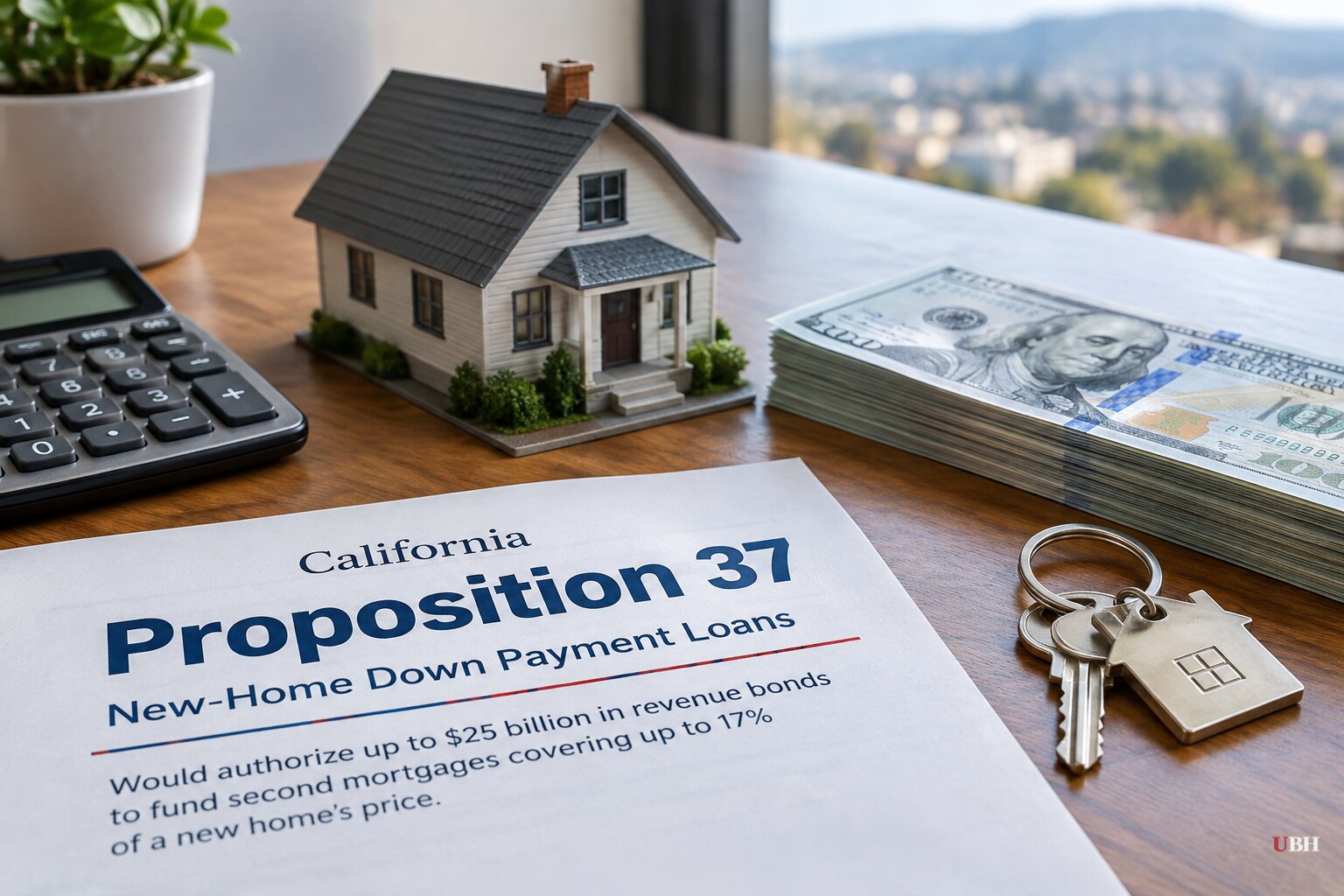
California voters will decide on Tuesday, Nov. 3, whether to let the state raise up to $25 billion to help people buy newly built homes.
For scale, the LA Times notes that one of the state's existing down payment programs, California Dream For All, launched several years ago with $500 million, just 2% of the funding involved in Proposition 37.
How the money would move
The California Housing Finance Agency would sell revenue bonds to private investors. It would then lend that money to eligible buyers as second mortgages covering up to 17% of the purchase price of a newly constructed home.
Buyers would still need a regular first mortgage from a bank or broker. They would also have to put in at least 3% of the home price as their own down payment.
On an $800,000 home, the example CalMatters uses, the typical 20% down payment is $160,000. Under Prop. 37, that would fall to $24,000. On the $900,000 statewide median price cited by the California Association of Realtors, a 20% down payment is $180,000.
The bonds would be repaid by homeowners' loan payments, not by the state's General Fund. The official ballot summary lists the fiscal impact as "no direct state or local costs." Most other bonds on this ballot, including Propositions 1 and 38, would be repaid directly with tax dollars.
Gov. Gavin Newsom, statewide unions and mayors from Santa Monica to San José back the measure. "Prop. 37 is a historic opportunity to expand homeownership opportunities for generations of working families, at zero cost or risk to taxpayers," Newsom said in a statement. No official argument against the measure was submitted for the voter guide. The League of Women Voters opposes it, concerned it would saddle residents with too much debt and that the loan terms are opaque, with details worked out only after the vote.
Who qualifies
Borrowers must be California residents, occupy the home, meet income limits and make monthly payments. The income cap is 200% of area median income, which the Public Policy Institute of California says reached $373,000 for a family of four in some places in 2024.
PPIC researcher Eric McGhee found that 91% of renters would have cleared that bar in 2024. The home price ceiling is 125% of the county's conforming loan limit. McGhee calculated that at $1.15 million in 2024. The ballot guide's summary puts the cap at about $1.5 million. The limit is tied to the federal figure, which is reset each year.
The limits critics and analysts point to
The program covers only new construction. The LA Times reported that some critics say the high cost of building could narrow its reach.
The measure also does not set the interest rate or repayment period. The California Housing Finance Agency would decide those after passage.
McGhee's analysis targets affordability, not eligibility. With mortgage rates near 7%, he found that even an entry-level new home, defined as the 10th percentile of new homes in an area, would have been out of reach for 56% of California renters in 2024. That calculation caps total housing payments at 36% of income, Fannie Mae's maximum debt-to-income ratio. The median payment on such a home was $2,259 a month, and as high as $4,195 in some areas.
Among renters without a high school diploma, 71% could not have both qualified and afforded an entry-level home. McGhee wrote that the program "is ambitious and could have a meaningful impact," but that housing costs and interest rates "will limit its reach."
McGhee also offered a ceiling scenario. If every loan went to a home at the maximum allowable price and drew the full 17% support, he wrote, the program would have reached roughly 113,000 buyers in 2024, far short of the more than one million units California is estimated to need.
The default question
The measure's text says private bondholders, not taxpayers, would take the loss if borrowers stop paying. CalMatters reported that some analysts doubt state lawmakers could resist political pressure to bail out homebuyers if defaults came in a wave.
Supporters call the structure an "elegant" fix for a state where homeownership sits about 10 percentage points below the average of all other states, per PPIC. Detractors describe it as a Rube Goldberg-style gimmick that is too clever by half.
Some have also questioned whether investor appetite will be strong enough to buy the state-issued bonds. The Legislative Analyst's Office lists the extent of investor interest among several unknown factors that could affect the measure's scope and impact, alongside how loan costs compare with other down payment assistance options and whether the program increases home construction and homebuying.
Other programs
Down payment assistance itself is common. The LA Times cited reports of more than 2,700 programs nationwide. New York has distributed $70 million since 2021. Massachusetts has distributed more than $146 million since 2020.
CalMatters describes Prop. 37 as a down payment assistance program unlike any other in the country.
What happens next
If voters approve Prop. 37 on Nov. 3, the California Housing Finance Agency would set the interest rate and repayment terms. Those decisions would shape whether bond investors show up and whether monthly payments are workable for the buyers the measure targets. A "no" vote would mean the state would not be required to create the new homebuying assistance program.
Sources used for this briefing
7 links from 7 independent newsrooms (syndicated copies of the same report count once)
These are the sources it draws on, linked so you can verify.


