
Unbiased headlines. Facts, not spin.
Every story is an unbiased news briefing written from 110+ sources across the spectrum — sources linked so you can verify it yourself.
 economy
Low Interest (4/10)
July 12, 2026 at 09:06 AM
economy
Low Interest (4/10)
July 12, 2026 at 09:06 AM
California Generated $67.4 Billion in Farm Production in 2024, Nearly Double Any Other State
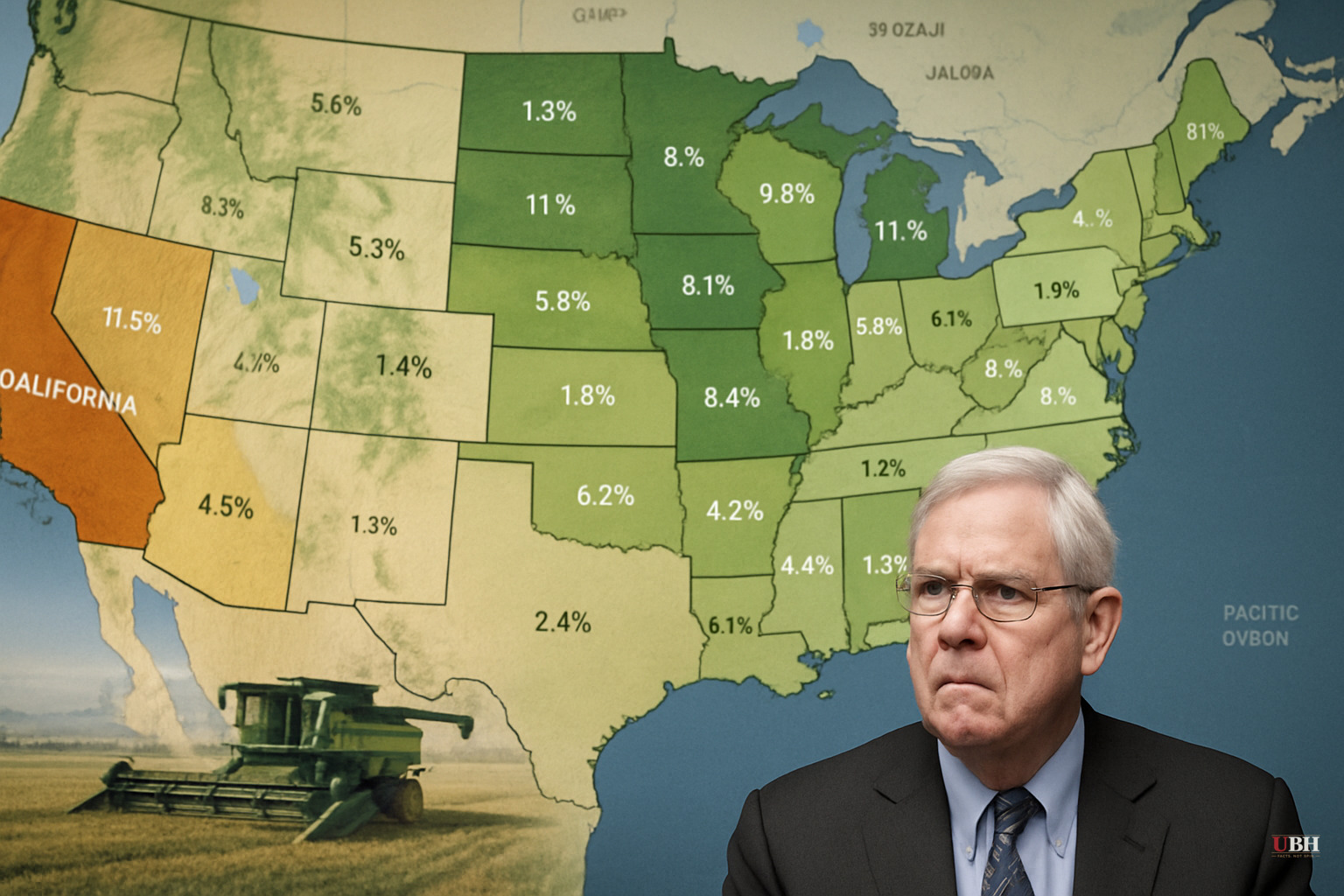
California Still Runs the Table
California generated $67.4 billion in agricultural production value in 2024, according to U.S. Department of Agriculture data cited by Visual Capitalist. That's nearly twice the output of the next closest state.
The Golden State pulls this off with a small share of the nation's farmland. Its edge comes from specialty crops, fruits, vegetables, nuts, and dairy, plus growing conditions no other state can match at the same scale.
That concentration is also a vulnerability. When California deals with drought, wildfire smoke, or water restrictions, it doesn't just hit local farmers. It hits the national supply of almonds, grapes, and leafy greens, because there's no real backup region producing at the same volume.
Texas and the Cattle Machine
Texas ranks third nationally at $37.6 billion, driven largely by cattle production, per the USDA figures. Between its land area, water access, and beef infrastructure, Texas has built a production model completely different from California's specialty-crop economy.
The Midwest Wins as a Bloc
No single Midwestern state touches California's number. But collectively, the Midwest accounts for 44% of U.S. agricultural production value, according to the data. Iowa, Nebraska, Minnesota, Indiana, and Illinois anchor that share.
These states together produce over 60% of America's corn volume. Many of the same states also lead in soybeans, livestock, and dairy. That combination makes the Midwest corn belt one of the most important agricultural production corridors on the planet, not just in the country.
Corn and soybeans grown in these states move through export terminals to buyers overseas, which means shifts in trade policy, tariffs, or foreign demand land directly on Midwestern farm income.
Regional Specialization, Not Uniformity
Agriculture doesn't look the same everywhere, and the USDA data reflects that. Western states lean into high-value specialty crops, vineyards, and dairy. Southern states dominate poultry, cotton, rice, and cattle production.
Northeastern agriculture is smaller in total dollar value compared to the coasts and the Midwest, but it still plays a real role supplying dairy, produce, and regional food distribution for a densely populated part of the country.
Why the Concentration Matters
When over half of America's agricultural production value comes from just ten states, and 44% comes from five Midwestern states alone, the food system runs on a narrow set of pressure points.
A reasonable critic of that concentration would say it makes the country more exposed to regional disruptions, whether from drought in California, extreme weather in the Plains, or disease outbreaks in livestock-heavy regions like Iowa and Texas. That's a fair point, and it's exactly why federal crop insurance and disaster programs are structured around these same states.
The counterpoint is that specialization exists for a reason: soil, climate, and water access aren't distributed evenly, and forcing production into less-suited regions would likely raise costs and lower yields nationwide. The USDA data doesn't argue for redistributing farming geographically, it just documents where production already happens most efficiently.
What's Unresolved
The USDA figures show where production value sits today, but they don't answer how durable that map is. Corn belt states depend heavily on export demand, particularly from China, for both corn and soybeans.
How ongoing trade negotiations and tariff disputes affect that export demand over the next planting cycle remains an open question, one that will show up in next year's USDA production numbers before it shows up in any political headline.
Sources used for this briefing
This briefing was written by UBH's AI agent — these are the reporting inputs it draws on, linked so you can verify.


