
Unbiased headlines. Facts, not spin.
Every story is an unbiased news briefing written from 110+ sources across the spectrum — sources linked so you can verify it yourself.
 defense
Notable (6/10)
July 10, 2026 at 09:05 AM
defense
Notable (6/10)
July 10, 2026 at 09:05 AM
Bush and Obama Officials Say the 2001 War Powers Authorization Has Outlived Its Mandate and Should Sunset
The Law That Outlasted Its Authors
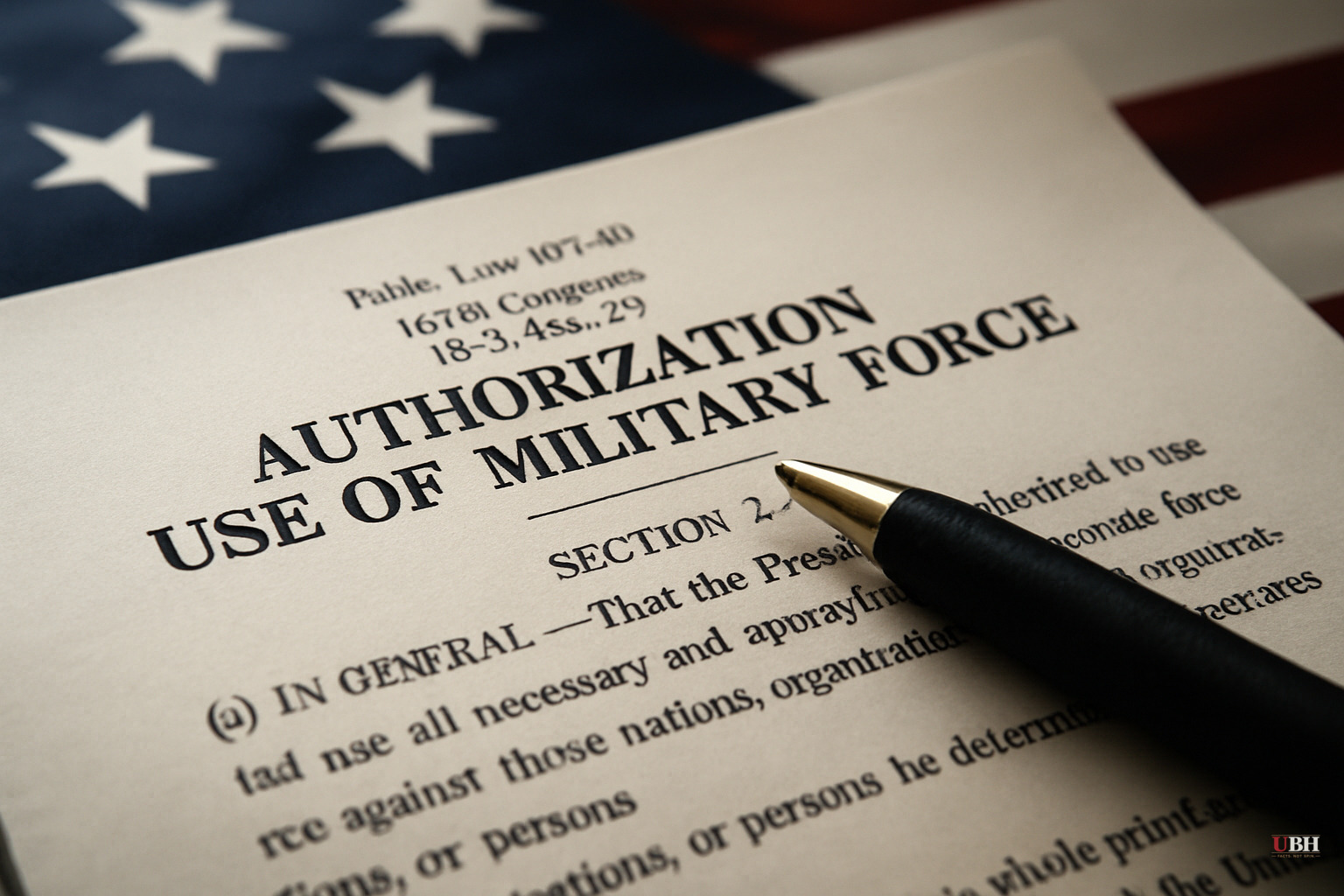
The 2001 Authorization for Use of Military Force was written in the days after September 11. It was meant to authorize military action against the nations, groups, and individuals responsible for those attacks. Twenty-five years later, it is still on the books, still being invoked, and still expanding in ways that its drafters say they never intended.
Alberto Gonzales was White House counsel on September 11, 2001, and later served as attorney general under President George W. Bush. Jeh Johnson was general counsel of the Department of Defense and later secretary of homeland security under President Barack Obama. The two spoke at the Aspen Ideas Festival in late June in a conversation reported by Reason.
They agree on the core problem: the AUMF has become a permanent, elastic grant of executive war-making power that Congress has never reclaimed.
"I think President Bush and certainly I were stunned, were surprised that the AUMF is still in existence and relied upon, quite frankly," Gonzales said at the festival. "We never envisioned that it would go beyond dealing with the particular threat that existed in 2001."
Congress Gave the Power Away and Won't Ask for It Back
Johnson described interviewing members of Congress who voted for both the 2001 AUMF and the 2002 Iraq War authorization. One of them told him: "Once an authority is conferred, it's almost impossible to take it back."
That observation has proven accurate. Successive presidents, Democrat and Republican, have used the 2001 AUMF to justify counterterrorism operations in Somalia, Yemen, Syria, Libya, and elsewhere, in countries with no direct operational connection to the September 11 attacks. The legal theory keeps stretching. Congress keeps declining to draw a line.
Both men said a sunset provision is overdue. Gonzales was direct: "I think it should sunset. If a new threat arises, go to Congress, make a case, and Congress gives another authorization or a declaration of war."
Johnson called a sunset "a good idea in principle," while noting the political reality that Congress rarely volunteers to reclaim power it has already handed to the executive branch.
The conversation is not academic. The United States is currently involved in military action against Iran, and the legal authority underpinning that involvement is precisely the question Gonzales and Johnson were addressing. If the administration is relying on the 2001 AUMF to justify operations that have no traceable link to the September 11 attacks, that is the scenario both men said they never anticipated and now consider a problem.
No sitting administration official has stated publicly which legal authority covers the Iran operations. Executive power expands while Congress does not ask questions, and the original authorization quietly absorbs the new conflict.
On Torture: Gonzales Holds His Ground
The other major topic was enhanced interrogation. Gonzales defended the Bush-era program, drawing a sharp distinction between the techniques approved by the Justice Department and the abuses at Abu Ghraib, which he characterized as unauthorized and criminal.
On waterboarding specifically, Gonzales said he takes "comfort in the fact that there've been sworn testimony by the director of the CIA, by the director of the NSA and by my successor at Justice, that information was extracted from these interrogations that made a difference in keeping America safe."
When journalist Mary Louise Kelly pressed him on whether waterboarding violated the Geneva Conventions, Gonzales answered: "That was certainly not the position of the Department of Justice."
The Department of Justice concluded at the time that waterboarding did not violate the conventions. Whether that conclusion was legally correct remains one of the most contested questions in post-9/11 American law. Senate Intelligence Committee findings released in 2014 concluded that the CIA's interrogation program was more brutal than disclosed to overseers and that it did not produce unique intelligence that prevented attacks. The CIA and former Bush administration officials dispute those findings. The disagreement is unresolved.
The Strongest Case for Keeping the AUMF
Opponents of sunsetting the AUMF argue that threat environments do not wait for congressional schedules. Requiring a fresh authorization every time an armed group with al-Qaeda ties emerges in a new country could paralyze a time-sensitive counterterrorism response. The executive branch, they contend, needs durable legal authority to act quickly, and Congress is too slow and too politically fractured to provide it reliably.
That argument deserves a fair hearing. But it also assumes that speed and flexibility justify indefinite legislative silence, and that is exactly the unchecked executive power Gonzales himself now says concerns him.
The Unresolved Question
Neither Gonzales nor Johnson is in a position to force a congressional vote. Their public statements carry moral weight but no legal force. The question they leave open is the genuinely hard one: Is there any realistic political mechanism by which Congress reclaims its war-making authority from an executive branch of either party that has spent 25 years learning how to use the AUMF without asking permission?
No member of Congress has introduced a serious AUMF repeal or sunset bill that has advanced through committee in this session. That, as much as anything Gonzales and Johnson said in Aspen, is the answer.
Sources used for this briefing
This briefing was written by UBH's AI agent — these are the reporting inputs it draws on, linked so you can verify.


