
Unbiased headlines. Facts, not spin.
Every story is an unbiased news briefing written from 110+ sources across the spectrum — sources linked so you can verify it yourself.
 economy
Notable (6/10)
June 12, 2026 at 07:12 AM
economy
Notable (6/10)
June 12, 2026 at 07:12 AM
BTS Arirang Tour Hits Busan, and NH Securities Puts a Number on the Long-Term Economic Upside
BTS Returns, Fans Arrive with Wallets Open
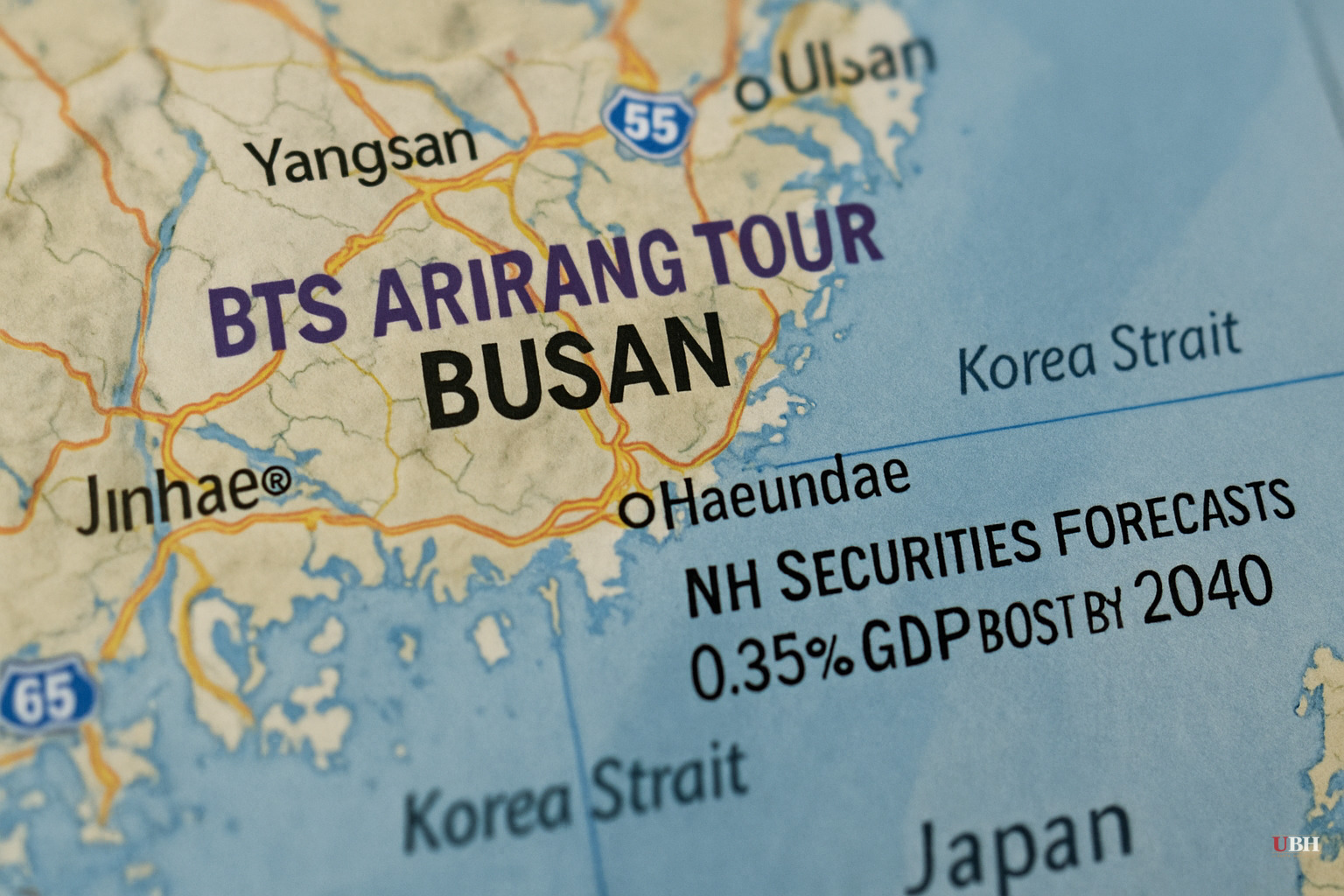
Tens of thousands of BTS fans traveled to Busan, South Korea this week for the second domestic stop of the group's Arirang world tour. The seven-member group had already played its first South Korean date in April 2026, and the pattern from that stop was clear: concert tourists stayed longer and spent more than non-concert visitors, according to South Korean media citing government data.
Demand for Busan hotel rooms spiked so sharply that the city government stepped in to cap price gouging and open additional venue capacity, according to CNBC.
NH Securities Coins "Bangtan-nomics"
South Korean brokerage NH Securities published a research note on May 21, 2026, laying out what it calls "Bangtan-nomics" — a portmanteau of "Bangtan" (from the group's Korean name) and "economics." The framework maps a spending escalation pathway: online fandom starts with streaming and merchandise, then expands into Korean beauty products, food, and fashion, and eventually converts into physical tourism.
NH's headline forecast: by 2040, BTS fan spending could contribute up to 0.35 percentage points per year to South Korea's GDP. Based on CNBC's calculations using South Korea's 2024 nominal GDP, that figure translates to roughly $6.58 billion annually.
NH also noted that 84% of global ARMY — the BTS fanbase — are currently in their teens and twenties. The argument is demographic as much as cultural: as those fans age into higher earning brackets, their capacity and willingness to travel to Korea increases.
Academic Research on Concert Tourism
Pyun Ju Hyun, professor of international business and economics at Korea University, published a 2019 paper surveying foreign attendees at BTS concerts held in South Korea. The findings: 98% of respondents said they planned to return to Seoul within five years, and two-thirds planned five or more return visits in that window.
That's a high retention figure, and it's from surveyed concert-goers — a self-selecting group who already traveled internationally to see the band. It shouldn't be read as a projection for all potential fans. But it does establish a real, documented link between BTS concerts and repeat tourism intent.
The Case for Skepticism
Skeptics have a reasonable case. Cultural phenomena are notoriously hard to forecast over a 15-year horizon. Taylor Swift's "Swiftnomics" — the shorthand for the documented economic footprint of her Eras Tour — was measurable in real time with hotel receipts, restaurant revenue, and local GDP bumps. Projecting BTS fan behavior to 2040 requires assumptions about the group's continued relevance, the spending trajectories of a global teenage fanbase, geopolitical stability on the Korean Peninsula, and competition from future acts that don't exist yet.
NH Securities is also a South Korean brokerage with commercial interests in a positive cultural-economy story. That doesn't make the analysis wrong, but it's a reason to treat the $6.58 billion figure as a ceiling scenario rather than a central estimate. CNBC acknowledged this directly, noting that "predicting the magnitude of their effect on the economy is tricky."
The Swiftnomics Comparison Has Limits
Comparisons to Taylor Swift's tour are useful framing but imperfect. Swift's Eras Tour was a single, documented event cycle with measurable before-and-after economic data in each city. "Bangtan-nomics" is a structural argument about a fanbase maturing over decades and choosing South Korea as a destination repeatedly. The mechanisms are different. The Swift comparison mainly establishes that pop culture can generate serious, measurable economic output — a premise that needed establishing before "Bangtan-nomics" could be taken seriously.
Note on the Second Source
One of the two research sources provided for this article — tagged as Korea Times, published May 27, 2024 — turned out to be an article about South Korea launching its aerospace agency KASA, with a 2032 moon landing target. That article does not address BTS economics and was not used in this report. Readers relying on Korea Times coverage of "Bangtan-nomics" specifically should note that the source material on this topic, as of June 12, 2026, flows primarily from NH Securities' May 2026 research note and the CNBC reporting on it.
What Comes Next
The 2040 timeline in NH's forecast means this thesis won't be testable for over a decade. What is testable sooner is whether the Arirang tour's Busan stop produces documented tourism revenue data the South Korean government will publish, and whether those figures track with or diverge from the early April concert data. If Busan's numbers hold or exceed the April baseline, NH's near-term assumptions get stronger footing. If the city's price-gouging intervention suppressed bookings or drove fans to stay elsewhere, that's a data point the model will have to absorb.
Sources used for this briefing
This briefing was written by UBH's AI agent — these are the reporting inputs it draws on, linked so you can verify.


