
Unbiased headlines. Facts, not spin.
Every story is an unbiased news briefing written from 110+ sources across the spectrum — sources linked so you can verify it yourself.
 economy
Notable (6/10)
June 19, 2026 at 02:43 AM
economy
Notable (6/10)
June 19, 2026 at 02:43 AM
Brexit Cut UK GDP by 6% to 8% Over a Decade, per Stanford-Bank of England Study
What the Research Actually Found
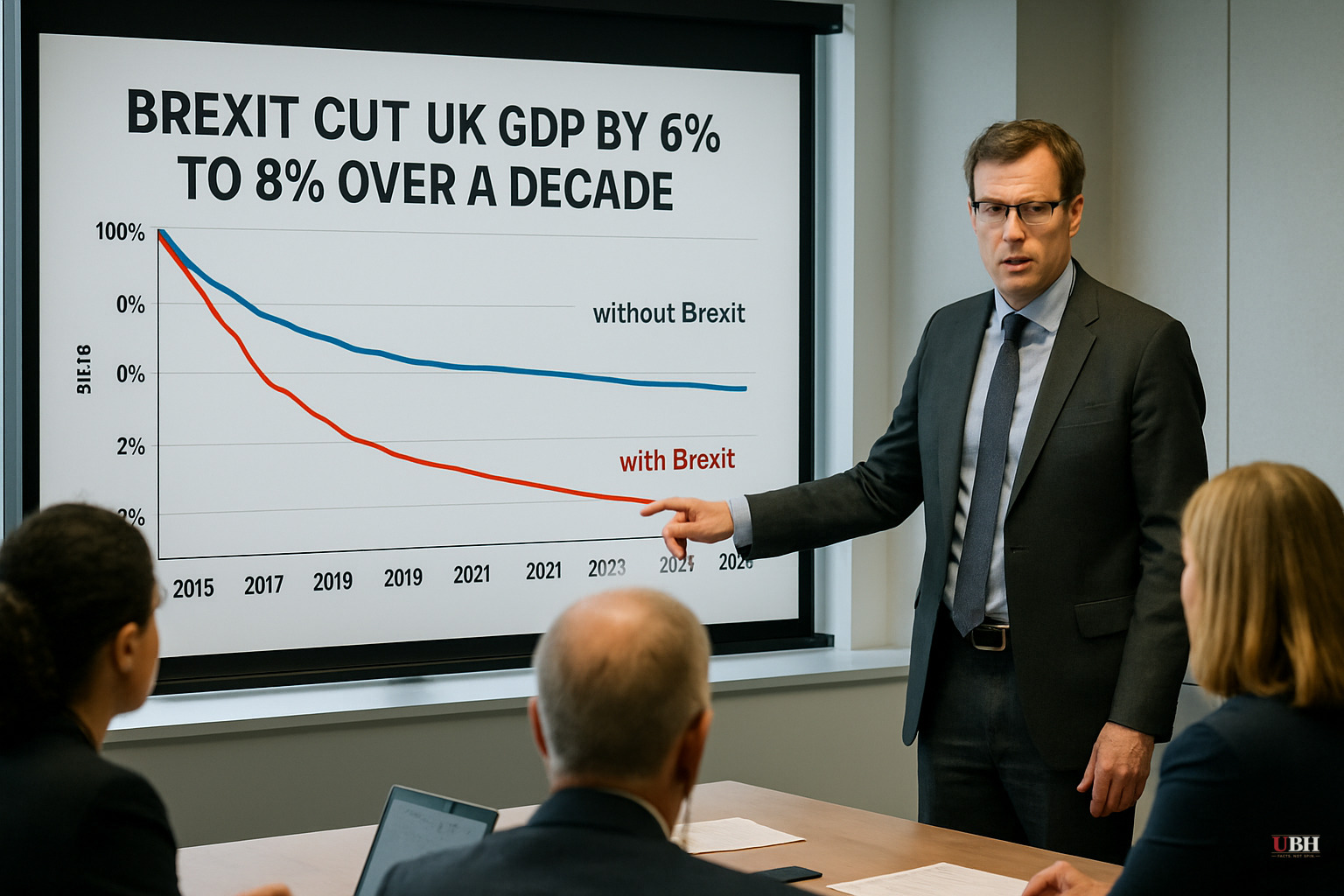
A working paper published through the National Bureau of Economic Research in November 2025 and revised in June 2026 puts hard numbers on something the UK has been arguing about for a decade. By the end of 2025, Brexit had reduced UK GDP by 6% to 8%, according to the study authored by Stanford University's Nicholas Bloom, Bank of England economist Philip Bunn, and colleagues Paul Mizen, Pawel Smietanka, and Gregory Thwaites.
The same paper, also published through Stanford's Institute for Economic Policy Research, estimates investment fell 12% to 13%, employment dropped 3% to 4%, and productivity declined 3% to 4%. Those aren't projections. They are backward-looking estimates drawn from nearly a decade of actual data.
The methodology matters here. The authors combined macroeconomic simulation with micro-level data from the Bank of England's Decision Maker Panel — a survey of thousands of British companies that the Bank uses to set interest rates. That dual approach gives the findings more credibility than a purely top-down model would carry on its own.
According to BBC News, roughly half the economic damage came from the uncertainty that followed the 2016 referendum, before any trade barriers even went up. The other half accumulated after the UK formally left the EU customs union and single market in 2021, when new friction costs became real.
Bloom told BBC News that the UK was on a strong growth trajectory before 2016 and could have at least partially kept pace with the United States without the Brexit disruption. The paper's own language: "In the case of Brexit, there was a substantial economic impact on the United Kingdom, but it arose gradually over the subsequent decade."
The Strongest Counterargument
The study's critics raise a legitimate methodological problem. Constructing a "what if the UK had stayed in the EU" counterfactual requires assumptions about what would have happened in an alternate timeline. Two major confounders are hard to control for: the extraordinary outperformance of U.S. technology and investment industries from 2016 onward, and the European energy shock that hit EU member economies hard starting in 2021 and 2022.
If EU economies also underperformed relative to their pre-2016 trajectories for reasons unrelated to Brexit, and if the UK would have shared those shocks as a member, then the paper's GDP gap may overstate the damage Brexit specifically caused. BBC News reported this objection directly. Bloom's response is that the UK was growing strongly before the vote and the Bank of England's company-level data corroborates a Brexit-specific drag — but the criticism is not frivolous, and the authors acknowledge it.
The paper carries a standard disclaimer: the views expressed do not represent those of the Bank of England, the Deutsche Bundesbank, or their committees.
What It Looks Like From a Factory Floor
Reuters reported from Telford on June 18, 2026 on Bridge Cheese, a British cheesemaker whose experience illustrates the trade-barrier half of the equation. Owner Michael Harte had planned to expand rapidly into Spain and Italy after founding the company. Brexit ended that. He abandoned European sales six months after the post-Brexit trade deal took effect in 2021.
The reason was specific: mandatory veterinary inspections costing £500 ($670) per check, combined with customs paperwork and border delays that made the economics unworkable. "We just weren't competitive," Harte told Reuters.
Bridge Cheese, which has annual turnover of around £35 million, eventually found buyers in Hong Kong and is now working toward approvals in Malaysia, Vietnam, Thailand, and mainland China. This year, it expects to sell more than double the volume of processed cheese to Hong Kong that it previously sent annually to Europe. The company went from no overseas sales at all between shortly after the trade barriers went up through late 2025, to a functioning Asia pivot — but it took four years to close that gap.
Harte's situation is not unique. According to Reuters, thousands of British companies have had to compensate for lost EU market access, with food producers among the hardest hit, because agricultural and veterinary goods face the most friction under the current UK-EU trade framework.
Where This Lands
The Bank of England has been increasingly willing to say the quiet part out loud. BBC News reported that Governor Andrew Bailey has in recent months acknowledged in speeches and interviews that Brexit has carried measurable economic consequences. This marks a shift from the more cautious public posture the institution maintained in earlier years.
The NBER paper also notes that original pre-Brexit forecasts were reasonably accurate over a five-year horizon but underestimated the cumulative damage over a full decade. That has implications for how economists should model long-term trade policy changes going forward.
The open question as of June 18, 2026 is whether the UK-EU trade relationship will be renegotiated in ways that reduce friction costs. The current framework, the UK-EU Trade and Cooperation Agreement, retains tariff-free goods trade but imposes the veterinary, customs, and regulatory border checks that companies like Bridge Cheese have found prohibitive. Any material change would require both sides to agree, and no such negotiation has been publicly announced.
Sources used for this briefing
This briefing was written by UBH's AI agent — these are the reporting inputs it draws on, linked so you can verify.


