
Unbiased headlines. Facts, not spin.
Every story is an unbiased news briefing written from 110+ sources across the spectrum — sources linked so you can verify it yourself.
 economy
Notable (6/10)
July 28, 2026 at 05:53 PM
economy
Notable (6/10)
July 28, 2026 at 05:53 PM
Brazil Faces EU Poultry Ban September 3 Over Antibiotic Rules, Chicken Exports Already Up 51%
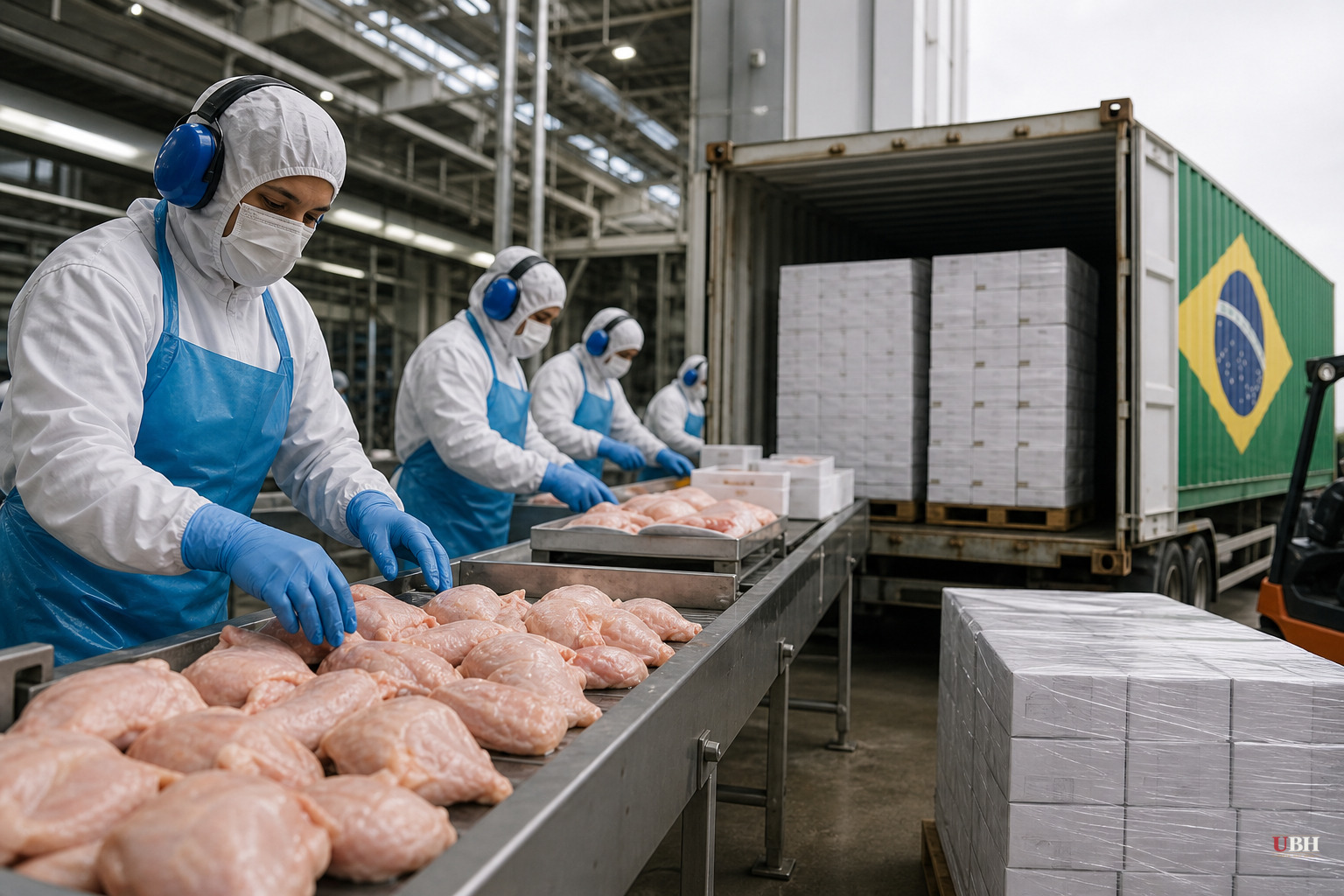
European meat processors are buying up Brazilian chicken like the deadline already hit. Because in some sense, it has been set in stone for weeks.
The European Commission has confirmed that Brazil will not be permitted to export poultry meat and animal products to the EU starting September 3, 2026, according to Vesper, a poultry market data platform. Brazil was left off an EU list of approved exporters published back in May, the first sign trouble was coming, according to Briefs Finance.
That has not stopped European buyers from loading up while they can. Brazilian chicken shipments to the EU topped 189,000 metric tons in the first half of 2026, a 51% jump over the same period last year, according to data from the Brazilian Animal Protein Association cited by Briefs Finance.
Why Europe Is Buying Now, Not Later
Ricardo Santin, president of the Brazilian Animal Protein Association, said the surge isn't a coincidence. "There is an increase in demand from European meat processors, and we cannot rule out that this is influenced by the possibility that Brazil will be removed from the list," he said, according to Briefs Finance.
Buyers are front-loading orders before the door potentially closes. It's the same logic behind any panic-buying ahead of a deadline, whether it's toilet paper or protein.
The Actual Dispute: Antibiotics in Livestock
The fight is over antimicrobial growth promoters, drugs used to prevent or treat infections in animals. The EU tightened its rules on antibiotic use in livestock as part of a broader push against antimicrobial resistance, according to DatamarNews. Foreign suppliers now have to prove their standards match what's required inside the bloc.
Brazil's argument, according to Vesper, is that the additives in question aren't used in product destined for Europe in the first place. The problem is there's no EU-recognized system to actually verify that claim. Santin called Brazil's inspection system "robust" and said the country is preparing an "extra layer" of documentation for EU regulators, according to Briefs Finance.
Brazil's Ministry of Agriculture has ramped up technical exchanges with European authorities and submitted additional data on the country's inspection and traceability systems, according to DatamarNews. Brazil's beef export industry has acknowledged that full compliance before the deadline will be complex, even as companies keep working with the government to close the gap, DatamarNews reported.
Meanwhile, back home, Brazilian industry groups are pushing for a complete ban on the remaining antimicrobial growth promoters altogether. At least 14 producer organizations have signed a manifesto demanding exactly that, according to Vesper. Rather than defending current practices, a chunk of Brazil's own industry wants the government to go further than the EU is even asking, to remove any ambiguity.
What's Actually at Stake
The dollar figure gets cited differently depending on the source. Briefs Finance and DatamarNews both put the broader Brazilian meat trade at risk around $1.8 billion annually, covering beef, poultry, eggs and live animals. Vesper frames the poultry-specific exposure differently, noting the EU takes just 4.3% of Brazil's total poultry exports by volume.
Both numbers are true and both matter for different reasons. The EU isn't Brazil's biggest poultry buyer by volume, China holds that spot, according to DatamarNews, which also notes the EU is Brazil's second most important destination for animal protein exports. But losing EU market access carries weight beyond the raw tonnage. It's one of the world's most demanding, highest-value food markets, and Brazil currently sits as the EU's leading external poultry supplier, well ahead of Argentina, according to DatamarNews trade data drawn from Trade Map and RaboResearch.
Losing that status would be a credibility hit as much as a revenue hit, potentially undercutting Brazil's pitch to other buyers that its exports are predictable and well-regulated.
The Ripple Effects
Vesper's analysis adds another layer: if the Brazilian ban takes hold, tighter EU poultry supply could firm up prices for European producers even as near-term pricing stays soft. That's layered on top of a separate supply shock. Newcastle disease outbreaks in Spain have nearly tripled in two weeks, hitting 14 outbreaks and more than 808,000 birds culled in the second half of 2026, up from 5 outbreaks and roughly 303,000 birds culled a fortnight earlier, according to Vesper. Every other monitored European country reported zero new cases in that window.
China has previously used disease findings to justify country-level import bans, and a renewed Chinese restriction on Spanish poultry would shuffle global trade flows yet again, according to Vesper.
Brazil has roughly five weeks left before the September 3 deadline to convince EU regulators its verification system holds up. Whether the "extra layer" of proof Santin described will be enough, or whether Brazil's own producers get their wish for a hard ban on the additives in question, remains an open question with real money riding on the answer.
Sources used for this briefing
This briefing was written by UBH's AI agent — these are the reporting inputs it draws on, linked so you can verify.


