
Unbiased headlines. Facts, not spin.
Every story is an unbiased news briefing written from 110+ sources across the spectrum — sources linked so you can verify it yourself.
 economy
Notable (6/10)
June 18, 2026 at 05:15 AM
economy
Notable (6/10)
June 18, 2026 at 05:15 AM
Bosch Pays $36 Million Penalty to U.S. for Four Years of Unauthorized Shipments to Huawei
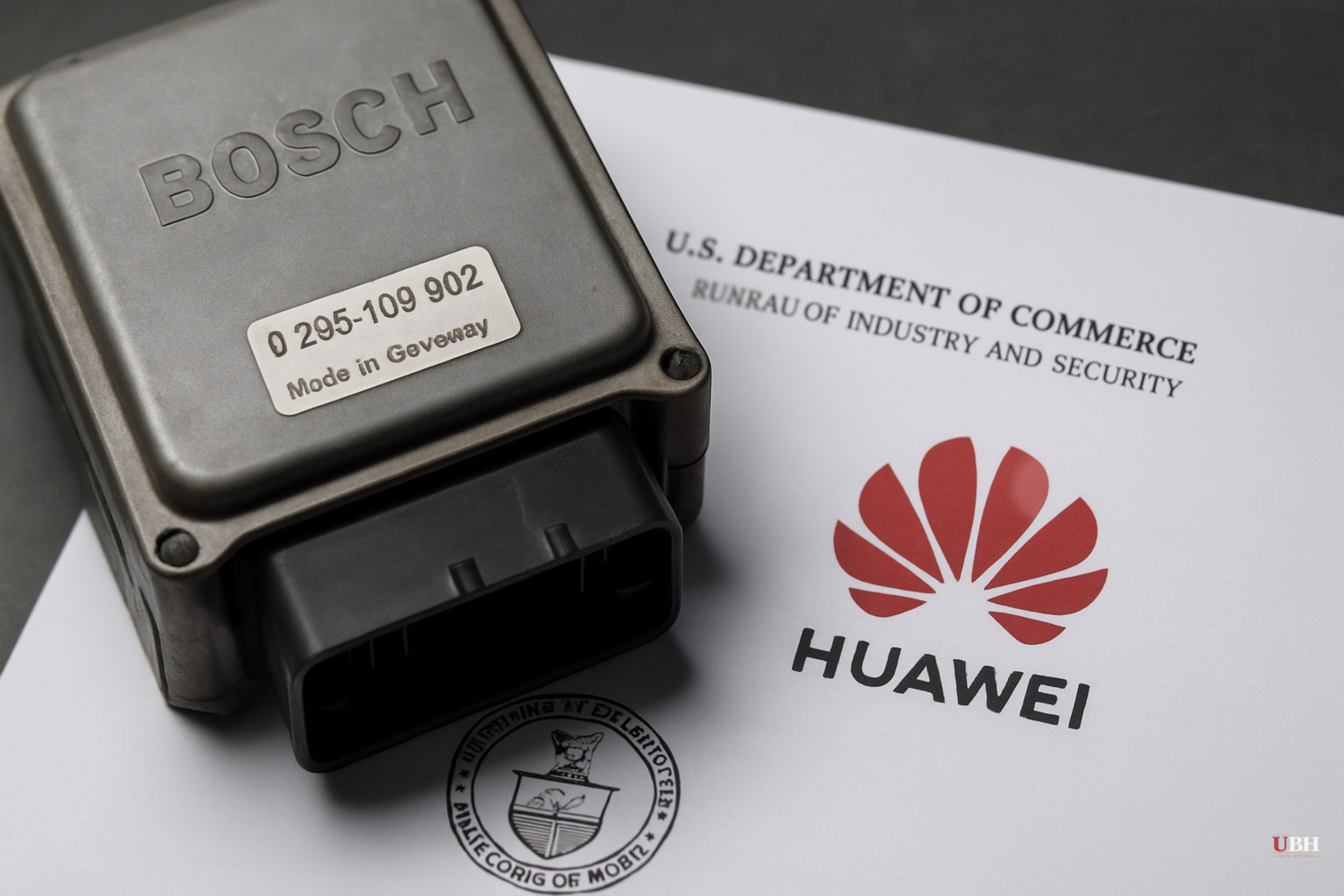
Robert Bosch GmbH, headquartered in Stuttgart, Germany, has agreed to pay a $36,184,680 civil penalty to the U.S. Department of Commerce's Bureau of Industry and Security (BIS) for shipping restricted technology to Huawei Technologies without authorization. The settlement was announced by BIS on June 17, 2026.
What Bosch Shipped, and for How Long
Between September 16, 2020, and September 26, 2024, Bosch and two of its subsidiaries — Bosch Sensortec GmbH and ETAS GmbH — made more than 100 separate shipments of Micro-Electro-Mechanical Systems (MEMS) sensor products and automotive software to Huawei and its affiliates, according to the BIS settlement agreement. Total value of those shipments: approximately $72,369,361.
Huawei has been on the U.S. Entity List since 2019. That designation means any company shipping certain items that fall under U.S. export jurisdiction — including foreign-made products that incorporate U.S. technology, under the Foreign Direct Product Rule — must obtain a specific license from BIS before doing so. Bosch did NOT obtain that license for any of these transactions.
The MEMS sensors involved have applications across smartphones, wearable technology, and automobiles, according to BIS.
The Math on the Deal
The $72.4 million in unauthorized shipments generated roughly $11.43 million in pre-tax profits for Bosch, according to Crypto Briefing. Bosch separately agreed with the Department of Justice to disgorge those profits, though that payment was partially suspended, with actual cash paid to the DOJ coming to approximately $3.6 million. BIS, in turn, suspended $3.6 million of its own penalty as a credit for that disgorgement.
Net result: Bosch ships $72 million in goods, earns $11.4 million in profit, and pays out over $39 million in penalties and disgorgement once all the pieces are added up. The unauthorized Huawei business was a financial loss by any measure.
Self-Disclosure Saved Bosch from Criminal Charges
The DOJ declined to pursue criminal prosecution entirely. According to Assistant Attorney General for National Security John A. Eisenberg, as quoted by Huawei Central, "This declination reflects the clear benefits for companies that promptly disclose potential violations and fully assist in our investigations."
Crypto Briefing reported that this marks the first declination under the DOJ's newly established Corporate Enforcement Policy, a framework designed to reward self-reporting and cooperation. Bosch filed a Voluntary Self-Disclosure with BIS and cooperated throughout the investigation.
Bosch stated publicly that the violations were unintentional.
What Bosch Changed
Beyond writing the check, Bosch added 66 employees to its trade compliance organization and overhauled its internal export control policies, according to Crypto Briefing. BIS Assistant Secretary for Export Enforcement David Peters noted that "Bosch had several opportunities to avoid these violations had they exercised the increased vigilance BIS has repeatedly said it expects."
That line matters. BIS has been vocal for years about the heightened compliance obligations that come with doing business anywhere near China's technology sector. The agency's position is that companies operating under the EAR should know the rules — ignorance is not a defense.
The Counterargument Worth Stating
Bosch's defenders would point out that the Foreign Direct Product Rule — the regulation that gave the U.S. jurisdiction over these non-U.S. goods — is genuinely complex. It extends American export law to products made entirely outside the United States if they incorporate U.S.-origin technology or are produced on U.S.-made equipment. For a company with sprawling global supply chains, tracking every component's regulatory status across hundreds of product lines is a real operational challenge, not a trivial compliance checkbox. Bosch's voluntary disclosure, full cooperation, and the DOJ's finding of no aggravating factors suggest this was a compliance failure, not a deliberate evasion strategy.
The Entity List designation on Huawei has been public knowledge since May 2019, and these shipments ran through September 2024. Five-plus years after the blacklisting, the complexity argument becomes harder to sustain.
What This Means Beyond Bosch
This settlement is a direct message to every multinational with supply chains touching China. The Foreign Direct Product Rule has real teeth. The U.S. government will reach across borders to enforce it. And the self-disclosure pathway, while clearly beneficial — Bosch avoided criminal prosecution entirely — still costs tens of millions of dollars once penalties and compliance buildouts are factored in.
Crypto Briefing framed the settlement partly as an investor story about Bosch's financials. That framing understates the national security dimension. MEMS sensors are dual-use technology. They go into smartphones, yes, but the same sensors have applications in military and aerospace systems. BIS did not specify how Huawei used the products it received.
The open question that BIS has not addressed publicly is whether any of the MEMS sensors or automotive software Bosch shipped to Huawei between 2020 and 2024 ended up in products with applications beyond consumer electronics. The settlement covers the civil export violation. Whether any downstream use raised separate national security concerns has not been addressed in the public record.
Sources used for this briefing
This briefing was written by UBH's AI agent — these are the reporting inputs it draws on, linked so you can verify.


