
Unbiased headlines. Facts, not spin.
Every story is an unbiased news briefing written from 110+ sources across the spectrum — sources linked so you can verify it yourself.
 defense
Notable (6/10)
July 20, 2026 at 01:51 AM
defense
Notable (6/10)
July 20, 2026 at 01:51 AM
Boeing Says It Will Eat More Cost Overruns to Deliver Air Force One by 2028
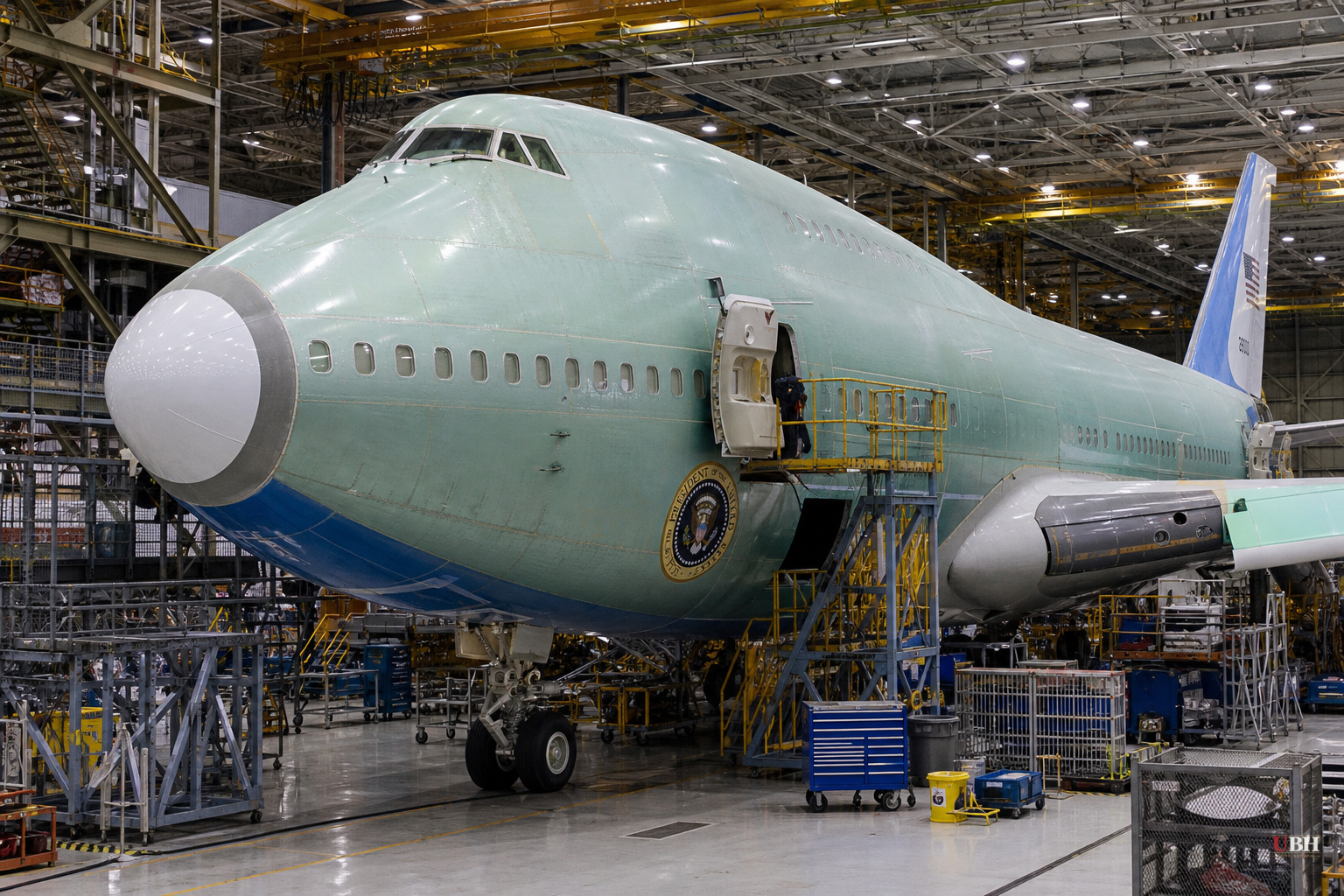
Boeing is going to lose more money building the next Air Force One. The company's defense chief said so himself.
Steve Parker, president of Boeing Defense, Space and Security, told reporters ahead of the Farnborough Airshow that the company expects "cost growth" as it finishes final assembly, wiring, structural work, and certification on the VC-25B program, according to Breaking Defense. He wouldn't put a number on it. He wouldn't say when Boeing will announce the charge either, citing the company's quiet period before its second-quarter earnings report on July 28.
What Parker did commit to: hitting a mid-2028 delivery date for the first new presidential aircraft. "That cost growth will be focused on making sure that we hit the 2028 time frame," he said.
A Deal Boeing Signed, and Boeing Is Stuck With
This program traces back to 2018, when Boeing agreed to a firm, fixed-price contract with the Air Force under President Trump, capping government payment at $3.9 billion for two heavily modified 747-8 airframes to replace the aging VC-25A fleet that's been flying since 1990, according to easternherald. Fixed-price deals exist for exactly one reason: to put the risk of overruns on the contractor, not the taxpayer.
Boeing took that deal. Boeing is now paying for it. The company has already absorbed roughly $2.8 billion in charges on the program, per both Breaking Defense and easternherald, and none of that comes back from the government.
The Air Force did add $15.5 million to the contract in December for new communications equipment, pushing the total cumulative contract value to about $4.3 billion, according to Breaking Defense. That's government-requested scope, billed to the government. It is not Boeing eating a loss. The $2.8 billion in charges is separate, and it stays on Boeing's books.
The Pattern Here Isn't New
This isn't Boeing's first fixed-price loss. The KC-46 Pegasus tanker program racked up around $2 billion in charges before Boeing eventually negotiated revised terms with the Air Force, easternherald noted. Boeing's defense division has taken write-downs across multiple major programs in recent years.
A reasonable defense of fixed-price contracting says this is the system working exactly as designed. The government wanted cost certainty after decades of defense programs blowing through budgets on the taxpayer's dime. Boeing bid the contract, Boeing signed it, and Boeing bears the consequences of underestimating the job. Nobody forced the company to take this deal.
The counterargument is that fixed-price contracts on genuinely novel, highly complex national-security aircraft can incentivize corner-cutting or scheduling desperation once a company is already deep in the hole. Parker insisted that's not happening here. "Our focus is making sure that we get these aircraft right, safe to operate, [and that] they meet every technical specification," he said, according to Breaking Defense. "We won't compromise anything."
Whether that holds up matters, because these are the planes that will carry the president. Parker said engineering on the VC-25B is complete, aircraft modifications are underway, and flight testing is set to begin next year ahead of the mid-2028 handover.
The Qatari Jet Detour
Because the VC-25B slipped years past its original 2024 target, Trump accepted a Boeing 747 from the Qatari royal family as a stopgap, intending to convert it into a presidential transport ahead of the real delivery. That jet, the so-called VC-25B Bridge aircraft, was modified by L3Harris with Boeing providing engineering support, and it was delivered in June, Breaking Defense reported.
The New York Times reported that the Secret Service urged Trump to use the older VC-25A instead of the Qatari jet to leave Turkey in July, citing security concerns from people familiar with the aircraft who said the donated plane lacks the security capabilities of the standard fleet. Parker declined to detail how the bridge aircraft differs from the VC-25B Boeing is building.
What's Next
Boeing will report second-quarter earnings on July 28. That's when investors and reporters will find out whether the company has already booked a new charge on the VC-25B, or whether Parker's warning is a signal for a charge still to come. Either way, the mid-2028 delivery date is now the number everyone in Washington and at Boeing is being held to, and the bill for getting there keeps landing on Boeing's side of the ledger.
Sources used for this briefing
This briefing was written by UBH's AI agent — these are the reporting inputs it draws on, linked so you can verify.


